Web App Development
  Cloud App Development
  Front-End Development
  Cross Platform Development
  MVP Development
  Application Modernization
  PWA Development
  SaaS Application Development
  Software Development Outsourcing
  Offshore Custom Software Development
  Full Stack Software Development
  Custom Software Development
  Enterprise Software Development
  Cloud Computing Solutions
  Cloud Development
  Managed Cloud Services
  Cloud Native Development
  AI Consulting
  Machine Learning Development
  LLM Development
  AI Chatbot Development
  Data Analytics
  CI CD Development
  Digital Transformation
  Dev Ops
  Content Development
  Blockchain Development
  Web Development
  Web Design



 Generative AI
  Large Language Model
  AI Chatbot
  AngularJs
  ReactJS
  Dotnet Core
  Android
  iPhone
  Swift
Swift  E-Commerce
  NopCommerce
  BigCommerce
  Laravel
  Yii
Yii  AWS
AWS  Google Cloud
  Azure DevOps
  Automation Testing
  Security Testing
  API Testing
  Functional Testing
  MEAN Stack
  MERN Stack
  Full Stack Developers
  biz.encodedots
  biz@encodedots.com
  +91 99747 42737


- What Is the Lovable AI App Builder?
- Is Lovable Good Enough for Production Applications?
- Where Lovable Works Well
- Main Lovable Limitations
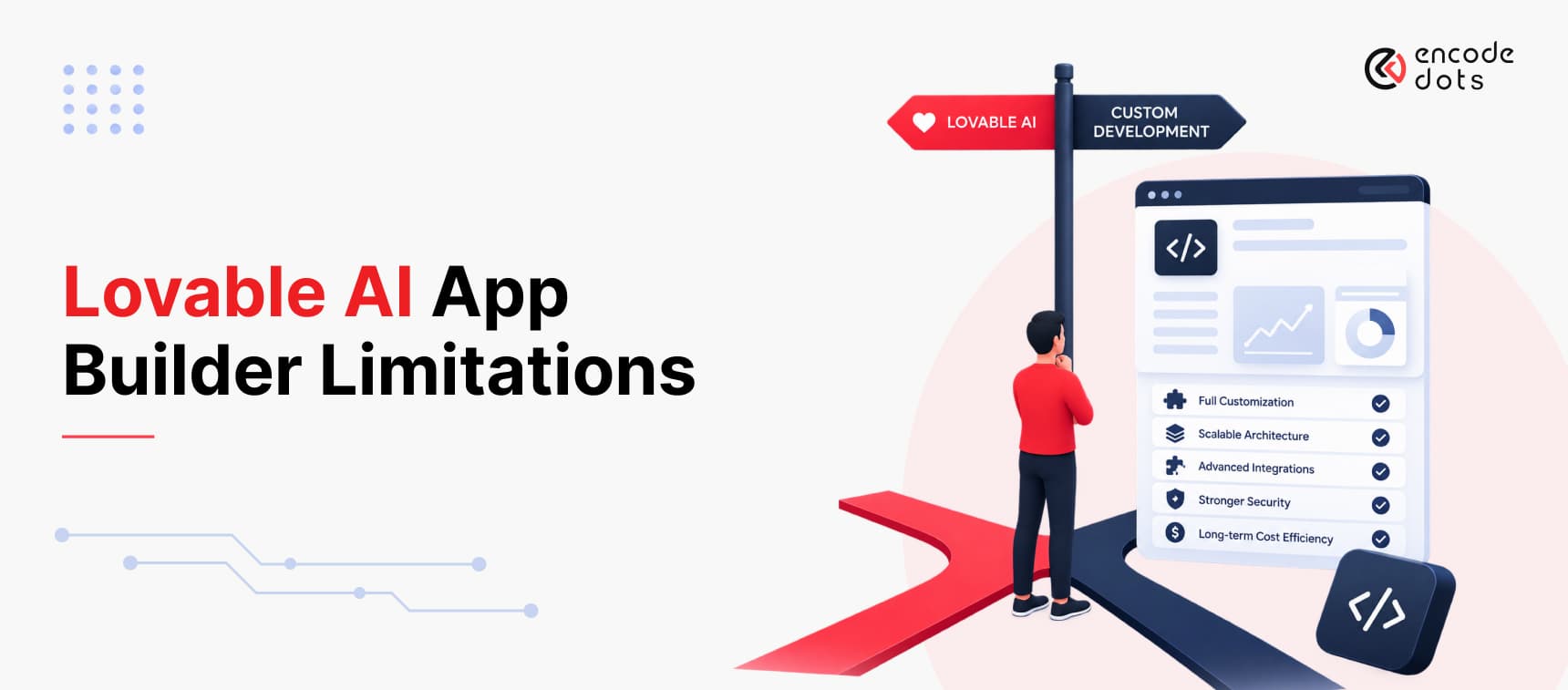
- When Should You Switch to Custom Development?
- Lovable vs. Custom Development: Decision Framework
- The Real Cost: Total Cost of Ownership
- When You Should NOT Switch Yet
- Real-World Scenarios
- Conclusion
- FAQs
If you’ve built something in Lovable and you’re wondering whether it can carry your business further, the short answer is: it depends on what “further” means. Lovable is a strong choice for MVPs, internal tools, and early-stage products where speed matters more than architectural control. It starts to show real limitations once an application needs complex business logic, deep integrations, strict security controls, or predictable performance at scale. This article walks through exactly where those limits show up, what they cost a business technically and financially, and how to decide with a framework, not a gut feeling, whether you should stay on the Lovable AI app builder or move to custom software development.
What Is the Lovable AI App Builder?
Lovable is an AI-powered app builder that turns natural-language prompts into working web applications, generating frontend UI, backend logic, and database schemas in one workflow. It sits in the category commonly called vibe coding, where a developer or founder describes what they want and the AI produces functioning code rather than a low-code drag-and-drop template.
Under the hood, Lovable generates real code (typically React on the frontend, with a managed backend such as Supabase), which is one reason it’s more flexible than older no-code tools. You can export the codebase, connect it to a database, and layer in some authentication and integrations without writing everything from scratch.
It’s designed for founders, product managers, indie hackers, and small teams who need to go from idea to working product fast without hiring a full engineering team first. That’s exactly what it does well, and exactly why its limitations show up once a product moves past the validation stage.
Is Lovable Good Enough for Production Applications?
Yes, for early-stage and low-to-moderate complexity products. Not automatically, for applications with complex logic, high security requirements, or scale demands.
“Production-ready” isn’t one fixed bar; it depends on what the application does and who depends on it. A landing page with a signup form and an internal reporting dashboard has very different production requirements than a healthcare portal or a payments platform.
For MVPs, internal tools, and SaaS prototypes, Lovable-generated applications can absolutely run in production. Plenty of early-stage products validate real customers and generate real revenue on AI-generated codebases. The gap appears when “production” starts to mean business-critical: applications that handle sensitive data, serve thousands of concurrent users, or need to integrate tightly with other enterprise systems. At that point, getting the app deployed and having it be genuinely production-grade are two different things.
Where the Lovable AI App Builder Works Well
Lovable is a genuinely good tool, not a compromise, for:
- Rapid prototyping to test an idea before committing engineering budget
- MVP development for founders validating product-market fit
- Internal tools like admin panels, dashboards, and simple workflow apps
- Simple SaaS products with straightforward CRUD operations
- Landing pages and marketing sites that need to ship fast
- Proofs of concept for stakeholders or investors
- Early product validation before a team knows exactly what to build
In each of these cases, speed and iteration matter more than architectural purity. Paying for custom development at this stage is often a waste of money, since you don’t yet know what the “right” architecture even is.
Main Lovable Limitations
Each limitation below follows the same pattern: what the problem is, why it happens, what it costs the business, and when it becomes serious enough to justify custom development.
1. Complex Business Logic
AI app builders are strongest with predictable, well-documented patterns: CRUD apps, dashboards, forms. They struggle more with multi-step workflows, conditional business rules, interdependent processes, and industry-specific logic (insurance underwriting rules, multi-party approval chains, dynamic pricing engines). The AI can generate code that looks correct, but subtle logic errors in edge cases are harder to catch without a human architect reviewing the flow. As the number of business rules grows, so does the risk of contradictory logic buried across generated files.
Business impact: incorrect calculations or broken workflows directly affect revenue and customer trust, not just inconvenience.
2. Scalability Requirements
Lovable applications typically run on a managed backend with a fixed architecture. That’s fine at low traffic. As concurrent users, database size, and background job volume grow, you need control over indexing strategy, caching layers, queueing, and horizontal scaling, none of which AI-generated, managed-backend apps are built to expose easily. Performance issues under an AI-generated schema are often harder to diagnose because the schema wasn’t designed with growth in mind from day one.
Technical impact: database query performance degrades, background jobs pile up, and there’s no clean lever to pull without re-architecting.
3. Advanced Integrations
Connecting to ERP systems, legacy databases, enterprise CRMs, or custom payment flows usually requires handling authentication edge cases, rate limits, data mapping, and error recovery logic that a general-purpose AI builder isn’t optimized to generate correctly on the first pass. Simple API integrations (a weather API, a basic webhook) are usually fine. Complex, stateful integrations with multiple failure modes are where things get fragile.
Business impact: broken syncs between systems create data inconsistency, which is expensive to untangle after the fact.
4. Security and Compliance
This is not a claim that Lovable is inherently insecure; it isn’t. Lovable includes reasonable default security features. The distinction that matters is between platform-level security features and a full security review for high-risk applications. Authentication, authorization, role-based access control, and API security need to be evaluated against your specific threat model, something automated generation can’t fully assess. For applications touching health data, financial data, or anything under regulatory scrutiny (HIPAA, SOC 2, GDPR), a professional security audit is not optional, regardless of what platform built the app.
Business impact: a compliance failure or breach is one of the few risks that can end a company, not just slow it down.
5. Custom Architecture Requirements
Microservices, event-driven systems, specialized backend services, and granular infrastructure control sit outside what a general-purpose AI builder is designed to produce. Lovable optimizes for a coherent, workable full-stack app, not for the kind of architectural decomposition that large engineering teams need to work independently on different parts of a system.
Technical impact: as soon as multiple teams need to own separate services, a monolithic AI-generated app becomes a bottleneck.
6. Performance Optimization
Production applications at scale often need custom database queries, caching strategies, CDN configuration, and asynchronous job processing tuned to actual usage patterns. AI-generated code tends to favor straightforward, general-purpose patterns over the specific optimizations that come from profiling a real production workload.
Business impact: slow applications lose customers; page load time and checkout latency are directly tied to conversion.
7. Technical Debt
This is where experience matters most. Fast development today does not always mean low maintenance tomorrow. Every time you prompt an AI builder to make a change, it may regenerate or touch code in ways that a human developer, working incrementally, would not. Over many iterations, this creates duplicate logic, inconsistent patterns, and files that no single person fully understands. It’s not that the code doesn’t work; it’s that changing it safely gets progressively harder.
Long-term impact: technical debt is often invisible until a new feature takes three times longer than it should, because every change now requires untangling code nobody planned deliberately.
8. Long-Term Maintainability
Documentation, testing, CI/CD, consistent coding standards, and monitoring are the unglamorous parts of software that keep a growing application healthy. AI-generated applications often lack automated test coverage and consistent code conventions because the tool optimizes for “does this work right now,” not “can a team maintain this in 18 months.”
Long-term impact: as the engineering team grows beyond one or two people, inconsistent code becomes a genuine onboarding and velocity problem.
9. Mobile Application Requirements
It’s worth being precise here: Lovable builds responsive web applications, which is different from native mobile applications. A responsive web app works fine on a phone browser. It is not the same as a native iOS or Android app with push notifications, offline support, or App Store distribution. If your product roadmap requires true native experiences, you’ll eventually need Swift, Kotlin, Flutter, or React Native regardless of how the web version was built. This limitation is real but shouldn’t be overstated; many products never need native apps at all.
Not sure whether to keep building with Lovable or switch to custom development?
Talk with experienced engineers about the right architecture for your product's next stage.
Talk to an ExpertWhen Should You Switch to Custom Development?
Consider moving to custom development when:
- Your application has highly complex, industry-specific business logic
- You need deep control over system architecture
- You require unusual or high-stakes integrations (ERP, legacy systems, custom payment rails)
- Security or compliance requirements become significant (health data, financial data, regulated industries)
- Performance bottlenecks require query-level and infrastructure-level optimization
- Your database architecture has outgrown a simple managed schema
- You need advanced, granular authorization models
- Native mobile applications are on the roadmap
- Multiple engineering teams need to work on the product independently
- The application has become core business infrastructure, not a side project
- AI-generated changes are becoming hard to review or trust
- Technical debt is visibly slowing down feature delivery
- Platform dependency creates a level of business risk you’re not comfortable with
- The product needs specialized infrastructure the platform doesn’t support
If two or three of these are true, it’s worth a conversation. If most of them are true, the decision has probably already been made; the only question is timing.
Lovable vs. Custom Development: Decision Framework
| Requirement | Lovable | Custom Development |
| MVP | Excellent fit | Often unnecessary |
| Prototype | Excellent fit | Usually unnecessary |
| Internal tool | Often suitable | Useful for complex workflows |
| Simple SaaS | Suitable | Useful as product grows |
| Complex SaaS | May need engineering support | Strong fit |
| Enterprise integrations | Case-by-case | Strong fit |
| Complex security/compliance | Professional review required | Strong fit |
| Native mobile | Not the primary fit | Strong fit |
| Highly customized architecture | May have limitations | Strong fit |
| Large-scale infrastructure | Requires careful evaluation | Strong fit |
A few rows deserve more nuance. Complex SaaS doesn’t mean Lovable becomes useless overnight; many teams keep the Lovable-built frontend and gradually replace backend logic as complexity grows. Enterprise integrations are genuinely case-by-case: a single well-documented API can work fine; a legacy SOAP-based ERP system usually can’t be handled reliably through AI-generated integration code. The right answer isn’t “custom development is always better”; it’s that custom development earns its cost as application complexity and business criticality increase.
The Real Cost: Total Cost of Ownership
It’s tempting to compare Lovable and custom development purely on upfront price. That comparison misses the point. The more useful lens is Total Cost of Ownership (TCO): everything spent across the life of the application, not just version one.
TCO includes:
- Initial development cost
- Ongoing AI platform subscription cost
- Developer time spent reviewing and validating AI-generated code
- Maintenance and bug fixes over time
- Infrastructure and hosting costs as usage grows
- Security review and compliance costs
- Debugging time when something breaks in unfamiliar generated code
- Refactoring cost when architecture needs to change
- Scaling costs as traffic and data grow
- Migration cost if you eventually move off the platform
The key insight: the cheapest way to build version 1 is not always the cheapest way to operate version 10. A SaaS product that costs very little to launch on Lovable can end up costing more over three years than a custom-built equivalent, if every new feature requires untangling AI-generated technical debt first. Conversely, paying for full custom development on day one for an unvalidated idea is often money spent solving a problem you don’t have yet.
When You Should NOT Switch Yet
Custom development is not automatically the right answer for every project. Stay on Lovable when:
- You’re still validating whether the product has real demand
- You’re in early MVP stage and iterating on features weekly
- The application is an internal tool with a small, known user base
- Your business logic is genuinely simple (mostly CRUD, no complex workflows)
- You’re running landing pages or marketing experiments
- You’re in an early-stage experiment where speed matters more than polish
- The application handles low-risk data with no compliance exposure
Switching too early wastes money on architecture the product may never need. The discipline is knowing which stage you’re actually in, not defaulting to custom development because it sounds more “serious.”
Real-World Scenarios
Founder building an MVP. A solo founder testing a subscription idea has no reason to hire a development team before knowing if anyone will pay for the product. Lovable lets them validate the concept in days, not months exactly the right tool for this stage.
Growing SaaS product. A product that started on Lovable now has paying customers, a support team, and a product roadmap. As feature requests get more complex and more people touch the codebase, architecture and maintainability start to matter more than raw build speed a natural transition point.
Healthcare application. An application storing patient data has to satisfy HIPAA-level security, strict authorization controls, audit logging, and data handling requirements. This is a case where a professional security review and likely custom backend architecture isn’t optional. (This is a representative scenario, not a specific client case.)
Enterprise ERP integration. A business needing to sync inventory data between a custom e-commerce app and an enterprise ERP system will typically hit the limits of generic API integration quickly. Custom integration architecture, with proper error handling and retry logic, becomes necessary.
High-scale consumer platform. A consumer app expecting spikes of tens of thousands of concurrent users needs infrastructure control, caching, load balancing, and database sharding that goes well beyond what a managed, AI-generated backend is designed to handle.
Conclusion
Lovable earns its place in the AI app builder category for a real reason: it lets founders and small teams move from idea to working product faster than traditional development ever could. That doesn’t mean every application built on it needs to move to custom development; plenty of products will run happily on Lovable indefinitely.
The decision comes down to complexity and business criticality, not company size or ambition. As business logic gets more intricate, as security and compliance requirements increase, as integrations multiply, and as the application becomes something the business genuinely depends on, custom development starts paying for itself. The practical next step is an honest architecture review: look at where your product actually sits against the checklist above, and decide based on what the application needs to become, not just what it needs to do today.
Not sure whether your Lovable-built application is ready for its next stage? Talk to a custom development expert or get your app architecture reviewed before you scale further.