Web App Development
 Cloud App Development
 Front-End Development
 Cross Platform Development
 MVP Development
 Application Modernization
 PWA Development
 SaaS Application Development
 Software Development Outsourcing
 Offshore Custom Software Development
 Full Stack Software Development
 Custom Software Development
 Enterprise Software Development
 Cloud Computing Solutions
 Cloud Development
 Managed Cloud Services
 Cloud Native Development
 AI Consulting
 Machine Learning Development
 LLM Development
 AI Chatbot Development
 Data Analytics
 CI CD Development
 Digital Transformation
 Dev Ops
 Content Development
 Blockchain Development
 Web Development
 Web Design
 Cloud Computing Solutions
 AI & ML Development
 Data Science Solutions
 UI/UX Design
 QA and Testing











 Full Stack Developers
 KnockoutJS Developers
 Microsoft Developers
 Swift Developers
 Xamarin Developers
 Blockchain Developers
 WebFlow Developers
 Software Developers
 Fintech Developers
 Security Testing Developers
 Functional Testing Developers
 Azure Developers
 Current Opening
 biz.encodedots
 biz@encodedots.com
 +91 99747 42772


- What Is a Café Loyalty App?
- Why Cafés Are Investing in Loyalty Apps
- Business Benefits of a Loyalty App
- Factors That Affect Development Cost
- Core Features Breakdown
- Realistic Cost Breakdown
- Development Timeline
- ROI: Will It Actually Pay Off?
- Questions We Ask Before Estimating Cost
- How EncodeDots Would Build This
- Recommended Architecture
- Tech Stack Recommendation
- Real-World Scenario
- Common Mistakes to Avoid
- Future Enhancements Worth Planning For
- Why Café Owners Choose EncodeDots
- Conclusion
- FAQs
A regular customer walks into your café three times a week, then, after one bad morning rush, never comes back. No text, no explanation. Just gone.
Here’s the uncomfortable truth: acquiring a new customer costs 5–7x more than retaining an existing one, yet most cafés still rely on paper stamp cards that get lost, forgotten, or thrown away before the 10th stamp. Industry research consistently shows that more than half of paper loyalty cards are abandoned within the first month, not because customers don’t want rewards, but because tracking them is inconvenient.
Meanwhile, cafés running digital loyalty programs report meaningfully higher repeat-visit rates, simply because reminders, points, and rewards live inside a phone customers already check dozens of times a day.
If you’re a café, coffee chain, or restaurant owner considering a loyalty app in 2026, this guide breaks down everything: real development costs, must-have features, realistic timelines, ROI potential, and the exact process a development team follows so you can make this decision with numbers, not guesswork.
What Is a Café Loyalty App?
A café loyalty app is a mobile application that replaces paper stamp cards with a digital system for tracking visits, points, and rewards. Instead of stamping a card, the customer scans a QR code at checkout, and the app automatically logs the visit.
In short: it’s the digital version of “buy 9 coffees, get the 10th free” except nothing gets lost, and the café owner can actually see who their loyal customers are.
A typical café loyalty app includes:
- Digital loyalty card points or stamps stored in the customer’s account, not a piece of paper
- QR-based rewards scan-to-earn and scan-to-redeem at the counter
- Membership tiers bronze/silver/gold-style programs for high-frequency customers
- Referral programs customers earn rewards for bringing in friends
- Push notifications reminders, offers, and birthday rewards sent directly to the phone
Unlike a generic ordering app, a loyalty app’s entire purpose is retention, not just transactions.
Why Cafés Are Investing in Loyalty Apps
Most café owners don’t wake up wanting an app; they wake up frustrated by a specific problem. These are the ones we hear most often:
- Low repeat customer rate new customers try the café once and never return, and there’s no way to know why
- Lost or damaged paper stamp cards customers lose the card, so they lose the reward, and the café loses the incentive that was supposed to bring them back
- No customer database there’s no record of who’s a regular, what they order, or how often they visit
- Rising advertising costs running ads to attract new customers is expensive, while retaining existing ones is nearly free by comparison
- Weak customer retention overall without any structured loyalty mechanism; customers have no reason to choose you over the café next door
A loyalty app doesn’t fix the coffee. It fixes the relationship between the café and the customer, and that relationship is where repeat revenue actually comes from.
Business Benefits of a Loyalty App
The value of a loyalty app should be measured in business outcomes, not features. Here’s what actually changes:
| Benefit | What It Means for the Business |
| More repeat customers | Structured rewards give customers a reason to return, not just a reason to like your coffee |
| Higher customer lifetime value (CLV) | A customer who visits 3x/week for a year is worth far more than one who visits once |
| Better customer insights | You know who your regulars are, what they order, and when they typically visit |
| Reduced marketing spend | Retaining existing customers costs a fraction of acquiring new ones through ads |
| Stronger brand loyalty | A well-designed rewards experience makes customers feel recognized, not just served |
In short: the app pays for itself not through new sales, but through customers you were already earning and now keep.
Factors That Affect Development Cost
No two loyalty apps cost the same, because no two cafés have the same needs. These are the variables that move the price up or down:
| Factor | Impact on Cost |
| Platform (iOS, Android, or both) | Cross-platform frameworks reduce cost vs. building two native apps separately |
| UI/UX complexity | Simple, template-based design costs less than fully custom branded design |
| Number of features | Each additional feature (referrals, tiers, gamification) adds development and QA time |
| Admin dashboard | A dashboard for managing rewards, customers, and analytics adds meaningful backend work |
| POS integration | Connecting to existing point-of-sale systems (Square, Toast, Clover, etc.) adds integration complexity |
| QR code system | Building a reliable scan-to-earn/scan-to-redeem engine requires backend logic and testing |
| Payment gateway | Adding in-app payments (Stripe, PayPal) increases scope and security requirements |
| Push notifications | Automated, segmented notifications need backend logic beyond basic alerts |
| Analytics & reporting | Customer behavior dashboards require data pipelines, not just UI |
| Third-party APIs | CRM, email marketing, or accounting integrations each add scope |
| Testing & QA | Multi-location, multi-device testing takes longer than a single-location MVP |
| Post-launch maintenance | Ongoing support, bug fixes, and OS updates are a recurring cost, not one-time |
Why this matters: a single-location café with a simple stamp-card app will cost far less than a five-location chain that needs POS sync, tiered memberships, and cross-branch reward redemption.
Explore the Insight: Mobile App Development Cost
Core Features Breakdown
Here’s what typically goes into a café loyalty app, based on real project requirements we see from café and restaurant clients:
OTP Login
What it does: Lets customers sign up/log in with just a phone number and a one-time code. Why it matters: Removes the friction of remembering passwords, critical for a walk-in customer base.
Digital Stamp Card
What it does: Replaces the paper card with an in-app visual tracker (e.g., 8 of 10 stamps collected). Why it matters: Customers always know exactly how close they are to a reward.
QR Code Scanning
What it does: Staff or customers scan a code at checkout to log a visit or redeem a reward. Why it matters: Removes manual tracking errors and speeds up the counter experience.
Reward Redemption
What it does: Lets customers claim free items, discounts, or perks once they hit a milestone. Why it matters: This is the moment that reinforces why the customer downloaded the app in the first place.
Membership Card
What it does: Digital membership tiers (e.g., Regular, Gold, VIP) with escalating perks. Why it matters: Gives your highest-value customers a reason to keep climbing, not just redeem and stop.
Push Notifications
What it does: Sends reminders, promotions, and personalized offers directly to the customer’s phone. Why it matters: Brings customers back without relying on them to remember you exist.
Birthday Rewards
What it does: Automatically triggers a reward around the customer’s birthday. Why it matters: A small, low-cost touch that creates outsized goodwill and repeat visits.
Referral Program
What it does: Rewards customers for inviting friends who make their first purchase. Why it matters: Turns your existing customer base into an acquisition channel at a much lower cost than ads.
Café Menu
What it does: Displays the live menu, prices, and items inside the app. Why it matters: Keeps the app useful even outside of the loyalty flow, increasing daily opens.
Store Locator
What it does: Shows nearby branches for multi-location cafés. Why it matters: Essential for chain customers who should earn and redeem rewards at any branch.
Opening Hours
What it does: Displays real-time store hours, including holiday adjustments. Why it matters: A small feature that reduces customer frustration and support calls.
Admin Dashboard
What it does: Gives café owners/staff a backend to manage customers, rewards, and performance data. Why it matters: Without this, the loyalty program is invisible to the business; you can’t manage what you can’t see.
Realistic Cost Breakdown
These are illustrative ranges based on typical scope for a single-location café app vs. a multi-location chain app. Actual pricing depends on the factors covered above, and should always be confirmed with a detailed scoping call.
| Component | Single-Location MVP | Multi-Location / Advanced |
| UI/UX Design | Lower templated, brand-adapted design | Higher fully custom, multi-brand design system |
| Backend Development | Moderate core loyalty logic, single-location data | Higher multi-location sync, POS integration, advanced rules |
| Mobile App (iOS + Android) | Moderate cross-platform build | Higher additional testing across more devices/OS versions |
| Admin Dashboard | Basic customer list, reward management | Advanced multi-branch analytics, role-based access |
| QA & Testing | Lower single environment | Higher multi-location, multi-device, integration testing |
| Deployment | Standard app store submission | Standard, plus staged multi-location rollout |
| Post-Launch Support | Basic bug-fix retainer | Ongoing feature development + dedicated support |
What increases cost: POS integration, in-app payments, multi-branch reward syncing, advanced analytics, gamification. What decreases cost: Starting with a focused MVP (stamp card + QR + push notifications) and adding features in phases after launch.
In short: a simple, single-café MVP is a fraction of the investment of a five-location chain app with full POS and CRM integration, and starting lean is almost always the smarter first move.
Ready to Turn More First-Time Customers Into Regulars?
A well-designed loyalty app can increase repeat visits, improve customer retention, and give you valuable insights into customer behavior. Let's build a solution that grows with your café or restaurant business.
Talk to Our Loyalty App ExpertsDevelopment Timeline
A realistic loyalty app project typically moves through five phases:
1. Discovery (1–2 weeks): Requirements gathering, competitor research, defining the MVP feature set, and confirming integrations (POS, CRM, payments).
2. UX/UI Design (2–3 weeks): Wireframes, branded UI design, and customer journey mapping from first app open to first reward redemption.
3. Development (6–10 weeks): Backend build, mobile app development, admin dashboard, QR/reward engine, and third-party integrations.
4. QA & Testing (2–3 weeks): Functional testing, device testing, load testing (especially for multi-location rollouts), and security review.
5. Launch & Support (Ongoing): App store submission, staff onboarding, customer rollout communication, and post-launch monitoring.
In short: a focused MVP can realistically launch in 10–14 weeks, while a multi-location app with POS integration typically takes 4–6 months.
ROI: Will It Actually Pay Off?
This is illustrative math to show the shape of the return, not a guarantee, since every café’s numbers differ.
Example (illustrative only): Imagine a café serving 200 customers a day. If a loyalty program lifts repeat-visit frequency by even a modest percentage, say, an extra visit per month from a portion of regular customers, the additional monthly revenue from those extra visits alone can be significant, especially once you factor in that repeat customers also tend to spend more per visit than first-time customers.
The real ROI driver isn’t the app itself; it’s the behavior change it causes: customers who might have visited twice a month now visit three or four times, because they can see their progress toward a reward and get a nudge when they haven’t been in a while.
In short: the app is not the product being sold; repeat visits are. The app is simply the mechanism that makes those repeat visits measurable and automatic.
Questions We Ask Before Estimating Loyalty App Development Cost
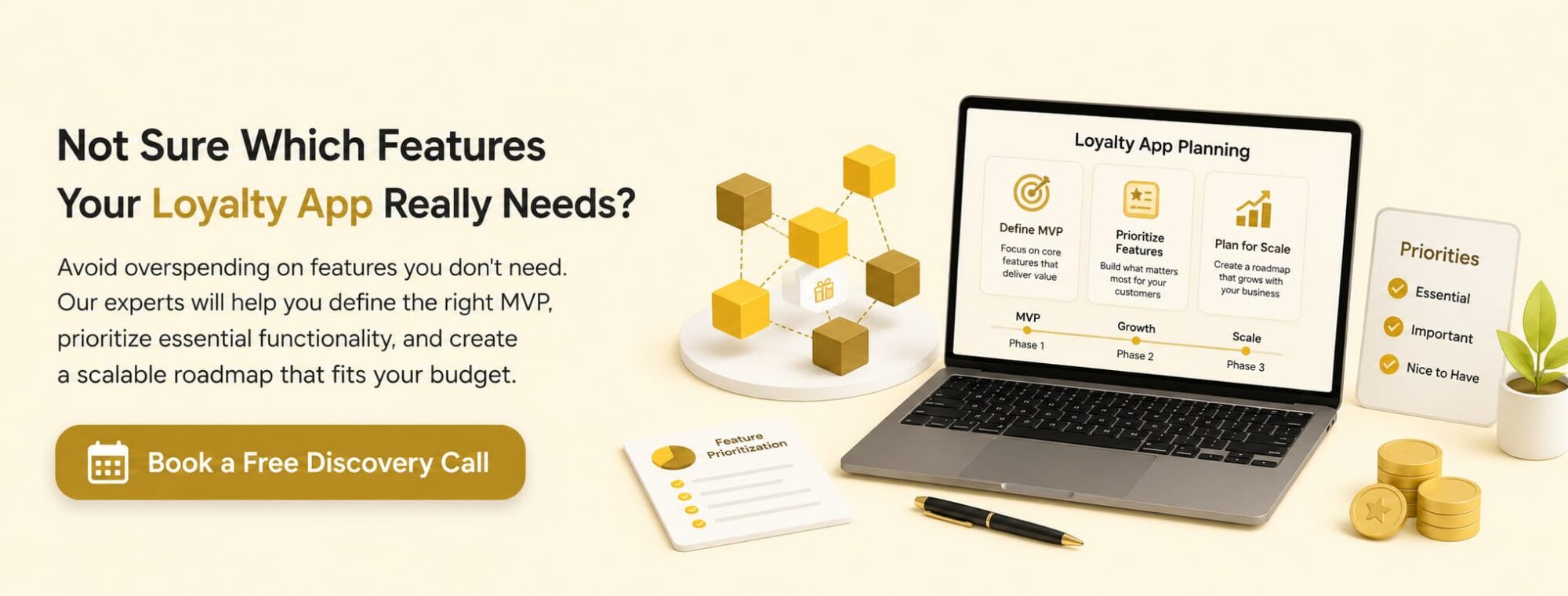
Before we give any café or restaurant owner a real number, we ask:
- Is this for a single café or a multi-location chain?
- Do you need Android only, or iOS as well?
- Do you need POS integration, and if so, which system (Square, Toast, Clover, etc.)?
- Do you already have a CRM, or does one need to be built in?
- What’s your required launch timeline?
- What loyalty model fits your business: points, stamps, tiers, or memberships?
- Do you have future expansion plans (new locations, franchising, delivery integration)?
These questions matter because a single-location stamp-card app and a five-location app with POS sync are two entirely different projects even though both are technically “a loyalty app.” Asking these upfront is what separates an accurate estimate from a guess.
How EncodeDots Would Build This
Rather than listing features, here’s the actual implementation approach we follow for café and restaurant loyalty apps:
- Discovery Workshop: We sit down with the café owner (or ops team, for chains) to map current pain points, customer flow, and what “success” looks like 6 months post-launch.
- Customer Journey Mapping: We design the exact path: first visit → app download → first reward earned → first redemption → repeat visit trigger.
- Flutter Cross-Platform Development: One codebase for both iOS and Android, which keeps cost and maintenance lower without sacrificing native performance.
- Secure Node.js Backend: Handles customer data, reward logic, and integrations with a scalable, well-tested architecture.
- QR-Based Reward Engine: The core mechanism for earning and redeeming, built to work reliably even during busy counter rushes.
- Admin Dashboard: Gives café staff and owners visibility into customers, redemptions, and performance without needing a developer involved.
- Push Notification Automation: Birthday rewards, win-back nudges for inactive customers, and promotional pushes, all rule-based rather than manually sent.
- Analytics Dashboard: Tracks repeat-visit rate, redemption rate, and customer segments over time.
- Cloud Deployment: Hosted on scalable infrastructure so performance holds up whether you have 200 or 20,000 customers.
- Ongoing Support: Bug fixes, OS updates, and iterative feature additions post-launch.
This isn’t a features list; it’s the actual sequence of decisions that turns a loyalty idea into a working product customers use every week.
Recommended Architecture
A scalable café loyalty app follows a layered structure:
Customer App (iOS/Android)
↓
API Layer
↓
Reward Engine
↓
Database
↓
Admin Dashboard
↓
Analytics
Why this matters: each layer is independent. If you add POS integration later, it plugs into the API layer without requiring a rebuild of the reward engine or customer app. If you expand from 1 to 10 locations, the database and reward engine scale without touching the customer-facing app at all. This is what “built to scale” actually means in practice not a buzzword, but an architecture that doesn’t need to be thrown away as the business grows.
Tech Stack Recommendation
| Technology | Why It’s Chosen |
| Flutter | Single codebase for iOS + Android, reducing both build cost and long-term maintenance |
| Node.js | Fast, scalable backend well-suited to real-time reward logic and API handling |
| Firebase Authentication | Reliable, secure OTP/phone-based login without building auth from scratch |
| PostgreSQL | Structured, reliable database for customer, transaction, and reward data |
| AWS | Scalable cloud hosting that grows with customer volume and location count |
| Firebase Cloud Messaging | Handles push notifications at scale, including scheduled and triggered messages |
| QR Engine (custom) | Purpose-built for fast, reliable scan-to-earn and scan-to-redeem at the counter |
In short: every technology here is chosen for one reason: it lets the app work reliably today and scale without a rebuild tomorrow.
Real-World Scenario
Example Scenario: Imagine a café chain with five locations that wants to replace paper loyalty cards with a digital rewards system, while keeping rewards valid across all branches.
Here’s how such an implementation could realistically unfold:
- Discovery confirms all five locations use the same POS system, simplifying integration.
- Design creates a single branded app experience, with a location switcher so customers see the nearest branch by default.
- Development builds the reward engine so that a stamp earned at Branch A is redeemable at Branch B a common request for chains, and a common failure point in poorly-scoped projects.
- QA specifically tests cross-branch redemption and POS sync under real transaction load, not just in isolation.
- Launch is staged: one branch first, staff trained, feedback collected, then rolled out to the remaining four.
The result: customers get one loyalty experience regardless of which branch they visit, and the business gets a single dashboard showing performance across all locations rather than five disconnected paper-card systems.
Common Mistakes to Avoid
- Choosing too many features for the MVP trying to launch with tiers, referrals, gamification, and POS integration all at once delays launch and inflates cost. Start focused, expand after real usage data comes in.
- Ignoring analytics without visibility into redemption and repeat-visit rates, you can’t tell if the loyalty program is actually working.
- No referral system a missed opportunity to turn happy customers into a low-cost acquisition channel.
- No push notifications an app that never reminds customers to come back rarely gets reopened after the first week.
- No CRM integration customer data trapped inside the app, disconnected from email/SMS marketing, limits what you can do with it later.
- Poor reward structure rewards that are too hard to reach (or too easy) both fail to motivate repeat visits; the structure needs to be tested, not guessed.
In short: most loyalty app failures aren’t technical failures; they’re scoping and reward-design failures that show up months after launch.
Future Enhancements Worth Planning For
Once the core loyalty app is live and adopted, these are natural next steps:
- AI-driven recommendations suggesting items based on past orders
- Personalized rewards offers tailored to individual customer behavior, not one-size-fits-all
- Apple Wallet / Google Wallet integration loyalty cards that live in the phone’s native wallet app
- Subscription memberships flat-fee monthly plans (e.g., unlimited coffee for $X/month)
- POS integration (if not done at launch) automatic visit logging without manual scanning
- Gamification streaks, challenges, and milestone badges to deepen engagement beyond simple points
In short: the smartest roadmap treats the MVP as a foundation, not a finished product; each of these adds real value once you know how customers actually use the core app.
Why Café Owners Choose EncodeDots
“Isn’t a discovery-first process just slower?” Not in practice; it’s what prevents the most expensive mistake in app development: building the wrong feature set. A short discovery phase upfront saves far more time than it costs by avoiding mid-project scope changes.
“How do I know I won’t be left in the dark during development?” We run weekly demos, so you see working progress every week rather than waiting months for a single reveal and can redirect early if something isn’t matching your vision.
“What if I need to add features after launch?” The architecture is built to scale from day one, so adding POS integration, new locations, or loyalty tiers later doesn’t require rebuilding the app from scratch.
“What happens after launch am I on my own?” Post-launch support is part of the engagement, covering bug fixes, OS updates, and iterative improvements based on real customer usage data.
“Is security actually taken seriously, or just mentioned?” Development follows a security-first approach: encrypted customer data, secure authentication, and safe handling of any payment integrations from the first line of code, not bolted on afterward.
Conclusion
A café loyalty app isn’t really about the technology; it’s about giving customers a reason to come back that a paper card never could. The businesses that get real ROI from these apps are the ones that start focused, get the reward structure right, and build on an architecture that can grow with them.
Planning to launch a loyalty app for your café or restaurant? Our team can help you define the right feature set, estimate development costs accurately, and build a scalable solution tailored to your business goals.