Web App Development
  Cloud App Development
  Front-End Development
  Cross Platform Development
  MVP Development
  Application Modernization
  PWA Development
  SaaS Application Development
  Software Development Outsourcing
  Offshore Custom Software Development
  Full Stack Software Development
  Custom Software Development
  Enterprise Software Development
  Cloud Computing Solutions
  Cloud Development
  Managed Cloud Services
  Cloud Native Development
  AI Consulting
  Machine Learning Development
  LLM Development
  AI Chatbot Development
  Data Analytics
  CI CD Development
  Digital Transformation
  Dev Ops
  Content Development
  Blockchain Development
  Web Development
  Web Design



 Generative AI
  Large Language Model
  AI Chatbot
  AngularJs
  ReactJS
  Dotnet Core
  Android
  iPhone
  Swift
Swift  E-Commerce
  NopCommerce
  BigCommerce
  Laravel
  Yii
Yii  AWS
AWS  Google Cloud
  Azure DevOps
  Automation Testing
  Security Testing
  API Testing
  Functional Testing
  MEAN Stack
  MERN Stack
  Full Stack Developers
  biz.encodedots
  biz@encodedots.com
  +91 99747 42737


- Scalable MVP
- Must-Haves vs. Nice-to-Haves
- The Architecture Decision
- The Cost vs. Timeline Matrix
- Avoiding the Technical Debt Trap
- Build a Custom MVP
- Common MVP Architecture Mistakes
- Conclusion
- FAQ
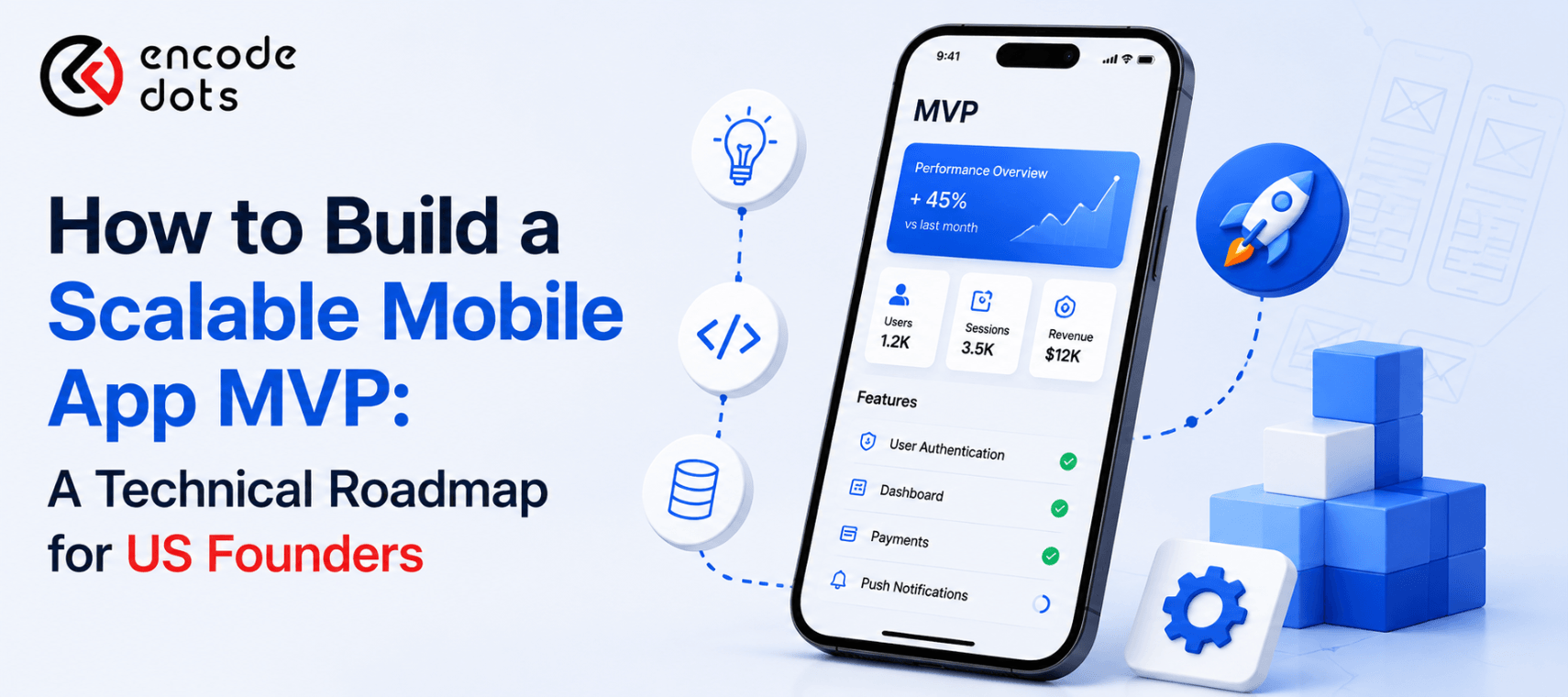
Most mobile app MVPs don’t fail because of a bad idea. They fail because founders either build too much before validating anything, or they build just enough to launch on an architecture that buckles the moment real users start showing up. That’s a costly mistake, both in time and rebuild budget. If you’re a US-based founder preparing to ship your first mobile product, this roadmap is built for you: technically honest, cost-grounded, and focused on building something that survives its own success.
At EncodeDots, we work with US founders to audit technical architecture before writing the first line of code. Book a free scoping call to get an expert eye on your current approach.
What Does “Scalable MVP” Actually Mean?
An MVP, or Minimum Viable Product, is not a broken app with missing features. It’s the smallest complete version of your product that tests a specific hypothesis with real users. “Scalable” means that when your hypothesis turns out to be right, and users start flooding in, you don’t need to tear everything down and rebuild.
The two failure modes to avoid:
- Over-engineered from day one: You spend 9 months building microservices, custom DevOps pipelines, and enterprise-grade features before a single user has validated the core idea. You run out of runway.
- Under-architected for growth: You ship fast on a spaghetti codebase. You hit 5,000 users, the app starts breaking, and your engineering team tells you the only fix is a full rewrite. You’ve essentially built twice.
A scalable MVP threads this needle: clean architecture decisions upfront, feature scope limited to what matters, and technical foundations that hold under pressure.
Phase 1: Core Feature Scoping Must-Haves vs. Nice-to-Haves
The biggest trigger for scope creep is a founder who confuses “features I want” with “features users need to validate the core value.” Before your first sprint begins, every feature request should pass this filter:
Does removing this feature make it impossible to test the core hypothesis?
If the answer is no, it’s a V2 feature.
A Practical Scoping Framework
| Feature Category | Definition | MVP Inclusion Rule |
| Core Loop | The action users must take to get their primary value | Always include |
| Onboarding & Auth | Account creation, login, basic profile | Include only what’s required for the loop |
| Notifications | Push, email, in-app alerts | Include only if the core loop depends on it |
| Analytics & Reporting | Dashboards, usage data for users | Defer unless it’s your core product |
| Social Features | Sharing, referrals, reviews | Defer test retention first |
| Admin Panel | Internal management tools | Lightweight version only |
| Payment Integration | If monetization is the hypothesis | Include; if not, defer |
The goal is a user feedback loop, not a polished product. Build only what you need to learn something real.
One underrated move: map your core user journey as a sequence of 5–7 screens. Anything that doesn’t appear in that journey is a V2 feature by default.
Phase 2: Choosing a Scalable Tech Stack – The Architecture Decision
This is where most MVP decisions go wrong, either through over-complexity or through choices that create painful migration work later.
Cross-Platform vs. Native: The Honest Answer
For most US startup MVPs, Flutter is the right cross-platform choice. It gives you a single codebase for iOS and Android, near-native performance, and a rich component ecosystem. React Native is the other common option; it has a larger talent pool, but Flutter has fewer “brown bag” issues with platform-specific behavior.
Go native (Swift for iOS, Kotlin for Android) only if your app is deeply hardware-dependent, think real-time AR, complex sensor integration, or professional video editing. For SaaS tools, marketplaces, booking apps, and productivity tools, Flutter handles it cleanly.
Backend: Monolith First, Microservices Later
This is the single most important architectural decision for an MVP.
Start with a monolith. A Node.js/Express or Node.js/NestJS backend with a PostgreSQL or MongoDB database is the right call for 95% of MVPs. It’s faster to build, easier to debug, and simpler to deploy. The engineering myth that microservices are inherently more scalable is misleading. Microservices are operationally complex and only pay off when you have multiple teams shipping independent services at scale.
Transition to microservices when: you have distinct, independently scaling services (e.g., a notification engine that spikes independently from your core API), multiple teams working on separate domains, and the operational bandwidth to manage service orchestration.
Infrastructure: Firebase vs. AWS vs. GCP
| Infrastructure | Best For | Scalability | Cost at Scale | Control Level |
| Firebase (Google) | Fast MVP, real-time apps | Good to ~100K users | Can spike unexpectedly | Low managed platform |
| AWS (Amplify or EC2 + RDS) | Production-ready MVPs, complex backends | Excellent | Predictable if planned | High |
| GCP + Cloud Run | Containerized backends, ML-heavy apps | Excellent | Competitive | High |
| Supabase | PostgreSQL-first MVPs, small teams | Good | Affordable | Medium |
For a US market MVP targeting initial validation, Firebase with a well-structured Firestore data model or Supabase gets you to launch the fastest. If you’re planning B2B enterprise sales or have compliance requirements (HIPAA, SOC 2), start with AWS; directly retrofitting compliance onto Firebase is painful.
Phase 3: The Cost vs. Timeline Matrix
One of the most frustrating parts of the US startup experience is getting wildly inconsistent quotes. Here’s a grounded breakdown of realistic market rates across different team configurations.
MVP Development Cost Comparison (US Market Context)
| Development Approach | Timeline | Estimated Cost | Best Suited For |
| US-based agency (full-service) | 4–6 months | $80,000 – $200,000+ | Well-funded Series A+ |
| US-based freelancers | 5–8 months | $60,000 – $140,000 | Founder-managed teams |
| Nearshore (Latin America) | 4–6 months | $35,000 – $80,000 | Cost-conscious seed stage |
| Indian development agency (quality tier) | 3–5 months | $15,000 – $45,000 | Bootstrapped / pre-seed |
| Remote team extension (dedicated) | 3–5 months | $18,000 – $50,000 | Founders who want direct control |
What these numbers include: UI/UX design, mobile development (Flutter or React Native), backend API (Node.js/MERN), basic admin panel, QA, and deployment to app stores.
What they don’t include: Post-launch bug fixes and iteration cycles (budget 20–30% of initial build cost), App Store/Play Store fees, third-party API subscriptions (Twilio, Stripe, etc.), and infrastructure costs.
The most common mistake: US founders assume the cheapest quote is for the same scope. Always compare line-by-line deliverables, not total price.
Phase 4: Avoiding the Technical Debt Trap
Technical debt is the hidden tax on speed. Every shortcut you take during the MVP phase that you don’t document or plan to resolve becomes a structural problem at V2. Here’s how to keep the debt manageable without slowing down shipping.
Debt-Prevention Practices That Don’t Kill Velocity
1. Enforce a Module Boundary from Day One
Even in a monolith, structure your codebase as if it might become microservices later. Group your code by domain (auth, payments, notifications, core product) rather than by type (controllers, models, services). This makes future extraction dramatically easier.
2. Write Integration Tests, Not Unit Tests (for MVP)
Unit testing every function in an MVP is overkill. Focus your test coverage on integration points, the API contracts between your mobile app and backend, payment webhook handlers, and third-party service integrations. These are the most fragile pieces.
3. Use Environment-Based Configuration from the Start
Hardcoded API keys, database URLs, and configuration values are a maintenance nightmare. Use .env files and a proper config management pattern from sprint 1. It takes 30 minutes to set up and saves days of debugging later.
4. Document Architectural Decisions, Not Just Code
Keep a lightweight Architecture Decision Record (ADR) document, even a Notion page works. Log why you chose Firebase over AWS, why you went with a monolith, and why you picked a particular third-party SDK. When you hire your next engineer or come back after 3 months, this context is invaluable.
5. Set a “Tech Debt Sprint” Cadence
Every 6–8 product sprints, dedicate one sprint entirely to cleaning up shortcuts, updating dependencies, and addressing code review flags that were deferred. Teams that skip this cadence reliably find themselves in “rewrite territory” within 18 months.
Ready to Build an MVP That Can Scale From Day One?
Avoid costly rebuilds and launch with a scalable architecture designed for future growth. Our experts help founders validate ideas faster and build investor-ready MVPs.
Book a Free MVP ConsultationWhen NOT to Build a Custom MVP
This is the section most roadmap guides skip.
If your core hypothesis can be tested with a no-code or low-code tool, building a custom app immediately is a waste of capital. Before committing to a full development engagement, ask:
- Can I test user demand with a Webflow landing page + a waitlist?
- Can the core flow be simulated with Bubble, Glide, or FlutterFlow at 1/10th the cost?
- Is the “app” really just a mobile-responsive web experience that doesn’t need native distribution?
Custom development is the right call when: (a) your core value proposition requires device-level capabilities (camera, GPS, BLE, biometrics), (b) your business model requires App Store distribution, or (c) performance and security requirements can’t be met by no-code platforms.
If none of these apply, validate with no-code first. Build custom when you have paying users who want more.
Common MVP Architecture Mistakes US Founders Make
Choosing a database before understanding data access patterns. Founders pick MongoDB because it’s “flexible” without thinking through how their data will be queried. A relational structure with PostgreSQL is almost always easier to evolve than a document store with poorly thought-out nesting.
Building user roles and permissions at full complexity on day one. Simple boolean flags (isAdmin: true/false) are fine for MVP. Role-based access control systems are a V2 problem. Over-engineering auth on day one adds weeks to your timeline.
Using a managed BaaS (Firebase) for a product that will need complex server-side logic. Firebase works beautifully for simple CRUD apps with real-time needs. It becomes a nightmare when you need complex business logic, multi-step transactions, or heavy server-side processing. If your product roadmap implies the latter, start with a custom backend.
Not planning for App Store review timelines. First submissions to App Store and Google Play can take 3–10 business days, sometimes longer. Factor this into your launch plan. Plan for at least one rejection and revision cycle.
Conclusion
Building a mobile app MVP that scales isn’t about picking the right framework or the cheapest team. It’s about making three or four architectural decisions correctly, upfront tech stack, backend structure, infrastructure, and data model, so that when the product works, you’re adding features instead of rebuilding foundations.
The roadmap above gives you the technical logic to make those decisions. But every product has context-specific constraints: your compliance requirements, your team’s existing skills, your funding timeline, and the specific user behavior you’re trying to test.
At EncodeDots, we help US founders map out technical architecture before writing the first line of code. Our scoping process identifies the decisions that will cost you most if you get them wrong before they become expensive problems. Schedule a technical scoping call to audit your roadmap with our engineering team.