Web App Development
  Cloud App Development
  Front-End Development
  Cross Platform Development
  MVP Development
  Application Modernization
  PWA Development
  SaaS Application Development
  Software Development Outsourcing
  Offshore Custom Software Development
  Full Stack Software Development
  Custom Software Development
  Enterprise Software Development
  Cloud Computing Solutions
  Cloud Development
  Managed Cloud Services
  Cloud Native Development
  AI Consulting
  Machine Learning Development
  LLM Development
  AI Chatbot Development
  Data Analytics
  CI CD Development
  Digital Transformation
  Dev Ops
  Content Development
  Blockchain Development
  Web Development
  Web Design



 Generative AI
  Large Language Model
  AI Chatbot
  AngularJs
  ReactJS
  Dotnet Core
  Android
  iPhone
  Swift
Swift  E-Commerce
  NopCommerce
  BigCommerce
  Laravel
  Yii
Yii  AWS
AWS  Google Cloud
  Azure DevOps
  Automation Testing
  Security Testing
  API Testing
  Functional Testing
  MEAN Stack
  MERN Stack
  Full Stack Developers
  biz.encodedots
  biz@encodedots.com
  +91 99747 42737


- What is a live sports streaming platform?
- Why live sports are harder than on-demand video
- Live streaming architecture: the seven layers
- Pick your latency target first
- Designing for the kickoff spike
- Sports-specific features teams underestimate
- A tech stack that suits most sports platforms
- What it actually costs
- Build vs buy: when not to build this
- Common mistakes in live streaming builds
- Where live streaming is heading in 2026
- Key takeaways
- Building a live sports streaming platform?
- Frequently Asked Questions
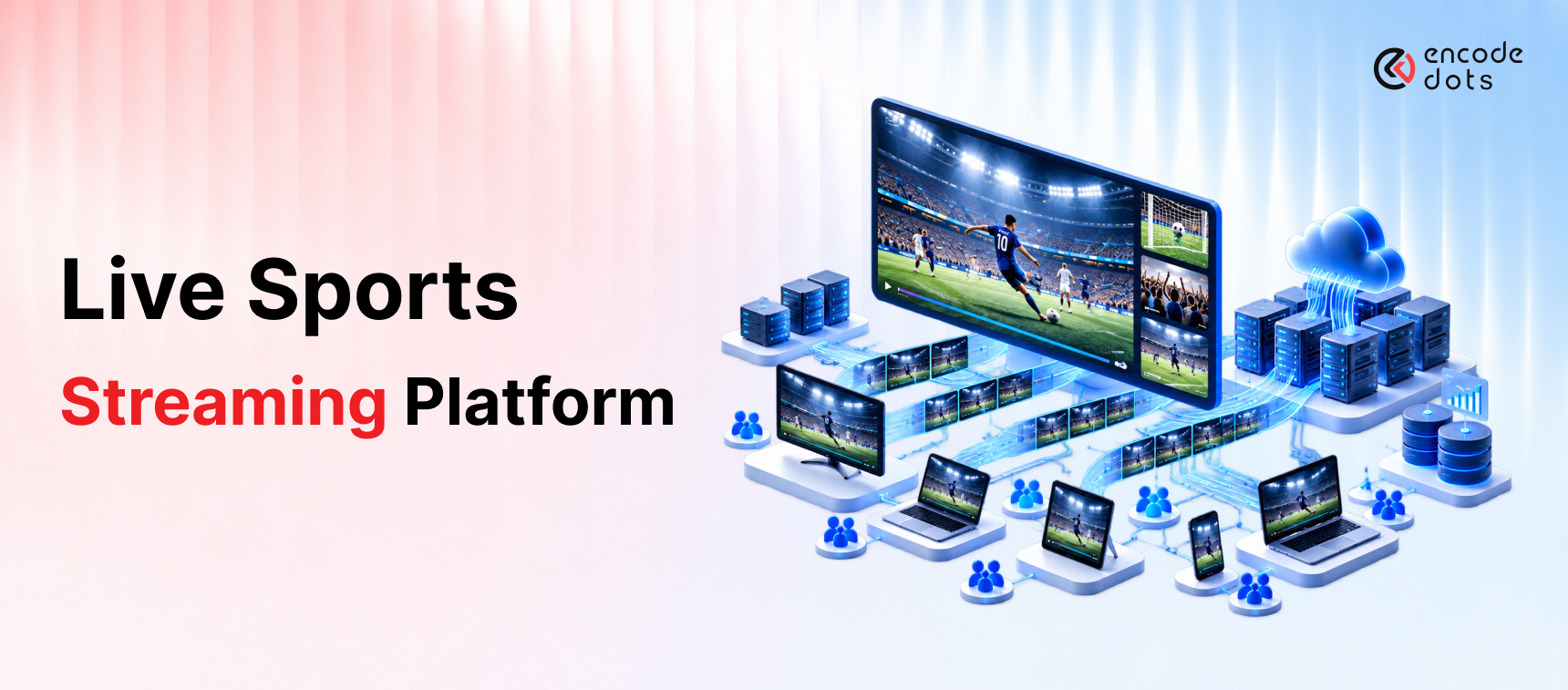
Live sports streaming platform development means building five things: a contribution pipeline that ingests the venue feed, a live transcoder, a packager with multi-DRM, a CDN delivery layer, and player apps. The hard part is not the video. It is surviving the traffic spike at kickoff and controlling bandwidth cost.
Here is the short version of everything below.
- Timeline: roughly 4–6 months for a credible MVP. Longer for a multi-sport, multi-platform product.
- Biggest cost: CDN egress, not engineering. It scales with every viewer, forever.
- Biggest risk: concurrency. Traffic can go from near zero to peak in under three minutes.
- Biggest shortcut: buy the encoding and delivery layer. Build the product layer.
One caveat before you read on. There is no single correct architecture for live sports. A regional league serving 20,000 viewers and a national broadcaster serving two million need genuinely different systems. Treat every figure below as a starting point for your own modelling, not a fixed answer.
What is a live sports streaming platform?
A live sports streaming platform takes a live match feed and converts it into multiple internet-ready quality levels. It then protects that video and delivers it to viewers within seconds.
Think of it as four jobs happening at once. It captures the game. It reshapes the video for every device and network speed. It checks who is allowed to watch. Then it pushes the stream out worldwide.
Illustrative example. A regional cricket league signs a three-year digital rights deal. The broadcast truck sends one clean feed. The platform turns that feed into six quality levels and blocks viewers outside the licensed territory. It inserts ads at over-by-over breaks and serves a large audience at once.
In short: it is a real-time logistics problem wearing a video costume.
Why live sports are harder than on-demand video
Many teams assume the video-on-demand experience transfers to live. It does not. The two systems fail in completely different ways.
With VOD, your content is already encoded and sitting in cache. Viewers arrive spread across the day. With live sports, the content does not exist until the moment it airs, and most viewers arrive together.
| Factor | Video-on-demand | Live sports |
|---|---|---|
| Traffic pattern | Spread across the day | Sharp spike at kickoff |
| Cache readiness | Fully pre-cached | Every segment is brand new |
| Encoding | Done once, offline | Done live, no second chance |
| Latency pressure | None | Severe — social media spoils the result |
| Failure impact | User picks another title | Refunds, rights breach, public backlash |
| Peak planning | Historical averages | Fixture list and rights calendar |
One more difference matters most. In VOD, a bad encode means you re-run the job. In live, a bad encode means the match is gone.
A view worth arguing with: teams tend to over-invest in latency and under-invest in origin cache behaviour. A viewer forgives three extra seconds. A viewer does not forgive a black screen at kickoff.
Live streaming architecture: the seven layers
Most live sports streaming platform development projects come down to seven layers. Each one fails differently, so each needs its own redundancy plan.
1. Contribution (venue to cloud)
This is the feed leaving the stadium. The public internet drops packets, so plain RTMP is a weak choice for a rights-protected match.
SRT and RIST both recover lost packets and handle jitter on unstable links. SRT is maintained as an open-source protocol by the SRT Alliance. RIST is specified by the Video Services Forum in its TR-06 documents. Both have broad hardware encoder support.
Run two contribution paths. One fibre, one bonded cellular. A single link into your cloud is a single point of failure on live television.
2. Live transcoding
The incoming feed becomes an ABR ladder: several renditions at different bitrates. A viewer on hotel Wi-Fi gets 720p. A viewer on fibre gets 1080p or 4K.
Keep the ladder tight. Every extra rung adds compute cost and splits your CDN cache. Five to six rungs cover most real audiences.
GPU transcoding through NVIDIA NVENC handles high channel counts well. CPU transcoding with x264 generally gives better quality per bit, which matters more when channel counts are low.
3. Packaging and DRM
The packager wraps renditions into HLS and DASH manifests. Use CMAF so both formats share one set of media segments instead of two. The DASH Industry Forum publishes implementation guidelines for this.
Rights holders will normally require multi-DRM: Widevine for Android and Chrome, FairPlay for Apple devices, and PlayReady for Windows and many smart TVs.
One detail that trips teams up. Common Encryption defines two modes. The older CENC mode uses AES-CTR and works with Widevine and PlayReady, but not FairPlay. The CBCS mode uses AES-CBC and is supported across all three. If you want one encrypted asset to serve every platform, you need CBCS. Confirm current device support with your DRM vendor before committing, because older smart TVs lag.
Do not treat DRM as a launch-week task. Licence server integration, device testing, and rights-holder security review take weeks.
4. Origin and CDN
The origin stores segments. The CDN does the actual delivery to viewers.
Put an origin shield in front. It collapses many edge requests into one origin request per segment. Without a shield, kickoff can overwhelm your origin.
Consider multi-CDN for any tier-one property. Two providers with real-time switching based on QoE data protect you when one network has a bad night in one region.
5. Playback clients
You need web, iOS, Android, and TV apps. TV is where timelines slip.
Roku, Samsung Tizen, LG webOS, Android TV, and Apple tvOS each have their own store review, their own DRM quirks, and their own certification process. Budget for all of them separately.
6. Application and API layer
This is the part your business actually owns. Authentication, subscriptions, entitlements, catalogue, fixtures, favourites, and the paywall.
Keep it stateless. Put session and entitlement state in Redis. Push events into Kafka so analytics never blocks playback.
7. Real-time data and engagement
Live scores, commentary, polls, and chat ride alongside the video. Use WebSocket or SSE fan-out through a pub/sub layer.
Shard channels per match. A viral match should never be able to slow down every other fixture on the platform.
How Much Will It Cost to Build Your Sports Streaming Platform?
Planning to launch your own live sports streaming platform? Share your required features, target audience, and preferred platforms with our team. We’ll help you understand the development scope, estimated timeline, and key cost considerations.
Get Your Development Estimate!Pick your latency target first
Latency drives your cost and complexity profile. Choose it before you choose anything else.
The ranges below are glass-to-glass estimates under normal conditions. Your real numbers depend on segment duration, player buffer settings, encoder configuration, and CDN support, so measure your own chain rather than trusting any published range.
| Approach | Typical latency | Scales to large audiences? | Relative cost | Best for |
|---|---|---|---|---|
| Standard HLS / DASH | ~20–45 sec | Yes, easily | Lowest | Highlights, replays, low-stakes fixtures |
| LL-HLS / LL-DASH (CMAF chunked) | ~2–8 sec | Yes, with tuning | Moderate | Most live sports products |
| WebRTC (WHIP/WHEP) | Under 1 sec | Difficult and expensive | Highest | Interactive and latency-critical feeds |
What drives those ranges:
- Standard HLS latency comes mostly from segment duration multiplied by the player’s buffer depth. Six-second segments with a three-segment buffer put you near 20 seconds before encoder delay is counted.
- LL-HLS cuts this using partial segments and blocking playlist reloads, described in Apple’s low-latency HLS documentation. Your CDN must support the required request behaviour, so confirm this with your provider.
- WebRTC achieves sub-second delivery but does not use the HTTP segment caching model, which changes your delivery economics substantially. WHIP and WHEP are the IETF specifications standardising WebRTC ingest and playback; check their current status at the IETF datatracker.
A reasonable default for most sports platforms: LL-HLS at a 4–6 second glass-to-glass target.
The reasoning is straightforward. Standard HLS puts you far enough behind the broadcast that push notifications spoil goals before viewers see them. WebRTC solves latency but breaks the caching model that makes mass delivery affordable. LL-HLS sits between the two.
Common mistake: chasing sub-second latency when your own data feed already lags the venue by several seconds. Measure the whole chain before you set the target.
Designing for the kickoff spike
Concurrency is the defining engineering problem of sports streaming. Handle it well, and everything else is manageable.
The shape of the problem
Traffic for a scheduled match does not ramp. It steps. A large share of your audience arrives within a few minutes of the start whistle.
That creates four simultaneous stress points:
- Login and entitlement checks all fire at once.
- Manifest requests repeat every few seconds, per viewer, for the whole match.
- Segment requests hit the CDN for content that has never been cached.
- Chat and score sockets all connect within the same minute.
Pre-scale; do not autoscale
Autoscaling reacts. Kickoff does not wait for it.
Use scheduled scaling tied to your fixture list. Warm your API fleet, database connections, and socket servers well before the whistle. Tell your CDN partners the expected peak in advance so they can pre-provision capacity.
Protect cache hit ratio above all else
Cache hit ratio is your single biggest cost and stability lever. A 99% hit ratio and a 95% hit ratio sound similar. In origin load terms, the second one is five times worse.
Four rules that protect it:
- Never put user-specific query strings on segment URLs. Each variation creates a separate cache object.
- Use signed cookies or path-based tokens instead of per-user query parameters.
- Keep the ABR ladder small. Ten rungs fragments cache ten ways.
- Set segment cache headers deliberately. Live segments are immutable once written. Manifests are not.
Watch manifest traffic, not just segments
Here is a detail teams often miss. With four-second segments, each viewer requests a new manifest roughly every four seconds. Segments are large but infrequent. Manifests are tiny but constant.
Worked estimate (illustrative). At 500,000 concurrent viewers requesting a manifest every four seconds, the platform sees roughly 125,000 manifest requests per second. That is a request-rate problem, not a bandwidth problem. It needs edge caching with short TTLs to survive.
Design your degradation ladder
Decide now what you will shed under extreme load. Write it down before match day.
A sensible order: drop chat first, then reduce the top ABR rung, then disable multi-view, then relax the latency target. Video playback is the last thing to go.
Sports-specific features teams underestimate
These requirements rarely appear in a generic streaming brief. They appear in most real rights contracts.
Blackouts and territory rights
Rights are sold by territory and often by time window. Your platform must block viewers geographically, and sometimes block a local audience entirely while a regional broadcaster holds exclusivity.
This needs geo-IP filtering, VPN and proxy detection, and a rules engine that understands fixtures, territories, and time windows together. Enforce it at the CDN edge, not only in your app.
Concurrent stream limits
Credential sharing is a persistent revenue leak in subscription sports. One subscription, a whole group chat watching.
You need a session service that tracks active streams per account and revokes the oldest session when the limit is exceeded. Build it early. Retrofitting session enforcement into a live player is painful.
Server-side ad insertion
Client-side ad players get blocked and interrupt the viewing experience. SSAI stitches ads into the stream itself.
This relies on SCTE-35 markers in the incoming feed to signal ad breaks. Those markers are defined in the SCTE standards catalogue. Ad decisioning then uses VAST and VMAP from IAB Tech Lab. Sports has natural break points, which makes SSAI more valuable here than in general entertainment.
Instant highlights and clipping
Viewers who miss a goal want it in seconds, not after the match. Build a clipping service that reads from your live DVR window and publishes short VOD assets automatically.
Tie it to your event data feed. When the data provider signals a goal, the clip job triggers itself.
Multi-view and alternate feeds
Multiple camera angles, alternate commentary languages, and stats overlays are now common expectations in tier-one sports products.
Each one multiplies your encoding and delivery cost. Treat multi-view as a premium tier, not a default.
A tech stack that suits most sports platforms
The stack below is a reasonable starting point for a mid-size platform targeting a six-figure peak audience. Your own constraints existing team skills, cloud commitments, rights-holder security requirements should override any generic recommendation.
| Layer | Option | Why |
|---|---|---|
| Contribution | SRT, dual path | Packet recovery on unreliable links |
| Live encoding | Managed live encoder, or FFmpeg + NVENC on GPU instances | Managed cuts ops load; self-hosted cuts unit cost at scale |
| Packaging | CMAF with LL-HLS + DASH output | One segment set serves both formats |
| DRM | Multi-DRM service covering Widevine, FairPlay, PlayReady | Usually a rights-holder requirement |
| Delivery | Multi-CDN with origin shield | Regional failover and cache protection |
| Backend | Node.js or Go microservices on Kubernetes | Fast horizontal scaling under spike load |
| State | Redis for sessions, PostgreSQL for core data | Entitlement checks need to be fast |
| Events | Kafka | Decouples analytics from the playback path |
| Real-time | WebSocket gateway with pub/sub, sharded per match | Isolates viral fixtures |
| Players | Shaka Player / hls.js (web), AVPlayer (iOS), ExoPlayer (Android) | Mature LL-HLS and DRM support |
| Observability | QoE monitoring plus infrastructure APM | Rebuffer ratio is your real health metric |
On Go vs Node.js: choose Go if your team is comfortable with it and you expect heavy socket fan-out. Choose Node.js if delivery speed matters more and your team already writes JavaScript.
What it actually costs
Cost splits into two very different buckets. Build cost happens once. Run cost happens at every match, forever.
Run cost: the calculation nobody shows you
Most articles quote vague CDN figures. Here is the actual method, so you can run it against your own numbers and your own contracted rates.
Step 1: Data per viewer. GB per viewer-hour = average bitrate in Mbps × 0.45
(Derivation: 1 Mbps × 3,600 seconds = 3,600 megabits = 450 megabytes = 0.45 GB, using decimal GB as CDN providers bill. Binary GiB gives a slightly lower figure.)
Step 2: Total data per match. Total GB = GB per viewer-hour × match length in hours × concurrent viewers
Step 3: Cost. CDN cost = total GB × your contracted per-GB rate
Worked example illustrative only
Assumptions: 50,000 concurrent viewers, two-hour match, 4 Mbps average delivered bitrate across the ABR ladder, all viewers watching the full match, single CDN.
- Per viewer-hour: 4 × 0.45 = 1.8 GB
- Per viewer, per match: 1.8 × 2 = 3.6 GB
- Total: 3.6 × 50,000 = 180,000 GB (180 TB)
Apply your own rate to that 180 TB. For scale, published list pricing and committed-volume pricing can differ by several times over, so the same match can vary widely in cost depending purely on your contract. Check current rates directly with your providers; for example, the AWS CloudFront pricing page, since rates vary by region, tier, and commitment, and change over time.
Two things should jump out.
First, your negotiated CDN rate will change the answer more than any code you write. Rate negotiation deserves as much attention as architecture.
Second, check peak bandwidth separately from total transfer. In this example: 50,000 × 4 Mbps = 200 Gbps at peak. These are two different billing concepts. Transfer billing charges for total gigabytes moved. Peak or commit-based billing charges against sustained throughput, often measured at the 95th percentile. A sports platform with sharp, short spikes can look cheap on transfer and expensive on peak. Model both before signing.
Monthly run cost drivers
The table below shows relative scale, not prices. Actual figures depend on your rates, regions, fixture volume, and architecture.
| Component | Scales with | Notes |
|---|---|---|
| CDN egress | Viewers × bitrate × hours | Dominates the bill at scale |
| Live transcoding | Number of channels, not viewers | Fixed per match regardless of audience |
| DRM licensing | Licence requests | Negotiate a flat tier at volume |
| Compute and database | Peak concurrent sessions | Pre-scaling adds idle cost |
| Monitoring and QoE | Viewer sessions tracked | Often priced per play |
The key insight: transcoding cost scales with the number of channels. Delivery cost scales with the number of viewers. Twenty matches at 5,000 viewers each costs very differently from one match at 100,000 viewers, even though the total viewer-hours match.
Build cost
Build cost is a function of scope, not a fixed price. Calculate it as: team size × blended rate × duration. The bands below are planning estimates to help you scope, not quoted prices.
| Scope | Indicative team | Indicative timeline | What it covers |
|---|---|---|---|
| MVP | 4–6 people | 4–6 months | Web + one mobile platform, single sport, basic DRM, standard latency |
| Production | 8–12 people | 7–10 months | Multi-platform including TV, LL-HLS, multi-DRM, SSAI, blackouts |
| Enterprise | 14+ people | 10–14 months | Multi-CDN, multi-view, highlights automation, full analytics |
The three drivers that move these numbers most:
- Number of TV platforms. Each one is close to a separate app project, with its own certification queue.
- DRM and rights complexity. Blackout rules multiply testing effort quickly.
- Latency target. Sub-second changes your entire delivery architecture.
Working out the numbers for your own fixture load? Send us your expected peak concurrency and match calendar, and our team will model the delivery cost with you.
Build vs buy: when not to build this
We build custom platforms for a living, so this section argues against our own interest. It is still the right advice.
Do not build a custom platform if:
- You do not own the rights. No architecture fixes a missing licence.
- Peak concurrency stays small. An off-the-shelf OTT platform will usually be cheaper and faster below a few thousand concurrent viewers.
- You need to launch in under three months. A serious platform does not compress that far.
- Your catalogue is mostly VOD with occasional live. Buy a video platform and move on.
- You have no in-house DevOps capability. Live video needs someone on call during matches, every match.
Build a custom platform when:
- You hold multi-season rights, and the revenue justifies the investment.
- Your business model needs something standard platforms cannot do: regional pricing tiers, complex blackout rules, fantasy or second-screen integration.
- Per-viewer SaaS fees have overtaken the cost of running your own delivery stack.
- Your audience data is a strategic asset you cannot hand to a third party.
The hybrid path most teams should take
You do not have to choose one side. The best outcome is usually a split.
Buy encoding, packaging, DRM, and CDN. These are commodity layers with mature providers, and building them yourself rarely pays off.
Build the product layer: subscriptions, entitlements, fixtures, personalisation, engagement, and data. That is where competitive advantage lives.
Common mistakes in live streaming builds
- Load testing the API but not the delivery path. Your backend can be fine while cache hit ratio collapses.
- Relying on autoscaling for a scheduled event. You know the kickoff time. Pre-scale.
- Leaving DRM until the final sprint. Device certification and rights-holder review are slow.
- Running a single CDN for tier-one rights. Regional outages happen during finals.
- Building an oversized ABR ladder. More rungs means more cost and worse cache behaviour.
- No failover contribution feed. One venue uplink is one point of failure.
- Measuring uptime instead of QoE. Track rebuffer ratio, startup time, and video start failures.
- Ignoring the TV app timeline. Store certification adds weeks that rarely appear in the plan.
- Skipping the post-match review. Every fixture is a free load test. Capture the data.
Where live streaming is heading in 2026
- AV1 adoption is accelerating. Better compression means real bandwidth savings, though device support still needs a fallback ladder.
- Low latency is becoming an expectation, not a premium feature.
- WHIP and WHEP are standardising WebRTC ingest and playback, which makes sub-second delivery more practical than it was.
- Edge compute is moving personalisation closer to viewers, including manifest manipulation and ad decisioning at the edge.
- Interactive layers are expanding multi-view, real-time stats overlays, and second-screen experiences.
- Content security expectations are tightening, with rights holders increasingly requiring formal security review before granting premium rights.
Key takeaways
- Live sports streaming is a concurrency problem first and a video problem second.
- Pick your latency target before anything else. It determines your cost model.
- LL-HLS at 4–6 seconds suits most sports platforms.
- Cache hit ratio and your CDN rate drive economics more than your code does.
- Pre-scale to the fixture list. Never autoscale into a kickoff.
- Buy the video pipeline. Build the product layer.
- Model both total transfer and peak throughput before signing a CDN contract.
Building a live sports streaming platform?
Live sports gives you one chance per fixture. The architecture decisions you make early — latency target, cache strategy, build versus buy shape both your cost per match and your ability to survive kickoff.
EncodeDots builds custom software, backend systems, and mobile and TV applications for businesses handling high-concurrency workloads. If you are scoping a streaming platform, we can review your architecture and model your delivery cost against your real fixture calendar. Talk to our team