Web App Development
  Cloud App Development
  Front-End Development
  Cross Platform Development
  MVP Development
  Application Modernization
  PWA Development
  SaaS Application Development
  Software Development Outsourcing
  Offshore Custom Software Development
  Full Stack Software Development
  Custom Software Development
  Enterprise Software Development
  Cloud Computing Solutions
  Cloud Development
  Managed Cloud Services
  Cloud Native Development
  AI Consulting
  Machine Learning Development
  LLM Development
  AI Chatbot Development
  Data Analytics
  CI CD Development
  Digital Transformation
  Dev Ops
  Content Development
  Blockchain Development
  Web Development
  Web Design



 Generative AI
  Large Language Model
  AI Chatbot
  AngularJs
  ReactJS
  Dotnet Core
  Android
  iPhone
  Swift
Swift  E-Commerce
  NopCommerce
  BigCommerce
  Laravel
  Yii
Yii  AWS
AWS  Google Cloud
  Azure DevOps
  Automation Testing
  Security Testing
  API Testing
  Functional Testing
  MEAN Stack
  MERN Stack
  Full Stack Developers
  biz.encodedots
  biz@encodedots.com
  +91 99747 42737


- Quick Answer
- What Makes a Good MoneyLion Alternative?
- Quick Comparison: 15 Apps Like MoneyLion
- Best Cash Advance Apps Like MoneyLion
- MoneyLion as the Benchmark
- How Much Can a Cash Advance Really Cost?
- What Happens If You Can't Repay a Cash Advance?
- Cash Advance Apps vs. Earned Wage Access
- Cash Advance Apps vs. Payday Loans
- What to Check Before Using a Cash Advance App
- Are Cash Advance Apps Safe?
- Final Takeaway
- Want to Build a Cash Advance or EWA App?
- Frequently Asked Questions
Editorial note: Cash advance limits, fees, eligibility requirements, state availability, and repayment terms can change frequently. Figures in this guide reflect provider information available at the time of writing. Always review the provider’s current terms before requesting an advance.
Quick Answer
The best MoneyLion alternative depends on the type of product you need, not simply the biggest advertised amount.
- Higher potential limits: Albert and B9 Premium
- Accessing already-earned wages: EarnIn, DailyPay, Payactiv, and Current
- Already using a banking app: Chime MyPay, Cash App Borrow, and Varo Advance
- Small cash gaps: FloatMe
- Installment repayment: Possible Advance
- No required subscription for the advance itself: Albert Instant Advance
In short: Compare the amount you actually qualify for, the total cost, the repayment date, and what your finances will look like after repayment.
If you need money before payday, MoneyLion is one of many apps that can help cover a short-term cash gap. But the right alternative depends on what you actually need.
Some apps provide a cash advance, while others let you access wages you’ve already earned through earned wage access (EWA). Some charge a monthly membership, while others charge primarily for faster delivery. And an advertised maximum doesn’t necessarily mean you’ll qualify for that amount.
This guide compares 15 cash advance apps and paycheck-access alternatives to MoneyLion in 2026, focusing on the factors that matter most: available amounts, fees, repayment, transfer speed, eligibility, and product structure.
Important: This article provides general financial information, not personalized financial advice. Product availability and terms can vary by provider, state, income, deposits, account history, and other eligibility factors.
What Makes a Good MoneyLion Alternative?
A good alternative isn’t the app with the biggest advance. It’s the one with the lowest total cost and a repayment date you can absorb.
Compare these seven things before choosing.
Advance amount
A provider may advertise $500 or $1,000, but your personal limit can be far lower.
Albert, for example, lists Instant Advance limits from $25 to $1,000 while also stating that few customers qualify for the $1,000 maximum.
Fees
“No interest” does not mean “free.”
Look for monthly membership fees, express-transfer fees, and service charges. A $100 advance with an $8 fee is materially different from a $100 advance that costs nothing.
Repayment
Find out when repayment is due and how it happens. Depending on the product, repayment may come from your next paycheck, a linked bank account, or scheduled installments.
Eligibility
Requirements can include qualifying direct deposits, minimum income, bank-account history, employer participation, or account activity.
Credit checks and reporting
Some products don’t use traditional credit checks. Others are credit products and may evaluate consumer-report information. Don’t assume every product from the same company follows the same rules.
Transfer speed
Standard delivery is often free but slower. Instant delivery is usually available for a fee.
Product type
This is the most important distinction, and the one most comparison articles skip.
Cash App Borrow is a loan product. EarnIn Cash Out, Current Paycheck Advance, DailyPay, and Payactiv are built around accessing earned or paycheck-related funds. Varo Advance is a small-dollar credit product. These are not interchangeable, and they carry different repayment mechanics and different consumer protections.
Quick Comparison: 15 Apps Like MoneyLion
| App | Advertised Amount | Main Cost | Product Type | Best For |
| Brigit | $25–$500 | $8.99–$15.99/month may apply; express fee may apply | Cash advance | Financial-management tools |
| Dave | Up to $500 | 5% ExtraCash fee on applicable electronic overdraft amount ($5 min/$15 max); external debit-card transfer 1.5% | Cash advance | Cash + budgeting |
| EarnIn | Up to $150/day; up to $1,000/pay period | No mandatory fee; instant transfer from $3.99 | Earned wage access | Accessing earned pay |
| Albert | $25–$1,000 | No subscription required for the advance; external instant transfer $5.99–$14.99 | Cash advance | Higher potential limits |
| Chime MyPay | $20–$500 generally | 3% instant fee ($2 min/$5 max) | Paycheck advance | Existing Chime users |
| Current | $25–$750 | Free within 3 days; instant fee varies | Earned wage access | Paycheck access |
| Cash App Borrow | Up to $500 | Flat fee disclosed before borrowing | Loan product | Cash App users |
| Vola | $15–$500 | From $3.99/month; no extra instant-transfer fee | Cash advance | Users without linked payroll |
| Varo Advance | $20–$250 initially; up to $700 over time | $1.60–$100 depending on amount/deposits | Small-dollar credit | Varo customers |
| FloatMe | $50 new members; $100 existing members | $4.99/month + $1–$7.50 instant fee | Cash advance | Small emergencies |
| Possible Advance | From $10 single advance; $50–$300 installment advance | $15/month membership for Installment Advance | Advance product | Installment repayment |
| DailyPay | Based on earned wages | $0 standard; instant fee varies by employer | Earned wage access | Employer-based access |
| Payactiv | Based on earned wages | Free options available; expedited fees may apply | Earned wage access | Participating employees |
| Klover | Varies by eligibility (in-app offer) | Membership and delivery fees may apply | Cash advance | Small advances |
| B9 | $10–$250 Basic; up to $1,000/pay period Premium | $9.99 Basic / $19.99 Premium monthly | Paycheck advance | Higher potential limits |
Important: These are advertised or published maximums, not guaranteed offers. Your actual amount can be lower.
Want to Build a Cash Advance App Like MoneyLion?
Looking to launch your own cash advance, earned wage access (EWA), or fintech app? Our team can help you plan the product, design the user experience, integrate financial services, and build a secure, scalable platform. Ready to turn your fintech idea into a real product?
Talk to Our Fintech ExpertsBest Cash Advance Apps Like MoneyLion
1. Brigit Best for Financial-Wellness Features

Brigit is one of the closest alternatives to MoneyLion if you want cash access alongside budgeting tools.
Brigit says eligible users can receive $25 to $500, while Maine residents are limited to $25 to $250. Brigit’s own site also reports an average advance of about $73, which is a useful reality check against the $500 headline.
A monthly subscription fee of $8.99–$15.99 may apply, and Express Delivery may incur an additional fee. Standard delivery takes longer but avoids the express charge.
Main advantage: Combines an advance product with broader financial tools.
Main limitation: The monthly subscription makes it expensive if you need an advance only occasionally.
2. Dave – Best for Cash Access Plus Budgeting
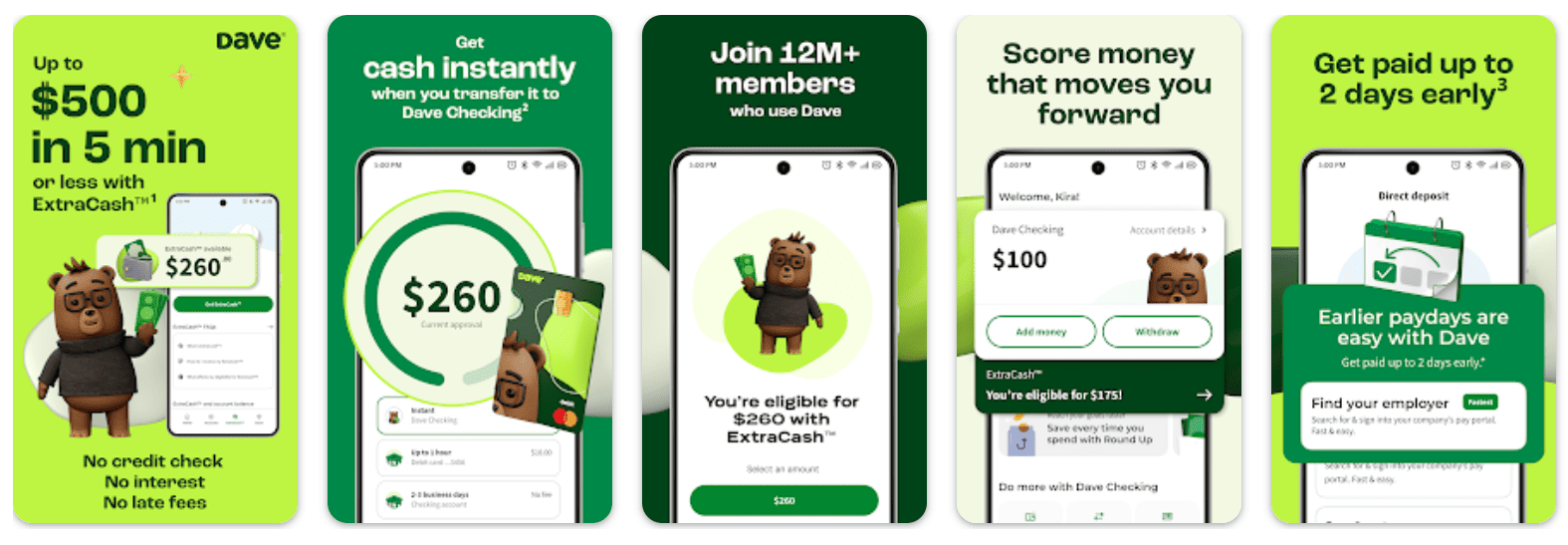
Dave’s ExtraCash has a published maximum of up to $500.
Its fee schedule is worth checking directly, because older articles often describe Dave’s pricing using outdated tipping information. Dave lists a 5% fee on applicable electronic overdraft amounts, with a $5 minimum and $15 maximum. An external bank debit-card transfer can cost 1.5%, while an ACH transfer to an external bank account is free.
Dave’s pricing has changed more than once, so check its current fee schedule and any applicable membership charge before taking an advance.
Main advantage: Up to $500 with multiple transfer options, including a free ACH route.
Main limitation: The cheapest delivery option is also the slowest.
3. EarnIn – Best for Accessing Earned Wages

EarnIn differs from a conventional cash advance because Cash Out is built around wages you’ve already earned.
Eligible users can access up to $150 per day and $1,000 per pay period. The daily cap usually matters more than the pay-period cap for anyone who needs money immediately.
EarnIn says there are no mandatory fees, while Lightning Speed transfers start at $3.99. Users need a regular pay schedule and at least $320 in earnings per pay period. When your paycheck arrives, EarnIn automatically deducts accessed earnings, applicable tips, and fees.
Main advantage: No mandatory fee for standard access.
Main limitation: Your available amount depends on earnings, account activity, and the daily limit.
4. Albert – Best for Higher Potential Limits

Albert has one of the higher advertised limits in this category.
Instant Advance limits range from $25 to $1,000, although Albert explicitly says few customers qualify for $1,000. There is no credit check, interest, or late fee for Instant Advance, and no subscription is required to use the feature.
Transferring the advance to an external linked account within minutes can cost $5.99–$14.99. Albert says advances are generally due six days after the initial advance, with a possible seven-day extension available in the app.
Main advantage: High advertised maximum with no required subscription on the advance itself.
Main limitation: The $1,000 figure is not typical, and fast external transfers cost extra.
5. Chime MyPay – Best for Existing Chime Users
Chime MyPay lets eligible users access part of their pay before payday.
Most eligible members can access $20–$500 per pay period. Chime determines the amount using direct-deposit history, account activity, and other criteria.
Standard delivery within 24 hours is free. Instant delivery costs 3% of the advance, with a $2 minimum and $5 maximum per advance. Chime says there is no interest, mandatory fee, or late fee for MyPay.
Main advantage: Built into the Chime app with a genuinely free standard option and a low instant-fee cap.
Main limitation: Eligibility depends on Chime’s requirements, and your limit can change.
6. Current – Best for Paycheck Access
Current’s Paycheck Advance is designed around accessing part of your next paycheck early.
Eligible users can qualify for up to $750, delivered within three days for free. Instant Access is available for a fee shown in the app.
Current says there are no credit checks for Paycheck Advance and that withdrawals and repayments are not reported to credit bureaus. It requires eligible payroll deposits, and Current states users could qualify for the maximum when receiving eligible payroll deposits of $200 or more.
Main advantage: One of the highest limits here with a free standard delivery option.
Main limitation: Eligibility is tied to routing qualifying payroll deposits to Current.
7. Cash App Borrow – Best for Existing Cash App Users
Cash App Borrow is a genuine borrowing product, not an earned-wage-access feature. That distinction affects both repayment and the consumer protections that apply.
Cash App advertises borrowing up to $500 instantly for a flat fee, with personal limits based on eligibility.
Cash App says most users become eligible when they deposit $300 or more in paychecks per month into Cash App, or link an external account with $500 or more in monthly deposits. Borrow isn’t available in Colorado, Iowa, or Oregon. Repayment can be made as cash arrives, in weekly installments, or as a full balance payment.
Main advantage: Instant funding with flexible repayment options.
Main limitation: It’s a loan rather than an advance against earned wages, and three states are excluded.
8. Vola – Best for Cash Advances Without Linked Payroll
Vola provides cash advances from $15 to $500, depending on eligibility.
Unlike paycheck-focused products, Vola says you don’t need to link payroll. It evaluates bank-account age, transaction activity, and income instead. Vola also says there is no credit check and no interest on its cash advances.
Membership starts at $3.99 per month, and Vola says there is no additional fee for Instant Transfer. Most users receive funds within seconds when their bank supports real-time payments; otherwise, transfers can take up to one business day.
Main advantage: No payroll linking required, and no separate instant-transfer charge.
Main limitation: Membership is required whether or not you take an advance.
9. Varo Advance – Best for Bank-Integrated Advances
Varo Advance is structured as a small-dollar credit product integrated into Varo’s banking platform. It is the most credit-like option in this list.
Initial limits range from $20 to $250, with eligible customers able to build toward $700 over time. Varo lists fees from $1.60 to $100 depending on the advance amount and qualifying deposits.
Varo says qualifying customers receive funds immediately and have 30 days to repay. Building toward $700 involves qualifying direct deposits, regular account activity, and on-time payments.
Main advantage: Up to $700 over time with a clearly defined 30-day repayment window.
Main limitation: Fees can be substantial at higher amounts, and qualification can involve consumer reports.
10. FloatMe Best for Small Emergency Expenses
FloatMe is aimed at genuinely small cash gaps.
New eligible members can request up to $50, while existing eligible members can request up to $100. Membership costs $4.99 per month, and Instant Transfer fees range from $1 to $7.50. FloatMe says its advances aren’t reported to major credit bureaus.
Run the math before subscribing. A $50 advance with a $4.99 membership and a mid-range instant fee can cost close to 15% of the amount received.
Main advantage: Simple structure for small amounts.
Main limitation: The $100 ceiling rules out larger expenses, and fixed costs weigh heavily on small advances.
11. Possible Advance – Best for Installment Repayment
Possible offers something rare in this category: repayment split across installments rather than a single collection.
Possible Membership costs $15 per month and gives eligible members an Installment Advance of $50 to $300, with free instant disbursement and repayment in four smaller installments.
A Single Advance is also available without the membership, starting from $10, with free standard delivery or an optional instant-disbursement fee. Check the current amount and fee shown in the app, as both vary by eligibility and state.
Availability is limited by state, so confirm that Possible operates where you live before relying on it.
Main advantage: Four-installment repayment reduces the single-paycheck hit.
Main limitation: The $15 membership and limited state footprint make it unsuitable for most occasional users.
12. DailyPay – Best for Employer-Based Earned Wage Access
DailyPay is not a conventional cash advance. Eligible employees access part of their earned wages before payday through participating employers.
DailyPay lists $0 for accessing available earnings within 1–3 business days. Instant access is typically subject to an employer-specific fee, and DailyPay notes that fees vary by employer.
Main advantage: Access is connected to wages already earned, with a free standard option.
Main limitation: Employer participation is required, so it isn’t available on demand.
13. Payactiv – Best for Employer-Supported Earned Wage Access
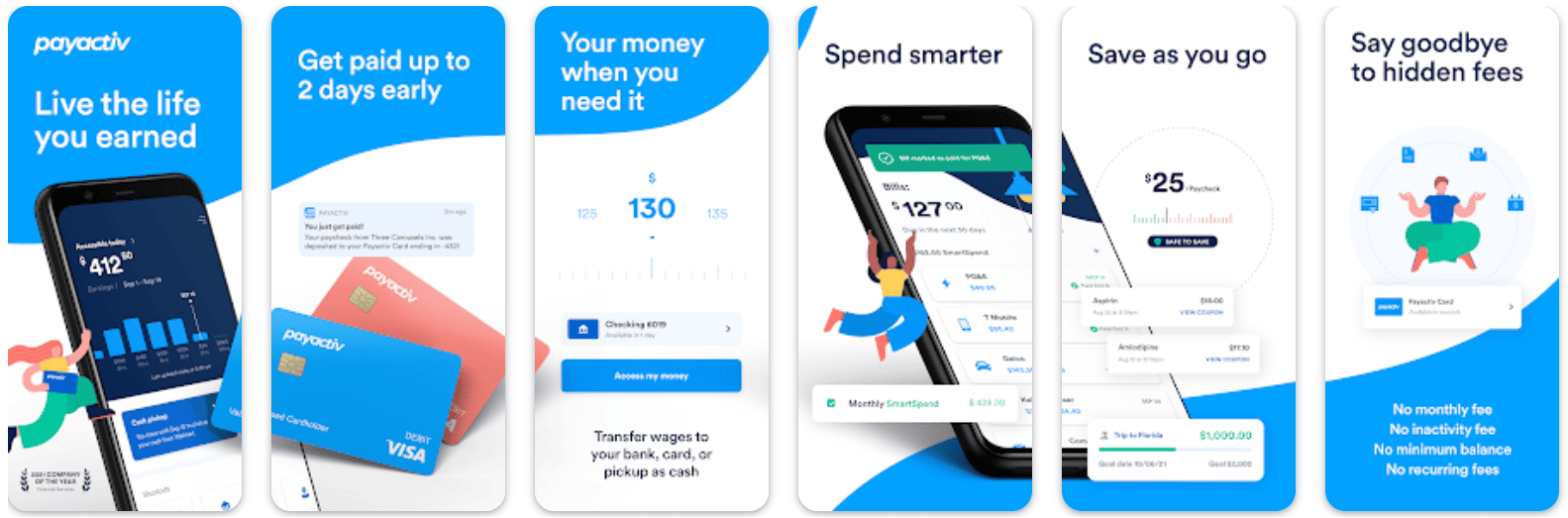
Payactiv is another earned-wage-access provider rather than a traditional cash advance app.
Employees can access earned wages through several routes, including ACH bank transfer, bill pay, gift-card and retail load options, and the Payactiv Visa Card. Some options are free, while expedited delivery can involve a fee.
Payactiv says users who make at least one successful $200 or more direct deposit per pay period to the Payactiv Visa Card can qualify for free card-based access; otherwise, a load fee can apply.
Main advantage: Multiple access methods, several of them free.
Main limitation: Employer participation and program configuration determine what you actually pay.
14. Klover – Best for Small Advances and Rewards
Klover combines cash advances with a points-based rewards system.
Klover’s advertised amounts have varied across its own marketing, so treat the offer shown in your account as the authoritative figure rather than any headline number. This is good practice with every app on this list, but it matters more here.
Klover also says users can earn points through activities such as surveys and watching ads, which can contribute toward cash access.
Main advantage: Cash access plus rewards-style features for users who want them.
Main limitation: Advertised limits are inconsistent, so verify your actual offer and fees before accepting.
15. B9 – Best for Higher Potential Paycheck Advances
B9 is a paycheck-advance and banking platform with two membership tiers.
B9 Basic costs $9.99 per month, with eligible advances of $10–$250. New users typically qualify for $10–$50, and B9’s own disclosure has reported an average approved Basic advance of around $70.
B9 Premium costs $19.99 per month and can provide eligible users advances up to $1,000 per pay period. B9 says membership is required for cash advances and that there is no interest or late fee on the advance itself.
That average-advance disclosure is the clearest illustration in this guide of why advertised maximums mislead: the headline is $1,000, while the typical Basic approval is closer to $70.
Main advantage: Highest realistic ceiling here for users who qualify for Premium.
Main limitation: Two months of Premium membership costs $40 whether or not you borrow.
MoneyLion as the Benchmark
MoneyLion is excluded from the 15 above because the point is to compare other options against MoneyLion, not count it as its own alternative.
MoneyLion’s Instacash advertises 0% APR and a $0 monthly administrative fee, with advances of up to $500 for eligible users. Regular delivery can be free, while Turbo delivery is optional and costs extra.
MoneyLion’s pricing page gives specific Turbo fees. For a $90–$100 advance, the listed Turbo fee is $6.99 to a MoneyLion Spend account or $8.99 to an external account.
Your available Instacash limit is personalized, displayed in the app, and can change over time.
That makes MoneyLion a useful benchmark, but not automatically the best option. On instant-delivery cost specifically, Chime MyPay’s $5 cap is lower than MoneyLion’s $8.99 external Turbo fee on a comparable amount.
How Much Can a Cash Advance Really Cost?
“No interest” can sound like a free product, but fees still determine the real cost.
Consider a simple example:
- Advance received: $100
- Monthly membership: $4.99
- Express-transfer fee: $3.99
- Total direct cost: $8.98
You receive $100 but pay $8.98 in fees, so the direct fee equals 8.98% of the amount received.
Annualizing that same short-term cost over seven days:
8.98% × (365 ÷ 7) ≈ 468.2%
That shows how expensive short-duration fees look when annualized.
One important distinction:
468.2% is an illustrative annualized cost, not the product’s legally disclosed APR. A legally calculated APR uses different assumptions and different treatment of optional fees.
The example isn’t meant to relabel every cash advance as a 468% loan. It’s meant to show why “0% interest” is a weak basis for comparing products.
What Happens If You Can’t Repay a Cash Advance?
The repayment mechanism matters as much as the original fee, and it varies more than most people expect.
EarnIn says repayment is usually collected around payday. If the linked bank account lacks funds when repayment is attempted, your own bank may charge overdraft or NSF fees under its own policies.
Cash App Borrow says an outstanding balance on the final due date can be automatically deducted from your Cash balance or a linked payment instrument.
Albert’s Instant Advance works differently again: Albert describes it as non-recourse, meaning it says it has no contractual or legal claim against you for an unpaid balance, though access to future advances can be suspended.
Three products, three different downside outcomes. That’s why the question before accepting an advance isn’t:
“How much can I get?”
It’s:
“What happens to my account when repayment is due?”
If repayment could leave you short for rent, food, utilities, or another essential bill, the advance may create a larger cash-flow problem than the one it solves.
Cash Advance Apps vs. Earned Wage Access
Cash advances and earned wage access get grouped constantly, but their structures differ.
What is a cash advance?
A cash advance provides money you are expected to repay under the product’s terms, typically on your next payday.
What is earned wage access?
EWA products provide earlier access to wages a worker has already earned but hasn’t yet received through the normal payroll cycle.
Why the difference matters
The structural differences show up in ways that affect you directly:
- Where the money comes from. A cash advance is funded by the provider. EWA is funded against wages you’ve already accrued.
- How repayment is collected. Cash advances are typically debited from a linked bank account. Employer-integrated EWA is usually deducted through the payroll process.
- What happens on a shortfall. Some cash advance products retry collection or deduct from future deposits, which can trigger bank overdraft fees. Some EWA products have no recourse against the worker at all.
- Who has to participate. EWA through DailyPay or Payactiv generally requires your employer to offer it. A cash advance app doesn’t.
Regulatory treatment of these products has continued to develop, and it depends on how a specific product is structured rather than what it’s called in marketing. For the current federal position, check the Consumer Financial Protection Bureau directly.
In short: a product’s marketing label doesn’t tell you how it works or what protections apply. Read the disclosures for the specific product you’re using.
Cash Advance Apps vs. Payday Loans
Both can cover an expense before payday, but they aren’t interchangeable.
A payday loan is generally a short-term loan with a defined finance charge. Cash advance apps use several different pricing and repayment models, and EWA services are structured around wages already earned.
That doesn’t make every cash advance app cheap. A membership fee plus an instant-transfer charge can make a small advance costly, and repeated use creates a cycle where each paycheck starts with less available money.
Rather than asking which category is better, compare:
- Amount received
- Total fees in dollars
- Repayment date
- Repayment method
- What happens if repayment fails
- Whether the product is borrowing or earned wage access
- Monthly membership costs
- Instant-transfer costs
- State availability
What to Check Before Using a Cash Advance App
1. Check your actual offer
Don’t assume you’ll receive the maximum advertised amount. B9’s own disclosure shows roughly $70 average against a $1,000 headline.
2. Calculate the total cost in dollars
Add membership, transfer, service, and other applicable fees. Percentages hide small-dollar impact.
3. Compare standard and instant delivery
If you can wait one to three days, free standard delivery is often available.
4. Check the repayment date
Know exactly when the money will be collected, and from where.
5. Understand failed repayment
Find out whether the provider retries the payment, deducts from future deposits, suspends access, or has no recourse at all. These outcomes are very different.
6. Know what type of product you’re using
A loan, cash advance, line of credit, and EWA service have different structures and different protections.
7. Check state availability
Cash App Borrow excludes three states. Possible operates in a limited set. Availability is not uniform.
8. Read the current provider disclosures
Financial products change pricing often. An article from last year may contain outdated limits or fees.
9. Think about the next paycheck
If repayment means you won’t have enough for essential expenses, borrowing isn’t solving the underlying problem.
Are Cash Advance Apps Safe?
Popularity and app-store availability are not safety signals. An app can have millions of downloads and still be the wrong product for your situation.
Before connecting your bank account, check:
- Who operates the product
- Whether a bank partner is involved
- What type of financial product you’re using
- How your bank information is accessed
- What fees apply
- How repayment works
- What happens after a failed payment
- Whether the service is available in your state
Also distinguish between a fintech company and a bank.
Cash App states it is a financial-services platform rather than a bank, with banking and loan products provided through partner institutions. Dave similarly states it is not a bank and identifies its partner banks for banking services.
That distinction matters because FDIC insurance applies to eligible deposits held at an FDIC-insured bank under applicable conditions. It does not automatically mean every product offered through a fintech platform is FDIC-insured.
Final Takeaway
There isn’t one universally best app like MoneyLion.
Brigit suits users who want financial-management tools. EarnIn, DailyPay, Payactiv, and Current make more sense for accessing earned or paycheck-related funds. Albert and B9 advertise higher potential limits. FloatMe is built for gaps under $100. Cash App Borrow and Varo Advance offer different borrowing structures worth comparing.
The most important number isn’t the largest amount an app advertises. It’s the amount you actually qualify for, the total dollar cost, when repayment happens, and what your balance looks like afterward.
Check those four things, read the provider’s current terms, and treat any advertised maximum as a ceiling rather than an offer.
Want to Build a Cash Advance or EWA App?
The apps compared in this guide may look simple to users, but the technology behind them is not. A cash advance or earned wage access (EWA) product needs secure bank-data connections, eligibility logic, payment rails, repayment workflows, transaction tracking, and the right compliance approach.
What Goes Into the Product?
| Layer | What it handles |
| Bank-data integration | Account connectivity, income and cash-flow data |
| Eligibility engine | Determines access and advance limits |
| Disbursement | ACH, debit-based transfers, RTP, or other payment rails |
| Repayment | Due dates, retries, partial payments, and failed transactions |
| Ledger | Advances, repayments, fees, and transaction records |
| KYC / AML | Identity verification and required monitoring |
| Compliance design | Product structure, disclosures, and applicable requirements |
A banking-as-a-service or payments provider can handle parts of the infrastructure, but it doesn’t replace your product logic. Your team still needs to design the eligibility experience, transaction flows, repayment behavior, ledger, and user-facing disclosures.
What Usually Makes These Products Difficult?
The challenge isn’t simply sending money to a user. Repayment and exception handling can be just as important as approval.
What happens when a repayment fails?
What happens when a bank connection breaks?
How does the system handle partial repayment?
How clearly does the user understand the fee and repayment date?
These decisions affect both the user experience and the economics of the product.
Where EncodeDots Fits
EncodeDots helps fintech teams design and build digital financial products across:
- Product strategy, product flows, technical planning, and unit-economics considerations
- UI/UX: onboarding, eligibility, fee disclosure, and repayment experiences
- Engineering: bank-data integrations, transaction systems, and payment workflows
- Integrations: banking, payments, KYC/AML, and other financial infrastructure
The biggest lesson from the apps compared above is simple: financial products need clear, predictable user experiences. Users should understand what they can access, what it costs, when repayment happens, and what happens if something goes wrong.
Planning a fintech product? EncodeDots can help you plan the product architecture, UX, integrations, and development roadmap.
EncodeDots is a software development company. We are not a lender, bank, or financial advisor. This article provides general informational content and is not financial or legal advice.