Web App Development
  Cloud App Development
  Front-End Development
  Cross Platform Development
  MVP Development
  Application Modernization
  PWA Development
  SaaS Application Development
  Software Development Outsourcing
  Offshore Custom Software Development
  Full Stack Software Development
  Custom Software Development
  Enterprise Software Development
  Cloud Computing Solutions
  Cloud Development
  Managed Cloud Services
  Cloud Native Development
  AI Consulting
  Machine Learning Development
  LLM Development
  AI Chatbot Development
  Data Analytics
  CI CD Development
  Digital Transformation
  Dev Ops
  Content Development
  Blockchain Development
  Web Development
  Web Design



 Generative AI
  Large Language Model
  AI Chatbot
  AngularJs
  ReactJS
  Dotnet Core
  Android
  iPhone
  Swift
Swift  E-Commerce
  NopCommerce
  BigCommerce
  Laravel
  Yii
Yii  AWS
AWS  Google Cloud
  Azure DevOps
  Automation Testing
  Security Testing
  API Testing
  Functional Testing
  MEAN Stack
  MERN Stack
  Full Stack Developers
  biz.encodedots
  biz@encodedots.com
  +91 99747 42737


- So What Is an "AI Chatbot," Really?
- Why Bother? a Few Reasons That Actually Hold Up
- What Can a Good Real Estate Chatbot Actually Do?
- The WhatsApp Piece Is the One That Converts
- Where It Earns Its Keep, Real Situations
- Why It Actually Flows, Start to Finish
- Not All Bots Are the Same Three Flavors
- What It Plugs into
- Now, the Money Question
- The CRM Behind Your Chatbot
- The Parts Vendors Won't Mention
- A Few Things That Separate a Good Bot from an Annoying One
- Wrapping Up
I’ll start with a confession. A few years ago, a client of mine, a developer with a genuinely good project on the outskirts of the city, was burning roughly two lakh a month on ads. The leads were coming. The phone just wasn’t being picked up fast enough. By the time his sales guy called back the next morning, half those people had already booked a site visit with someone else.
That’s the part nobody puts on the brochure. In real estate, you don’t usually lose deals because your property is bad. You lose them in the gap between “I’m interested” and “someone replied to me.”
And that gap is brutal. There’s a well-known study on lead response you’ve probably seen it floating around that found contacting a lead within five minutes makes you something like 21 times more likely to actually qualify them compared to waiting just half an hour. Half an hour. In real estate, half an hour is nothing. It’s one cup of chai and a phone that’s still on silent.
This is the whole reason AI chatbots have quietly become a serious tool for property businesses, and not just a gimmick on the corner of a website. So let me walk you through what they really do, where they’re worth it, where they’re not, and what you should expect to pay. No fluff.
So What Is an “AI Chatbot,” Really?
Strip away the jargon, and it’s just this: a digital assistant that talks to people on your website or WhatsApp, understands what they’re looking for, and either answers them or hands them to your team instantly, at any hour.
The “AI” part matters, though, and here’s the difference most people miss.
The old chatbots were basically glorified menus. Press 1 for pricing, press 2 for location. The second a visitor typed something the bot wasn’t programmed for, it froze and gave you that useless “Sorry, I didn’t understand.” Honestly, those did more harm than good; they made brands look cheap.
A proper AI chatbot is different because it understands intent. Someone types “looking for a 2BHK near a metro, budget around 70 lakhs, ready to move in,” and the bot actually gets it the configuration, the location priority, the budget, the urgency, and responds like a salesperson would, not like a vending machine. That’s the leap. One feels like a form. The other feels like a conversation.
Why Bother? a Few Reasons That Actually Hold Up
Let me be straight: not every business needs every shiny tool. But for real estate specifically, a chatbot solves almost universal problems.
The obvious one is that buyers don’t shop on your schedule. They research at 11 at night, on Sunday afternoons, and during their lunch break at work. Your team isn’t online then. The bot always is. It doesn’t sleep, doesn’t take Diwali off, doesn’t “forget to follow up.”
Then there’s the speed thing I mentioned. Whoever replies first usually wins. Not always, but usually. A chatbot replies in seconds, every single time, with the same energy at 2 PM and 2 AM.
And there’s a quieter benefit people underestimate: it filters the noise. If you’re running ads, you know most of your “leads” are time-wasters, wrong numbers, or people who just liked the photos. A good bot asks a couple of smart questions and separates the genuine buyers from the browsers, so your sales team isn’t wasting their day chasing ghosts. That alone is worth a lot.
What Can a Good Real Estate Chatbot Actually Do?
Here’s where I’ll get specific, because “AI chatbot” can mean almost anything depending on who’s selling it to you. The features that genuinely matter:
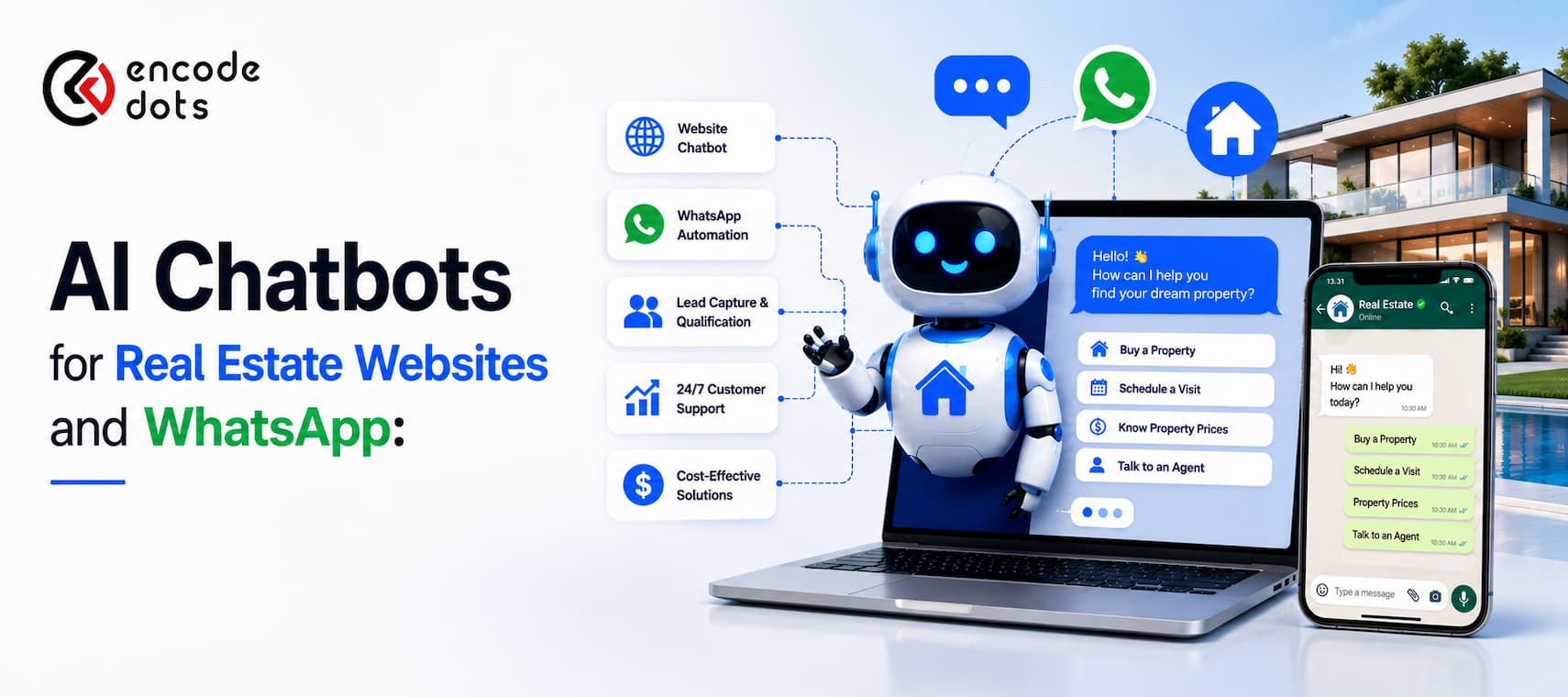
It recommends properties. Based on what someone tells it, budget, area, BHK it pulls matching listings from your inventory and shows them then and there. Think of it as a salesperson who has memorized every single unit you’ve got.
It captures leads without the awkward form. Instead of dumping a “Fill your details” box on people, it gathers the name and number naturally inside the chat. People hate forms. They don’t mind chatting.
It handles the same fifty questions you’re tired of answering. Price, possession date, parking, RERA number, loan eligibility, distance from the highway, the bot answers all of it instantly, which frees your humans to do actual selling.
It books the site visit or call right inside the conversation, syncing to your calendar. This one’s underrated. The faster you lock a visit, the more likely it actually happens.
And critically, everything flows into your CRM automatically, plus it can carry the conversation over to WhatsApp, which, let’s be honest, is where Indian buyers actually live. More on WhatsApp in a second, because it deserves its own bit.
Oh, and the analytics. You’ll finally see which campaign is producing real conversations versus which one is just eating budget. That data changes Why you spend.
The WhatsApp Piece Is the One That Converts
If I had to pick the single most valuable channel for a real estate chatbot, it’s not your website; it’s where your customers are already having conversations.
Think about your own habits. An email sits unread for days. A missed call gets ignored. But a WhatsApp message? You open it. Almost reflexively. That’s why a WhatsApp chatbot is so powerful for property: it meets people exactly where their attention already is.
What makes it click for real estate specifically is the media. In one tap, the bot can send a brochure, a floor plan, a Google location pin, the price sheet, or even a video walkthrough. No more “let me email that to you, sir,” and then losing the thread.
And property buying is slow. Nobody sees a flat on Monday and books it on Tuesday. The deal lives in the follow-up, the gentle nudge two weeks later, the “this configuration just got a price revision” message, and the new-launch alert. A WhatsApp bot keeps that relationship warm without your team manually setting reminders they’ll inevitably forget. Booking confirmations, visit reminders, document checklists, construction updates, all of it runs on autopilot and, frankly, makes a small builder look as organized as a big one.
Want to automate your Real Estate inquiries on WhatsApp?
Start using an AI chatbot that replies instantly, qualifies leads, and books site visits automatically.
Talk to Our Experts Now!Where It Earns Its Keep, Real Situations
Let me make this concrete instead of theoretical, because that’s Why you’ll actually judge whether it’s for you.
Someone clicks your Meta ad at midnight. Normally, that lead just… sits there till morning. With a bot, they’re greeted instantly, asked what they’re after, shown matching options, and booked for a visit while they’re still warm and excited. That’s the difference between a lead and a deal.
Or you run a launch campaign, and suddenly four hundred people hit your site in two days. No human team on earth can talk to all of them live. The bot can. Every single one, at the same time, without dropping a thread.
Or the classic time-waster filter: instead of your salesperson spending twenty minutes on a call only to discover the guy’s budget is half your entry price, the bot figures that out in three messages. Your team only ever talks to people worth talking to.
These aren’t hypotheticals. This is just Tuesday for businesses using this stuff well.
Why It Actually Flows, Start to Finish
People always ask me to explain the “journey,” so here it is in plain terms.
A visitor shows up from an ad, a search, a forwarded link, whatever. The bot says hello and offers to help find them something. It asks a few natural questions: budget, location, BHK, and when they’re looking to move. Based on that, it suggests the right properties with photos and the key details. Somewhere in that friendly back-and-forth, it picks up their name and number. All of that drops straight into your CRM, neatly tagged. And then the follow-up engine kicks in, nurturing the lead with timed messages until either they’re ready to buy or a human jumps in at the perfect moment to close.
Clean. No data entry. No leads rotting in a spreadsheet someone forgot to check.
Not All Bots Are the Same Three Flavors
Quick reality check, because vendors love to blur this.
Rule-based bots are the cheap, button-driven kind. Fine for basic FAQs, terrible the moment someone goes off-script. I’d only use one for the simplest needs.
AI-powered bots understand free typing, handle messy real questions, and actually converse. More capable, more flexible, but they need proper setup and training to shine.
Hybrid bots mix both: structured flows for predictable stuff like booking a visit, and AI for the open-ended questions. For most real estate businesses, honestly, this is the sweet spot. You get reliability where you need it and intelligence where it counts.
What It Plugs into
A chatbot is only as good as what it connects to. At a minimum, you want it embedded on your website homepage, project pages, and landing pages. Then, the WhatsApp Business API connection, so conversations continue where buyers prefer. Then your CRM, so nothing gets lost. And if you’re running social campaigns, hook it into Messenger and Instagram DMs too, because leads come from everywhere now, not just your site.
The rule of thumb: every channel you leave disconnected is a place that leads quietly to leak out of.
Now, the Money Question
Everyone wants a number, and I get it. But the honest answer is “it depends,” and here’s what it actually depends on.
Features drive cost more than anything. A basic FAQ bot is cheap. One with AI recommendations, multiple languages, and CRM sync costs more because it’s doing more.
Integrations add up, too. Connecting WhatsApp, a CRM, and ad platforms involves setup work and sometimes ongoing API fees (WhatsApp itself charges per conversation in many cases).
And the AI level matters; a simple rule-based bot sits at the bottom of the range, a genuinely smart conversational assistant at the top.
On Why you pay, you’ve basically got three models. A monthly subscription is the most common way you rent a platform, pay a recurring fee, often tiered by conversation volume. Easiest entry point for small and mid-size players. One-time Development means a custom build: higher upfront cost, but you own it and skip recurring platform fees. And usage-based, where you pay per conversation or message, so the cost scales with actual volume.
My practical advice after watching a lot of businesses do this: don’t pay for advanced AI you won’t use in year one. Start with your genuine must-haves, prove it works, then scale. I’ve seen people buy the enterprise package and use 10% of it.
The CRM Behind Your Chatbot: Ready-made or Custom?
This is where most people get confused.
Your chatbot is what your customers interact with. It answers questions, captures leads, and starts conversations.
But what actually powers everything behind the scenes? That’s your CRM.
Every lead your chatbot captures, every follow-up, every deal stage, it all depends on Why your CRM is set up. So choosing the right one isn’t a small decision. It directly impacts Why well your chatbot performs.
A ready-made CRM is the plug-and-play option. You can get started quickly, the cost is predictable, and the setup is straightforward. For many teams, this is the fastest way to go live. But there’s a trade-off: you’ll need to adjust your sales process to fit the system. Not everything will match Why your team naturally works.
A custom CRM, on the other hand, is built around your business. Your workflow, your pipeline, your logic, everything is Designed to fit exactly Why you operate. It also allows deeper integration with your chatbot, so the entire experience feels smooth and connected. The downside? It takes more time to build and requires a higher upfront investment.
So which one should you choose?
If you’re starting or running a small real estate agency, a ready-made CRM makes more sense. It helps you move fast without overcomplicating things.
But if you’re scaling, handling multiple projects, larger teams, and more complex follow-ups, a custom CRM becomes a smarter investment. At that stage, trying to force your process into a rigid system can slow you down more than building the right one.
There’s no one-size-fits-all answer here. The right choice depends on where your business is today and Why you plan to grow.
Explore the Insight: Best real estate Lead Management Software
The Parts Vendors Won’t Mention
Let me balance the sales pitch, because I’d rather you go in clear-eyed.
Setup isn’t instant. Wiring the bot to your site, WhatsApp, and CRM takes planning and a bit of technical effort. Anyone promising “live in five minutes with full integration” is overselling.
The bot needs training. It has to learn your projects, your pricing, and the way your buyers actually talk. Feed it lazily, and it’ll perform lazily. Garbage in, garbage out, same as everything else.
It needs maintenance. Inventory changes, questions evolve, and a bot left untouched for six months slowly drifts into giving wrong answers. Treat it as a living thing, not a one-time install.
And data privacy is real. You’re handling people’s contact details and their financial intentions. Store it securely, respect the rules. This isn’t optional, and it isn’t just legal box-ticking; it’s trust.
None of these are reasons to skip a chatbot. They’re just reasons to do it properly and with someone who knows what they’re doing.
A Few Things That Separate a Good Bot from an Annoying One
Keep it simple. Don’t drown people in options and walls of text. Short, clear, friendly. Nobody wants to read a paragraph from a chat window.
Make it personal. Use the person’s name, tailor suggestions to what they actually said. The difference between “Here are our properties” and “Based on your 80-lakh budget near Whitefield, here are three options” is the difference between robotic and helpful.
Always, always give people a way to reach a human. Some buyers want a real voice, and if your bot traps them in a loop, you’ve just annoyed your hottest lead. Make the handoff effortless.
And review it regularly. Read the chat transcripts. See where the bot fumbled, where people dropped off, and what they kept asking that it couldn’t answer. Then fix it. A chatbot gets better only if you pay attention to it.
Wrapping Up
Real estate has always been about relationships. What’s changed is that the relationship now begins the second someone clicks your ad, often long before a human says a word. An AI chatbot lets you own that first moment instead of losing it to a phone on silent.
Recommendations, instant answers, site-visit booking, CRM sync, WhatsApp follow-ups done well, the whole thing works like your most dependable pre-sales person. One who never sleeps, never forgets to follow up, and never lets a midnight inquiry go cold. In a market where the fastest, smartest responder tends to win, that’s not a nice-to-have. It’s an edge.
If you’re tired of watching good leads slip through the gap between “interested” and “someone replied,” that’s exactly the gap this closes.
Want to plug that leak in your pipeline? Let’s build you a smart chatbot that turns every website visitor and WhatsApp message into a booked site visit.