Web App Development
  Cloud App Development
  Front-End Development
  Cross Platform Development
  MVP Development
  Application Modernization
  PWA Development
  SaaS Application Development
  Software Development Outsourcing
  Offshore Custom Software Development
  Full Stack Software Development
  Custom Software Development
  Enterprise Software Development
  Cloud Computing Solutions
  Cloud Development
  Managed Cloud Services
  Cloud Native Development
  AI Consulting
  Machine Learning Development
  LLM Development
  AI Chatbot Development
  Data Analytics
  CI CD Development
  Digital Transformation
  Dev Ops
  Content Development
  Blockchain Development
  Web Development
  Web Design



 Generative AI
  Large Language Model
  AI Chatbot
  AngularJs
  ReactJS
  Dotnet Core
  Android
  iPhone
  Swift
Swift  E-Commerce
  NopCommerce
  BigCommerce
  Laravel
  Yii
Yii  AWS
AWS  Google Cloud
  Azure DevOps
  Automation Testing
  Security Testing
  API Testing
  Functional Testing
  MEAN Stack
  MERN Stack
  Full Stack Developers
  biz.encodedots
  biz@encodedots.com
  +91 99747 42737


- Why Generic AI Tools Fail Businesses
- What Is RAG?
- What Is Fine-Tuning?
- The Real Question
- RAG vs Fine-Tuning
- The Real Power Move
- How to Choose: A Decision Framework
- Industry Use Cases
- Legal & Professional Services
- Customer support, Almost Anywhere
- Cost Breakdown
- Use Either The Part Most Experts Ignore
- Common Mistakes to Avoid
- Future Trends
- Turn AI Into Measurable Business Impact with EncodeDots
- The Bottom Line
- Frequently Asked Questions
Most companies pick the wrong one. Not because the teams are careless, but because the question gets framed badly from the start. Someone in a meeting says, “Let’s fine-tune a model on our data,” everyone nods, and six weeks later, the project is bleeding budget on something that should have been a two-week RAG build.
So before you commit engineering hours or sign off on a vendor quote, you need to understand the real difference between RAG vs fine-tuning, not the textbook version, the business version. This guide walks you through both approaches, when each one actually wins, what they cost, and the decision framework we use with clients before we write a single line of code.
If you only remember one thing: RAG and fine-tuning solve different problems. Mixing them up is where the money goes to die.
Why Generic AI Tools Fail Businesses
Off-the-shelf tools like ChatGPT are brilliant generalists. That’s exactly the problem.
A general model knows a little about everything and nothing about your business. Ask it about your refund policy, and it invents one. Ask it about a product you launched last quarter, and it has no idea the product exists. Ask it to write in your brand voice, and you get the same polished, slightly-too-eager tone every other company is now drowning in.
There are three places where generic AI consistently lets businesses down:
- Private knowledge. It can’t see your contracts, support tickets, internal wiki, or product catalog. So it guesses, and guesses confidently.
- Freshness. Its knowledge stops at a training cutoff. Your business changes weekly.
- Behavior. It won’t reliably follow your formatting rules, your tone, or your domain-specific way of doing things without heavy prompting every single time.
RAG and fine-tuning are the two main ways to close these gaps. They just close different gaps.
What Is RAG? (Retrieval-Augmented Generation)
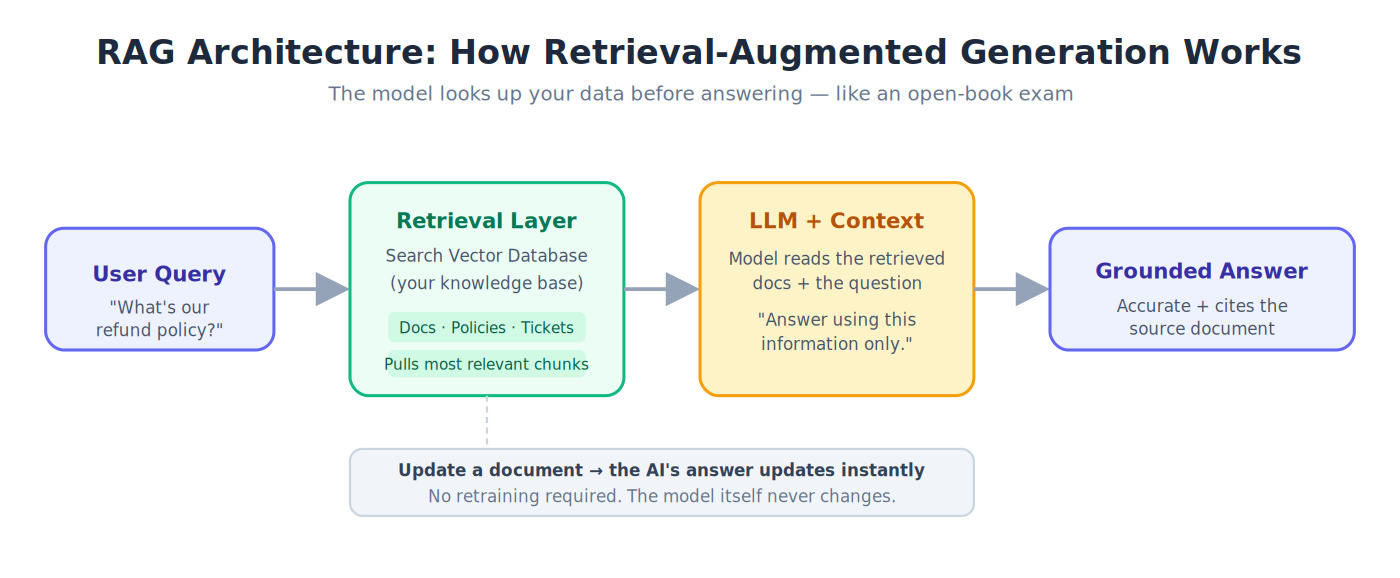
RAG is the approach where you connect a language model to your own knowledge base and let it look things up before answering.
Here’s the plain-English version. When a user asks a question, the system first searches your documents, policies, manuals, past tickets, product data, whatever you’ve loaded, and pulls out the most relevant pieces. It then hands those pieces to the model along with the question and says, in effect, “answer using this.” The model reads the supplied material and responds.
Think of it like the difference between a closed-book exam and an open-book exam. Fine-tuning is the closed-book student who memorized everything in advance. RAG is the open-book student who’s allowed to flip to the right page mid-question. For most business facts, you want the open-book student because the textbook keeps changing.
RAG is the right call when you need:
- Answers grounded in your specific information
- Knowledge that updates often (prices, policies, inventory, docs)
- Citations and traceability (“where did this answer come from?”)
- A fast, lower-cost way to get value out the door
The key thing to understand: RAG doesn’t change the model itself. You’re not retraining anything. You’re giving a smart model the right reading material at the right moment. Update a document, and the AI’s answer updates instantly, no retraining, no waiting.
What Is Fine-Tuning?
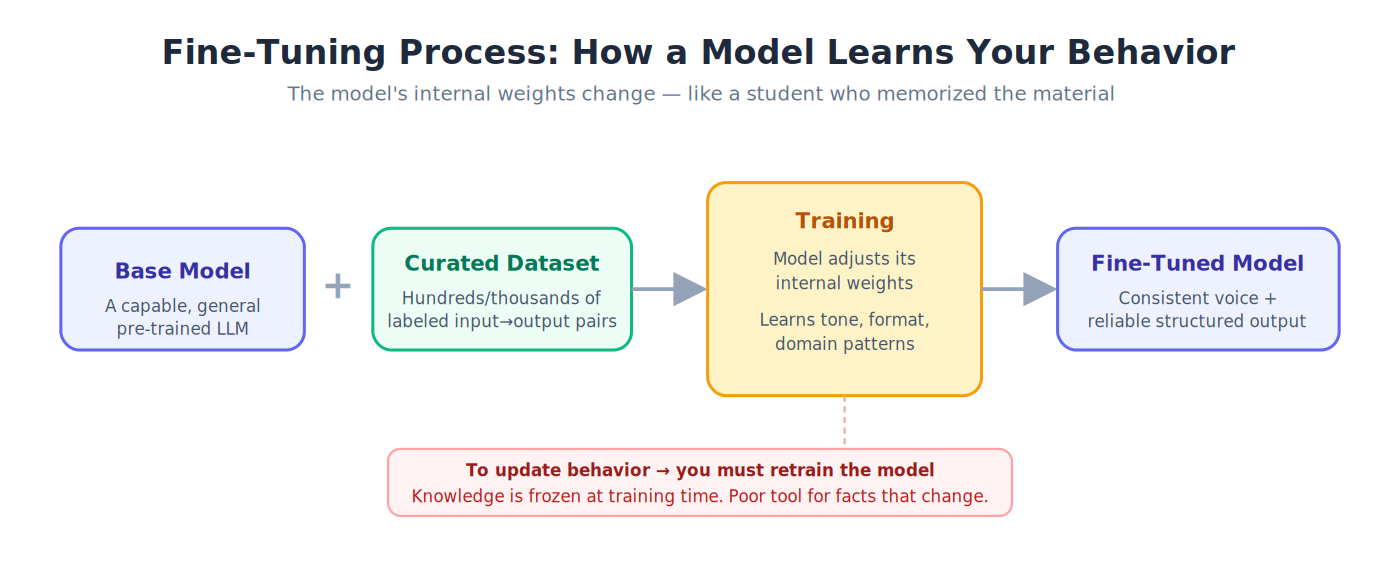
Fine-tuning means actually retraining a model on your own examples so its behavior changes.
You take a base model and continue training it on a curated dataset, hundreds or thousands of examples of the inputs and the outputs you want. Over that process, the model adjusts its internal weights and “learns” your patterns: your tone, your formatting, your way of classifying things, your domain’s particular logic.
Back to the exam analogy, fine-tuning is the student who studies so hard that the material becomes second nature. They don’t need to look anything up because the way of thinking is baked in. That’s powerful for skill and style. It’s useless for facts that change tomorrow, because what’s memorized today is stale next month.
Fine-tuning earns its keep when you need:
- A consistent voice, tone, or persona across thousands of outputs
- Reliable structured output (always returning the same format)
- A specialized task, the base model handles clumsily (niche classification, domain-specific reasoning)
- Shorter prompts and lower latency, because the behavior is built in instead of explained every time
The trade-off: it requires good training data, costs more upfront, and updating it means retraining. Fine-tuning teaches a model how to act. It’s a poor tool for teaching it what’s currently true.
The Real Question: What Does Your Business Need?
Before looking at costs or comparison tables, ask yourself one simple question about the problem you are trying to solve:
Is the AI giving wrong or outdated answers because it does not have access to the right information? Or is the AI giving the right information, but in the wrong tone, format, or structure?
If the issue is missing or outdated information, your AI does not know your latest pricing, your product specs, your policy updates, your case history, which is a knowledge problem, and RAG is built to solve it.
If the issue is behaviour, the AI gives inconsistent responses, does not follow your required format, uses the wrong tone for your brand, or struggles with a specialised classification task that is a behaviour problem, and fine-tuning is built to solve it.
Many businesses assume they need fine-tuning when what they actually have is a knowledge problem that RAG solves faster and at a lower upfront cost. This is one of the most common and most expensive misdiagnoses in AI projects.
RAG vs Fine-Tuning: The Comparison That Actually Matters
Here is how the two approaches compare across the factors that matter most to a business decision-maker.
| Factor | RAG | Fine-Tuning |
| What it changes | The information the model can access | How the model behaves and responds |
| Best for | Facts, knowledge, up-to-date info | Tone, format, specialized skills |
| Setup time | Days to a few weeks | Weeks to months (data prep dominates) |
| Upfront cost | Lower | Higher |
| Updating it | Edit a document instantly | Retrain the model slowly |
| Data needed | Your existing documents | Curated labeled examples (hundreds+) |
| Handles fresh data | Yes, natively | No knowledge is frozen at training time |
| Citations/sources | Yes, can point to source docs | No, answers come from “memory.” |
| Hallucination risk | Lower (grounded in real docs) | Still present for facts |
| Maintenance burden | Keep documents current | Re-run training as needs change |
Read that table twice. Notice that almost everything a business worries about day-to-day, accuracy, freshness, traceability, speed to launch, cost control, leans toward RAG. That’s not an accident, and it’s why we steer most first projects there.
Fine-tuning’s column wins on a narrower but real set of needs: behavior, consistency, and specialization. When those are your bottlenecks, nothing else comes close.
Trying to decide between RAG and fine-tuning for your business?
EncodeDots can assess your use case and recommend the right approach.
Book a Free Consultation!The Real Power Move: Combining RAG + Fine-Tuning
Here’s what the “vs” framing hides: the most capable systems we build aren’t either/or. They’re both.
Picture a customer-support assistant for an insurance company. It needs to sound a precise way (regulated, careful, on-brand) and it needs to know current policy details that change constantly. Fine-tune the model for the tone and the structured, compliant response style. Layer RAG on top for the live policy data. The fine-tuning controls how it speaks; RAG controls what it knows.
That’s the hybrid pattern, and for serious production deployments it’s increasingly the real answer rather than a luxury. You don’t have to start there; most teams shouldn’t. But know that the door is open, and a good RAG foundation makes adding fine-tuning later far easier than the reverse.
(And yes, there’s a fourth option: building a model from scratch. For 99% of businesses, don’t. The cost runs into millions, and the use cases that justify it are rare. We mention it only so you can confidently cross it off your list.)
Thinking through which approach fits your situation? This is exactly the conversation EncodeDots has with companies before scoping any custom AI build, mapping the actual problem to the right architecture, so you don’t overspend on the wrong one.
How to Choose: A Decision Framework
Forget the technology for a second and answer these questions about your problem. The answers point you to the approach.
1. Is the core issue that the AI doesn’t know something? Missing facts, outdated info, and no access to your private data, RAG.
2. Is the core issue that the AI doesn’t behave the way you need? Wrong tone, inconsistent format, fumbles a specialized task: Fine-tuning.
3. Does your information change often? Weekly or faster RAG, full stop. Don’t fine-tune things that go stale.
4. Do you need to show users where an answer came from? Compliance, legal, medical, and financial contexts RAG, because it can cite sources.
5. Do you already have hundreds of clean input-output examples? No fine-tuning will be slow and expensive to even start. Lean RAG. Yes, fine-tuning becomes viable if questions 1–4 point there.
6. Is it both knowledge and behavior? Hybrid. Start with RAG, add fine-tuning once the knowledge layer is solid.
A simple rule of thumb we share with clients: start with RAG, fine-tune only when RAG hits a wall. RAG is faster, cheaper, and easier to maintain. Reach for fine-tuning when you’ve proven that retrieval alone can’t deliver the behavior you need, not before.
How This Decision Plays Out Across Industries
To make this less abstract, here is how the RAG vs fine-tuning decision typically plays out in three different industries.
Healthcare
A healthcare provider wants an AI assistant that helps clinical staff quickly find information from patient records, treatment protocols, and the latest research.
This is overwhelmingly a knowledge problem. Treatment guidelines update regularly, patient records change daily, and the organisation needs every answer traceable back to its source for clinical and compliance reasons. RAG is the natural fit it allows the AI to stay current with the latest protocols and research without requiring retraining every time a guideline changes, while keeping sensitive data within the organisation’s own systems rather than embedding it into model parameters.
Where fine-tuning might enter the picture: if the organisation later finds that the AI’s responses need to consistently follow a specific clinical documentation format across every interaction, a fine-tuning layer on top of the RAG system could enforce that structure. But the starting point and for many organisations, the full solution is RAG.
Note: Any AI system deployed in a healthcare environment must be assessed against applicable data privacy regulations such as HIPAA or GDPR, depending on region. Compliance requirements should be validated with legal and compliance teams before deployment.
Real Estate
A real estate agency wants an AI assistant that can respond to buyer and seller enquiries, answer questions about current listings, and draft property descriptions.
This is largely a knowledge problem with a behaviour component. Listings change constantly new properties, price updates, status changes — so the AI needs access to current data, making RAG essential for keeping the assistant accurate. At the same time, the agency likely wants every property description and client response to consistently match its brand voice, which is a behaviour requirement.
In practice, this often becomes a hybrid setup: RAG keeps the assistant grounded in current listings and market data, while a lighter fine-tuning pass (or even well-crafted prompt instructions in the early stages) ensures consistent tone across responses and descriptions.
Manufacturing
A manufacturing business wants an internal assistant that helps engineers and operations staff quickly find information across equipment manuals, maintenance logs, supplier specifications, and safety regulations.
This is a textbook knowledge problem. The information already exists it is just scattered across thousands of documents that are slow to search manually. RAG connects the assistant to this documentation library, allowing staff to ask plain-language questions and get answers grounded in the actual manuals and logs, with no need to retrain anything as documentation is updated.
Fine-tuning would only become relevant here if the business later wanted the assistant to perform a specific, repeated task at high volume for example, automatically classifying incoming maintenance reports into standardised categories across hundreds of records per day. Even then, RAG would likely remain the foundation, with fine-tuning added as a narrow enhancement.
Legal & Professional Services
Firms need documents drafted in a consistent house style, which is a fine-tuning problem. But every clause must also reflect current case law and client-specific context, which is RAG. Combine both, and you get a classic hybrid system that balances consistency with accuracy.
Customer support, Almost Anywhere
The interaction style is predictable and can be fine-tuned for consistency and brand tone. However, the knowledge layer policies, product details, pricing, and user-specific data change frequently. Most effective support systems are hybrid, but if you’re starting today, RAG will deliver the majority of value quickly, with fine-tuning layered in later.
Notice the pattern? Industries driven by fast-changing information naturally lean toward RAG. Industries where communication style, structure, and compliance matter most lean toward fine-tuning. In reality, most businesses operate somewhere in between, and that’s where hybrid systems deliver the best results.
Cost Breakdown
Numbers vary wildly with scope, data volume, and how clean your information already is, so treat these as ballpark planning figures, not quotes. In our experience building these systems, the rough shape looks like this:
RAG
- Pilot / MVP: a focused build connecting a model to one knowledge source typically lands in the lower five figures, depending on data volume and integration complexity.
- Ongoing: you pay for model usage (per query), the vector database, and hosting. Operationally light. The recurring cost is keeping documents current, which is a process, not engineering.
Fine-Tuning
- Upfront: the real cost isn’t the training run, it’s the data preparation. Curating, cleaning, and labeling a quality dataset is where the hours go, and it’s easy to underestimate. Expect a meaningfully higher upfront investment than a comparable RAG build.
- Ongoing: lower per-query cost once deployed (shorter prompts), but every significant change means another training cycle, so budget for retraining, not just the first run.
Hybrid
- Roughly the sum of both, but staged. Start with the RAG cost, add the fine-tuning investment when you’ve validated the need. Spreading it this way protects your budget and your timeline.
The expensive mistake isn’t choosing RAG or fine-tuning. It’s choosing fine-tuning first, spending the big upfront number, and then discovering a two-week RAG build would have solved the actual problem.
When Not to Use Either The Part Most Experts Ignore
Sometimes the honest answer is: you don’t need RAG or fine-tuning at all.
- When clever prompting already works. If a well-written prompt with a few examples gets you 90% of the way there, ship that. Don’t build infrastructure to solve a problem that a paragraph can fix.
- When your data is a mess. RAG retrieves garbage if your documents are garbage. Fine-tuning learns garbage if your examples are garbage. Fix your data house before you build either. This is the single most common reason AI projects underdeliver.
- When the volume doesn’t justify it. If you’re answering ten questions a week, the engineering cost won’t pay back. Use an off-the-shelf tool.
- When you haven’t defined the problem. “We want AI” is not a use case. If you can’t write down the specific task and what a good output looks like, you’re not ready to build your scope.
- When you’re reaching for fine-tuning to fix a knowledge gap. This is the big one. Teams keep trying to fine-tune facts into a model. It’s the wrong tool, it goes stale, and it costs more. If the gap is knowledge, it’s RAG.
Knowing when not to build is what separates an AI strategy from an AI expense.
Common Mistakes to Avoid
- Fine-tuning for facts. Said it twice already. Saying it again because everyone does it anyway.
- Skipping data cleanup. Both approaches are only as good as the data underneath them. There are no shortcuts here.
- Building the complex thing first. Hybrid systems are powerful, and they’re also harder to debug. Earn your way up. Start simple.
- Ignoring maintenance. RAG documents drift out of date. Fine-tuned models drift out of relevance. Whatever you build, someone owns keeping it current. Decide who before launch, not after.
- No evaluation plan. If you can’t measure whether the AI is getting answers right, you can’t improve it, and you can’t trust it. Build the test set alongside the system.
Future Trends 2026 and Beyond
AI is no longer in its experimental phase; it’s becoming a core part of how businesses operate, compete, and scale. But the way AI systems are built today is already evolving.
If you’re planning to invest in AI, it’s not just about what works now; it’s about what will still work 12–24 months from now.
Here are the key shifts shaping the future of AI systems.
- RAG is getting smarter:- Retrieval methods are improving fast, better ranking, better handling of long and messy documents, better grounding. The gap RAG can’t currently cover keeps shrinking.
- Fine-tuning is getting cheaper:- Lighter-weight techniques are making it more accessible to mid-sized companies, not just enterprises with deep ML budgets. The “too expensive to bother” objection is fading.
- Hybrid becomes the default:- As both get easier, combining them stops being advanced and starts being standard practice for serious deployments.
- AI agents raise the stakes:- As businesses move from chatbots to agents that take actions, grounding (RAG) and reliable behavior (fine-tuning) both matter more because now the AI isn’t just talking, it’s doing.
The direction of travel is clear: these stop being an either/or decision and become two tools in a kit most companies will eventually use together.
Turn AI Into Measurable Business Impact with EncodeDots
Most AI initiatives don’t fail because of technology they fail because they don’t connect with real business workflows.
At EncodeDots, we bridge that gap.
We help you move beyond experiments and actually make AI work where it matters inside your operations, customer journeys, and decision-making processes. Whether you’re deploying models, building AI agents, or scaling across teams, we ensure everything is aligned with real business outcomes.
Our approach is simple: connect AI with your data, your systems, and your goals without adding complexity.
Built for Performance. Designed for Reality.
AI shouldn’t slow you down or increase operational overhead. That’s why our solutions are designed to deliver fast, reliable, and cost-efficient performance from day one.
We enable you to:
- Deploy AI models faster with optimized inference pipelines
- Integrate seamlessly with your existing tools and infrastructure
- Build intelligent agents that automate real business tasks
- Scale across cloud, hybrid, or on-prem environments without friction
No rigid systems. No unnecessary complexity. Just AI that works.
What You Actually Gain
- Faster decision-making with real-time AI insights
- Reduced operational costs through smart automation
- Improved customer experience with intelligent workflows
- Flexibility to choose and run the right models for your use case
- Full control over your AI lifecycle from development to deployment
Why EncodeDots?
Because we don’t treat AI as a feature, we treat it as a business capability.
We focus on building solutions that are not just technically strong but also practically useful. That means everything we create is aligned with how your business operates today and how it needs to scale tomorrow.
Scale Without Complexity
From startups to enterprises, EncodeDots helps you deploy AI with confidence. No over-engineering. No guesswork. Just clear, scalable systems designed to deliver results.
Because today, success isn’t about who uses AI.
It’s about who uses it with clarity, speed, and purpose.
The Bottom Line
RAG vs fine-tuning isn’t really a competition; it’s a diagnosis. RAG fixes what your AI knows. Fine-tuning fixes how your AI behaves. Get the diagnosis right, and the build is straightforward. Get it wrong, and you’ll spend months and a large budget solving the wrong problem.
For most businesses, the smart move is to start with RAG, prove the value quickly and cheaply, and reach for fine-tuning only when you’ve hit a wall that retrieval genuinely can’t solve. The companies that get this right aren’t the ones with the biggest AI budgets; they’re the ones who matched the approach to the actual problem.
If you’re weighing this decision and want a straight answer instead of a sales pitch, that’s the conversation we have at EncodeDots before scoping any build. We map your real problem knowledge, behaviour, or both to the right architecture, so your first AI investment is the one that pays back. Talk to our team, and we’ll tell you honestly which approach your business actually needs, even if the answer is “neither, yet.”