Web App Development
  Cloud App Development
  Front-End Development
  Cross Platform Development
  MVP Development
  Application Modernization
  PWA Development
  SaaS Application Development
  Software Development Outsourcing
  Offshore Custom Software Development
  Full Stack Software Development
  Custom Software Development
  Enterprise Software Development
  Cloud Computing Solutions
  Cloud Development
  Managed Cloud Services
  Cloud Native Development
  AI Consulting
  Machine Learning Development
  LLM Development
  AI Chatbot Development
  Data Analytics
  CI CD Development
  Digital Transformation
  Dev Ops
  Content Development
  Blockchain Development
  Web Development
  Web Design



 Generative AI
  Large Language Model
  AI Chatbot
  AngularJs
  ReactJS
  Dotnet Core
  Android
  iPhone
  Swift
Swift  E-Commerce
  NopCommerce
  BigCommerce
  Laravel
  Yii
Yii  AWS
AWS  Google Cloud
  Azure DevOps
  Automation Testing
  Security Testing
  API Testing
  Functional Testing
  MEAN Stack
  MERN Stack
  Full Stack Developers
  biz.encodedots
  biz@encodedots.com
  +91 99747 42737


- The Architecture That Actually Works
- Two Use Cases Worth Engineering Properly
- What This Actually Costs
- The Security Layer Nobody Configures Right
- When NOT to Do This
- Common Architecture Mistakes
- What's Coming
- Ready to Audit Your ERP for AI Integration?
- FAQ
Most enterprise ERPs were built to handle structured data invoices, purchase orders, and inventory counts. What they were never designed for is the 80% of business-critical information that lives outside rows and columns: vendor emails flagging a supply delay, financial commentary buried in a PDF, or procurement notes typed freeform into a text field.
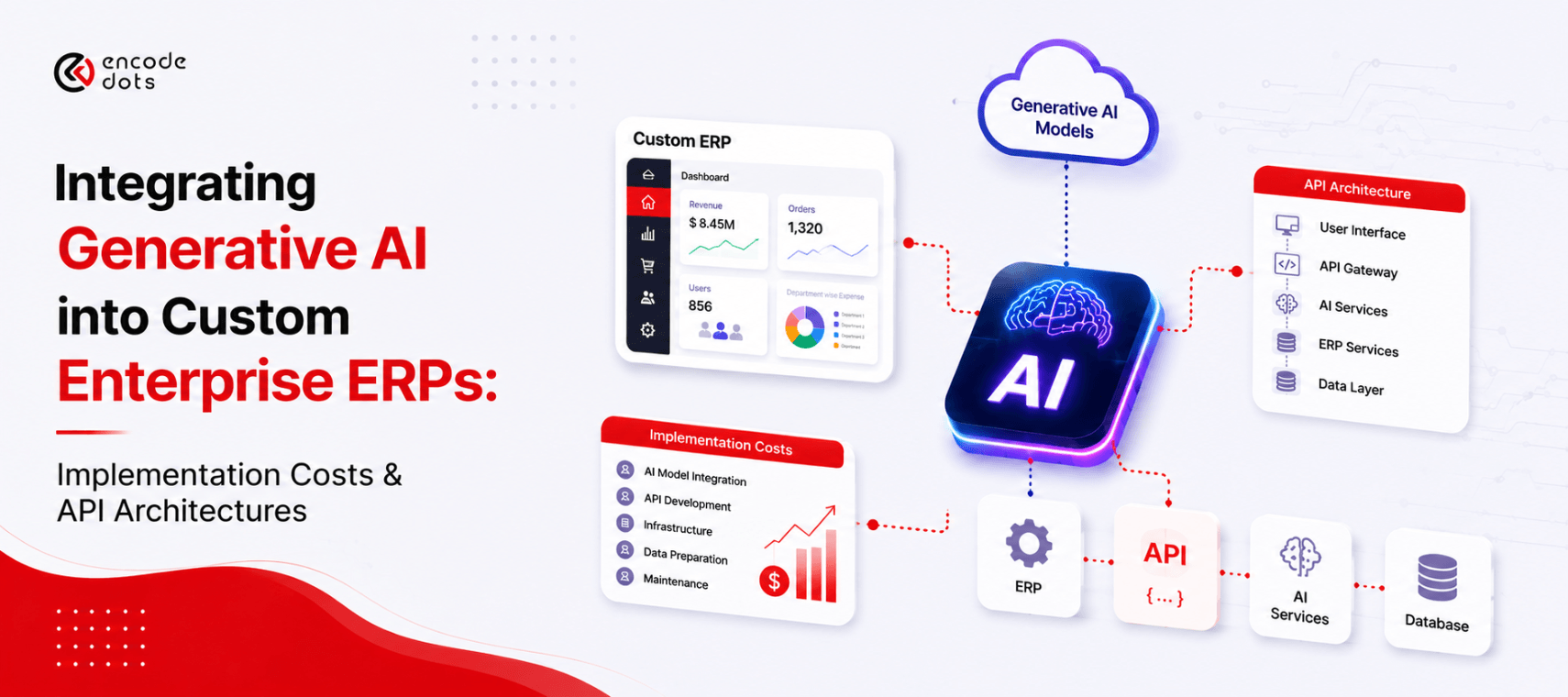
That gap is exactly where generative AI earns its keep. Integrating generative AI in enterprise software means building a layer that can read, reason over, and act on unstructured data without replacing your ERP’s transactional backbone.
To answer the question directly: GenAI modifies modern ERPs by adding a semantic reasoning layer on top of existing data infrastructure, enabling natural language querying, automated summarization, and predictive decision support, all without migrating your core database.
The Architecture That Actually Works
Forget the marketing version where you “plug an AI into your ERP.” Here’s what the real data flow looks like when a Fortune 500 ops team wants to query their supply chain in plain English:
ERP Database → Embedding Model → Vector Database → LLM Prompt → Secure UI
Each step matters. Here’s what happens at each node:
1. ERP Database (Source of Truth)
Your existing ERP, SAP, Oracle, Microsoft Dynamics, or custom-built system continues to handle transactional writes. The AI layer only reads. You extract relevant records, documents, and logs via API or scheduled ETL jobs.
2. Embedding Model
Text data from your ERP (financial summaries, vendor communications, warehouse notes) gets converted into numerical vectors using an embedding model, typically text-embedding-3-large from OpenAI or embed-english-v3.0 from Cohere. These vectors represent semantic meaning, not keyword matches.
3. Vector Database
Vectors are stored in a purpose-built database like Pinecone, Milvus, or Weaviate. When a user asks “which vendors have flagged delivery delays in the last 30 days?”, the query is also embedded, and a similarity search retrieves the most semantically relevant records rather than just keyword hits.
4. RAG Pipeline (Retrieval-Augmented Generation)
The retrieved context is packaged into a structured prompt and sent to an LLM GPT-4o, Claude 3.5 Sonnet, or a self-hosted Llama 3 variant. The model generates a response grounded in your actual ERP data. It doesn’t hallucinate because it’s not relying on training memory; it’s reasoning over what you fed it.
5. Secure UI Layer
Responses surface through a role-based interface. RBAC (Role-Based Access Control) ensures a warehouse manager doesn’t see CFO-level financial summaries. JWT tokens handle session authentication. HTTPS with TLS 1.3 encrypts everything in transit.
This is Retrieval-Augmented Generation (RAG), and it’s the architecture of choice for enterprise deployments where data accuracy is non-negotiable.
Two Use Cases Worth Engineering Properly
Automated Financial Summarization
A mid-market manufacturing company generates thousands of journal entries daily. Their CFO needs a morning briefing on cash flow, overdue receivables, and margin variance, not a raw export.
Here’s how it works in practice: The RAG pipeline pulls the last 24 hours of ledger entries, flags entries tagged as AR overdue or negative margin, and passes them to the LLM with a structured prompt template that enforces output format. The output is a 200-word executive summary, auto-generated and delivered via Slack or embedded directly in the ERP dashboard.
The edge cases that matter here: data drift (your account codes or categorization logic may shift over months, the embedding index needs to be updated in sync), and numerical hallucination (LLMs are not calculators; never let the model compute totals; compute in your backend and pass the result as context to the prompt).
EncodeDots handles both by building a validation layer that cross-checks LLM output against source database totals before any summary is surfaced to end users.
Intelligent Supply Chain Forecasting via Sentiment Analysis
A US logistics company receives 300+ vendor emails per week. Procurement managers can’t read all of them, and the ones flagging “partial shipment,” “port delays,” or “material shortage” get buried.
The AI layer ingests incoming vendor emails (via Gmail/Outlook API), runs sentiment scoring and delay-keyword extraction, and writes structured risk flags back into the ERP’s vendor table. Procurement managers see a real-time risk dashboard instead of an inbox.
This requires careful data modeling. Email threads need entity resolution matching “Smith & Co.” in an email to “Smith and Company LLC” in your vendor master. Fuzzy matching with a confidence threshold handles this without requiring perfect data hygiene.
The privacy concern here is real: vendor emails contain commercially sensitive terms. This is why the embedding and inference occur within a private VPC and are never routed through a public API endpoint.
What This Actually Costs
Enterprise leadership needs numbers before they greenlight a build. Here’s an honest breakdown for a mid-scale deployment serving 200–500 internal users:
| Cost Category | Component | Estimated Monthly Cost (USD) |
| Token/API Consumption | GPT-4o or Claude 3.5 Sonnet (input + output tokens) | $800 – $3,500 |
| Embedding Costs | OpenAI text-embedding-3-large at ~$0.13/1M tokens | $150 – $600 |
| Vector Infrastructure | Pinecone (pods) or Milvus on AWS EKS | $400 – $1,200 |
| Compute (Inference Hosting) | If self-hosted LLM (Llama 3 on A100 GPU) | $1,800 – $4,000 |
| RAG Pipeline Development | One-time build, amortized over 24 months | $600 – $1,400/mo |
| Fine-Tuning (Optional) | Domain-specific model adaptation, quarterly | $500 – $2,000/quarter |
| Maintenance & Monitoring | Index refresh, prompt tuning, model version upgrades | $300 – $700/mo |
Total operational range: $2,500 – $8,500/month depending on query volume, model choice, and whether you’re using hosted APIs or self-managed infrastructure.
One thing most vendors won’t tell you: token costs spike unpredictably at month-end when batch financial reports run. Budget for 1.4x your average monthly estimate to cover peak loads without throttling.
The Security Layer Nobody Configures Right
The #1 reason enterprise AI pilots get killed isn’t budget, it’s security sign-off. US enterprises, especially those under SOC 2, HIPAA, or FedRAMP obligations, have one hard requirement: company data cannot be used to train public models.
By default, the OpenAI API does not train on your data when accessed via API (not the free tier). But “by default” isn’t enough for a CISO.
Here’s what a proper security architecture looks like:
Option 1: Azure OpenAI Private Endpoints Deploy GPT-4o through Azure OpenAI Service with a private endpoint inside your Azure VNet. All traffic stays within Microsoft’s network. Data residency can be pinned to the US East or US West regions. Microsoft provides a Data Processing Agreement (DPA) that’s compatible with most enterprise compliance frameworks.
Option 2: Self-Hosted Open Source Models Deploy Llama 3.1 70B or Mistral Large on your own AWS or GCP infrastructure. No data leaves your cloud environment ever. The tradeoff is infrastructure cost and the engineering overhead of model management, but for industries like healthcare and financial services, this is often the only acceptable path.
Option 3: Anthropic Claude Enterprise API Anthropic’s Enterprise tier includes zero-data-retention guarantees at the API level. Useful when you need frontier model quality without the Azure dependency.
Regardless of the option, access should be gated through a middleware API layer that never exposes LLM credentials directly to the client application. The middleware handles authentication, rate limiting, PII redaction before prompts are sent, and audit logging for every query. That audit log is what your compliance team will ask for.
When NOT to Do This
Not every ERP needs a GenAI layer. If your primary data is already structured and queryable through standard BI tools, adding an RAG pipeline introduces latency and cost without proportional value.
Skip the AI integration if:
- Your reporting needs are fully covered by existing dashboards (Power BI, Tableau)
- Your user base is primarily data-entry operators, not decision-makers
- You have fewer than 5,000 documents/records, and a well-structured SQL query does the same job faster
- Your compliance environment prohibits any third-party data processing (some government contractors face this)
The right time to integrate is when unstructured data is creating decision bottlenecks, when your team is spending hours reading documents to extract insights that a properly architected system could surface in seconds.
Want this for your ERP?
EncodeDots has built RAG pipelines for manufacturing and financial ERPs. Let's talk about yours.
Schedule a Technical Discovery CallCommon Architecture Mistakes That Kill Enterprise AI Rollouts
1. Embedding the entire database
Don’t embed everything. Embed only the content your users will query in natural language. Embedding your entire transaction log adds noise, increases vector search latency, and inflates storage costs.
2. Not versioning your prompt templates
Prompts are code. When GPT-4o gets a model update, or you swap to a different LLM, unversioned prompts break outputs change silently without warnings. Treat prompt templates as versioned artifacts in your repo.
3. Skipping the re-ranking step
Vector similarity search returns the closest matches, not necessarily the most relevant ones. A re-ranking model (Cohere Rerank, cross-encoder models) runs a second pass to reorder results by actual relevance before they hit the LLM prompt. Skip this, and your financial summaries will occasionally include irrelevant context that confuses the model.
4. No fallback for low-confidence answers
If the retrieved context doesn’t contain enough information to answer a query, the LLM will hallucinate. Your pipeline needs a confidence threshold below a set similarity score; the system should return “Not enough data found” rather than an invented answer.
What’s Coming in 2026 and Beyond
Enterprise GenAI is shifting from single-turn Q&A to agentic workflows where the AI doesn’t just answer questions but executes multi-step tasks inside the ERP. Think: an AI agent that identifies an overdue vendor payment, checks the contract terms, drafts the escalation email, and logs the action without human intervention at each step.
The infrastructure for this exists today (LangGraph, AutoGen, CrewAI). The enterprise adoption curve is 18–24 months behind the tooling. Companies that architect their AI integration layer with agent-ready design patterns now clean API boundaries, structured output formats, and audit trails will be significantly ahead when they’re ready to deploy autonomous workflows.
Ready to Audit Your ERP for AI Integration?
Before committing to a vendor or architecture, what most enterprise teams actually need is a 90-minute technical scoping call walking through your existing ERP stack, data volumes, compliance requirements, and business objectives.
EncodeDots has built custom AI integration layers for ERPs across manufacturing, logistics, and financial services. We don’t sell a pre-packaged product; we architect the right solution for your infrastructure.
Schedule a Technical Scoping Call
Walk in with your ERP specs. Walk out with a clear architecture recommendation, realistic cost estimate, and a phased delivery plan your team can actually execute.