Web App Development
  Cloud App Development
  Front-End Development
  Cross Platform Development
  MVP Development
  Application Modernization
  PWA Development
  SaaS Application Development
  Software Development Outsourcing
  Offshore Custom Software Development
  Full Stack Software Development
  Custom Software Development
  Enterprise Software Development
  Cloud Computing Solutions
  Cloud Development
  Managed Cloud Services
  Cloud Native Development
  AI Consulting
  Machine Learning Development
  LLM Development
  AI Chatbot Development
  Data Analytics
  CI CD Development
  Digital Transformation
  Dev Ops
  Content Development
  Blockchain Development
  Web Development
  Web Design



 Generative AI
  Large Language Model
  AI Chatbot
  AngularJs
  ReactJS
  Dotnet Core
  Android
  iPhone
  Swift
Swift  E-Commerce
  NopCommerce
  BigCommerce
  Laravel
  Yii
Yii  AWS
AWS  Google Cloud
  Azure DevOps
  Automation Testing
  Security Testing
  API Testing
  Functional Testing
  MEAN Stack
  MERN Stack
  Full Stack Developers
  biz.encodedots
  biz@encodedots.com
  +91 99747 42737


- What Is a Travel Booking App?
- Why Businesses Are Investing in Travel Apps
- Types of Travel Booking Apps
- What Determines Development Cost?
- Cost Breakdown by Project Type
- Essential Features & Their Cost Impact
- AI Features That Add Business Value
- Travel APIs & Third-Party Integrations
- Development Timeline
- Choosing the Right Technology Stack
- Hidden Costs You Shouldn't Ignore
- MVP vs Full-Scale Platform
- In-House vs Freelancer vs Development Company
- How to Reduce Development Costs
- Real-World Cost Scenarios
- ROI & Revenue Models
- Common Mistakes That Increase Budget
- Future Trends
- How to Choose the Right Development Partner
- Conclusion
- FAQs
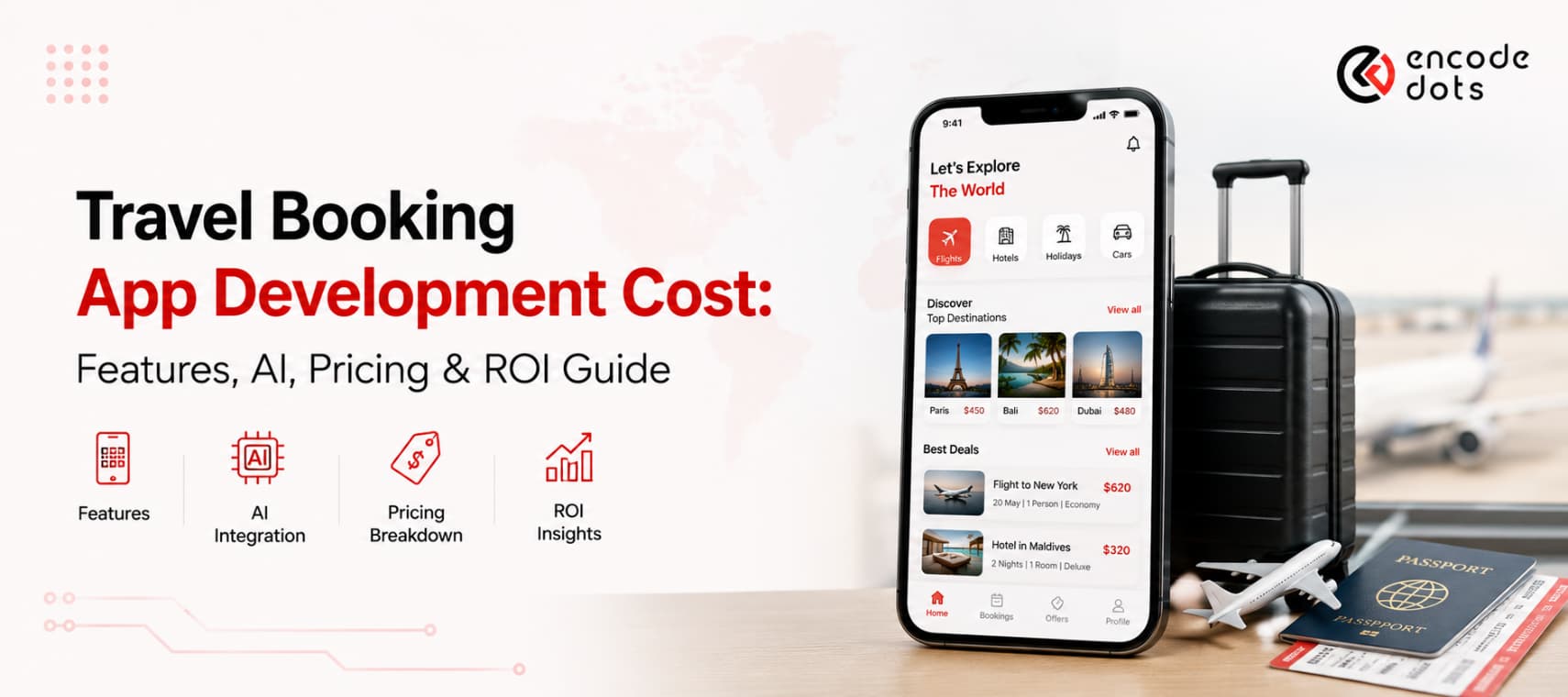
Launching a travel booking app isn’t just about listing hotels and flights; it’s about creating seamless travel experiences. From AI-powered itinerary planning to real-time pricing and secure payments, every feature impacts your development budget. So, how much should you really invest? This guide breaks down every cost, feature, and business decision to help you build a travel app that delivers long-term value, not unexpected expenses.
How much does travel booking app development cost? It depends on the app’s complexity, features, AI integrations, third-party APIs, supported platforms, and design requirements. A basic MVP costs significantly less than an enterprise-grade platform with AI-powered recommendations, real-time booking engines, and multi-vendor management. Planning features carefully is the best way to control costs while maximizing ROI.
What Is a Travel Booking App?
A travel booking app lets users search, compare, and book travel services flights, hotels, tours, rentals directly from their phone, usually with real-time pricing and instant confirmation.
- How it works: the app pulls live inventory and pricing from supplier APIs, lets users filter and compare options, processes payment, and issues a confirmed booking, often in under a minute.
- The customer journey typically runs: search → compare → select → pay → receive confirmation → manage or modify the booking later, all inside one app.
- Business benefits: direct customer relationships, repeat bookings, and data you actually own instead of renting visibility from a third-party marketplace.
- B2C vs. B2B travel apps: B2C apps serve individual travelers booking their own trips; B2B apps serve travel agents, corporate travel managers, or tour operators booking on behalf of others, and usually need bulk-booking and account-management features B2C apps don’t.
Key Takeaway: the app itself is simple to describe: search, compare, book, but each of those three steps hides most of the complexity (and cost) covered later in this guide.
Why Businesses Are Investing in Travel Apps
Travel has gone mobile-first almost everywhere; a growing share of bookings now start and finish on a phone rather than a desktop browser. That shift is exactly why standalone travel apps have become a serious business investment rather than a “nice to have.”
- Rising digital travel demand, with mobile increasingly the primary booking channel rather than a secondary one
- Mobile-first booking behavior, especially for last-minute and shorter-lead-time trips
- Customer convenience one app for search, booking, and trip management beats juggling emails and confirmation PDFs
- Personalized experiences that keep travelers coming back to your app instead of comparison-shopping elsewhere
- Higher direct bookings, which protect margins that would otherwise go to commission-charging marketplaces
- Reduced dependency on third-party marketplaces, giving you first-party customer data and a direct relationship
A note on statistics: travel industry figures (mobile booking share, market size, growth rates) shift often between reports. If you need a specific number for a business case, pull it directly from a current industry report rather than a recycled statistic. I don’t have live web access to verify current figures here.
Key Takeaway: the investment case for a travel app isn’t just “travel is going digital”; it’s specifically that owning the booking relationship protects margin and data that third-party platforms currently capture.
Types of Travel Booking Apps
- Flight Booking Apps best for airlines or OTAs focused purely on air travel search and booking
- Hotel Booking Apps best for hotel chains, property managers, or accommodation-focused OTAs
- Vacation Rental Apps best for platforms connecting property owners with travelers for short-term stays
- Tour & Activity Booking Apps best for tour operators and destination experience providers
- Car Rental Apps best for rental fleets or aggregators managing vehicle availability and pricing
- Cruise Booking Apps best for cruise lines or specialized cruise travel agencies
- Corporate Travel Apps best for businesses managing employee travel, approvals, and expense policies
- All-in-One OTA Platforms best for businesses aiming to be a one-stop shop across flights, hotels, and activities
Key Takeaway: the broader your app tries to be on day one, the more it costs and the longer it takes. Most successful platforms start with one category and expand once it’s proven.
What Determines Travel Booking App Development Cost?
- App complexity: the number and sophistication of features you’re building
- Number of platforms: iOS only, Android only, or both, plus web
- UI/UX design depth: templated design versus fully custom, branded experiences
- Backend architecture: how much custom logic sits behind search, pricing, and booking
- APIs: how many third-party integrations you need and how well-documented they are
- AI features: recommendation engines, chatbots, and dynamic pricing all add real engineering time
- Security requirements: payment handling and personal data protection aren’t optional extras
- Scalability needs: building for 1,000 users versus 1,000,000 users changes architecture decisions early
- Team location: onshore, nearshore, and offshore rates vary significantly
- Compliance requirements: payment regulations and regional data protection laws add scope
Key Takeaway: cost isn’t a single number; it’s the sum of 10 separate decisions, and changing any one of them can substantially affect your budget.
Travel Booking App Development Cost Breakdown
| App Type | Estimated Timeline | Complexity | What’s Typically Included |
| MVP | 2–4 months | Low | Core search and booking for one travel category, basic payments, minimal admin panel |
| Standard Booking App | 4–6 months | Medium | Multiple filters, user accounts, reviews, standard admin dashboard, one or two integrations |
| Multi-Service Travel Platform | 6–9 months | High | Multiple travel categories (e.g., flights + hotels), vendor management, richer personalization |
| Enterprise OTA Platform | 9–12+ months | Enterprise | Multi-vendor marketplace, AI features, advanced analytics, high scalability, compliance layers |
Key Takeaway: Most businesses overestimate what they need for version one. Matching your build to the row above that fits your actual current stage saves both time and budget.
Essential Features & Their Cost Impact
User-Facing Features:
- Registration & Social Login: reduces signup friction, directly affects conversion rates
- Search & Filters: the core of the experience; poor filtering is a top reason users abandon travel apps
- Booking Engine: the technical heart of the app; complexity here scales with how many travel types you support
- Secure Payments: non-negotiable, and a meaningful chunk of both build cost and ongoing compliance work
- Booking History: builds trust and supports repeat bookings
- Push Notifications: drives re-engagement for price drops, reminders, and confirmations
- Reviews: supports purchase decisions and builds platform credibility
- Wishlists: supports longer consideration cycles typical in travel planning
- Multi-language & Multi-currency: essential for any app targeting international travelers
- Maps: critical for hotels, tours, and rentals where location is a primary decision factor
- Customer Support: in-app chat or support ticketing reduces churn from unresolved issues
- Cancellation & Refunds: a top source of support tickets if not designed clearly upfront
Admin-Facing Features:
- Dashboard: the operational control center for the whole platform
- Vendor Management: essential for any multi-supplier or marketplace model
- Booking Management: handling modifications, cancellations, and disputes at scale
- Payment Reports: financial visibility and reconciliation
- User Management: support, moderation, and account administration
- Promotions: discount codes, seasonal offers, and loyalty incentives
- Analytics: the data layer that informs every future feature decision
Key Takeaway: user-facing features win customers, but under-investing in admin features is what makes a platform painful to actually run at scale.
AI Features That Add Business Value
| AI Feature | Business Benefit |
| AI Travel Recommendations | Increases booking conversion through relevant suggestions |
| Smart Trip Planner | Reduces planning friction, increases time spent in-app |
| Personalized Itineraries | Differentiates the app from generic search-and-list competitors |
| AI Chatbot | Reduces support costs while improving response time |
| Dynamic Pricing Suggestions | Helps vendors optimize pricing for demand in real time |
| Fraud Detection | Reduces chargebacks and protects payment integrity |
| Predictive Travel Insights | Supports better inventory and marketing decisions |
| Voice Search | Improves accessibility and convenience for on-the-go users |
| AI Review Summaries | Speeds up decision-making for users comparing many options |
| Customer Segmentation | Enables more effective, targeted marketing campaigns |
Key Takeaway: AI features are genuinely valuable, but they’re also where scope creep hides most easily. Pick the two or three that map directly to a business metric you’re trying to move, not all ten at once.
Travel APIs & Third-Party Integrations
- Flight APIs for live schedules, pricing, and seat availability
- Hotel APIs for property inventory, rates, and availability
- Maps for location display, directions, and proximity search
- Weather for trip planning context and traveler alerts
- Payment Gateways for secure, compliant transaction processing
- SMS for booking confirmations and alerts
- Email for confirmations, itineraries, and marketing
- CRM for managing customer relationships and support history
- Analytics for tracking user behavior and business metrics
- Currency Exchange for accurate multi-currency pricing
- Calendar Sync so bookings land directly on a user’s personal calendar
Every integration you add isn’t a one-time cost; most carry ongoing subscription fees and require monitoring, since a single API change on the vendor’s side can break a booking flow without warning.
Key Takeaway: integrations are where travel apps get their real functionality, but also where ongoing maintenance costs quietly accumulate; budget for upkeep, not just initial setup.
Travel App Development Timeline
Discovery → Planning → Wireframes → UI/UX Design → Development →
API Integration → Testing → Deployment → Launch → Maintenance
- Discovery: understanding your market, users, and competitive landscape
- Planning: translating goals into a concrete feature roadmap and technical plan
- Wireframes: structural layouts before visual design begins
- UI/UX Design: the full visual and interaction design of the app
- Development: the core build phase, typically run in sprints
- API Integration: connecting flight, hotel, payment, and other third-party services
- Testing: functional, security, and performance QA across the booking flow
- Deployment: preparing and releasing the app to app stores and production infrastructure
- Launch: going live, with close monitoring in the first days and weeks
- Maintenance: the ongoing phase that never really ends
Key Takeaway: API integration and testing are the two phases most often underestimated in travel apps specifically, because booking flows touch money and real-time data; budget extra time for both.
Choosing the Right Technology Stack
- Frontend: Flutter, Swift, Kotlin, React Native
- Backend: Node.js, Laravel, .NET
- Database: PostgreSQL, MongoDB, Firebase
- Cloud: AWS, Azure, Google Cloud
For startups, cross-platform frameworks like Flutter or React Native are usually the pragmatic choice; one codebase covering iOS and Android keeps early costs down while you validate the business. For enterprise platforms, native development (Swift for iOS, Kotlin for Android) often makes more sense once you need deep platform-specific performance, complex offline handling, or tight integration with device-level features.
Key Takeaway: the “best” stack is the one that matches your current stage, not the one with the most impressive name cross-platform for speed and validation, native for scale and polish.
Hidden Costs You Shouldn’t Ignore
- API subscription fees, which often scale with usage and can surprise teams post-launch
- Cloud hosting, which grows with your user base and data volume
- App Store fees, both developer account costs and platform commission on in-app purchases
- Maintenance, the ongoing cost of keeping the app working, not just building it once
- Security updates, especially critical given payment data involved
- Performance optimization as usage grows beyond initial testing conditions
- Customer support infrastructure and staffing
- Marketing, which is often a larger budget line than development itself
- Analytics tooling for ongoing measurement and decision-making
- Scaling infrastructure as booking volume increases beyond initial capacity planning
Key Takeaway: the development quote is rarely the full cost of the app budget for the ongoing line items above from day one, not as a surprise six months post-launch.
MVP vs Full-Scale Travel Platform
| Factor | MVP | Full-Scale Platform |
| Budget | Lower, focused spend | Significantly higher |
| Timeline | 2–4 months | 6–12+ months |
| Features | Core booking flow only | Full feature set across categories |
| Scalability | Limited by design | Built for scale from the start |
| Best For | Validating demand and business model | Proven businesses ready to expand |
| Risk | Lower financial exposure | Higher, but justified once demand is proven |
| ROI | Faster to first revenue signal | Larger potential, longer payback period |
Key Takeaway: an MVP isn’t a lesser version of your vision; it’s the fastest, cheapest way to find out if your vision matches what travelers will actually pay for.
In-House Team vs Freelancer vs Development Company
| Factor | In-House Team | Freelancer | Development Company |
| Cost | Highest fixed cost | Lowest upfront | Mid-to-high, scoped to project |
| Speed | Slower to assemble and ramp up | Fast for narrow scope | Fast with an established process |
| Quality | Depends entirely on hires made | Highly variable | Generally consistent via QA process |
| Communication | Most direct, but internal bandwidth-limited | Can be inconsistent | Usually structured, with a dedicated point of contact |
| Scalability | Hard to scale quickly | Very limited | Easiest to scale team size up or down |
| Security | Fully controlled internally | Inconsistent, depends on individual | Typically governed by defined processes |
| Maintenance | Ongoing internal cost and responsibility | Often unreliable long-term | Usually available as an ongoing service |
Key Takeaway: for a travel booking app specifically where payments, real-time APIs, and uptime all matter, the distributed risk of a development company usually outweighs the lower sticker price of a freelancer.
How to Reduce Travel App Development Costs
- Start with an MVP instead of the full vision on day one
- Prioritize core features that directly drive bookings, and defer the rest
- Use proven, well-documented APIs instead of building custom integrations from scratch
- Plan for scalability early in the architecture, even if you don’t build it all now; retrofitting is far more expensive
- Avoid unnecessary customizations that don’t map to a clear user or business need
- Build in phases, releasing and learning before committing to the next phase
- Reuse components across platforms and features wherever the design allows it
Key Takeaway: cost reduction in travel apps rarely comes from cutting corners on security or testing it comes from sequencing what you build and when.
Real-World Cost Scenarios
Example 1: Startup launching a hotel booking app
Goal: validate demand in a specific region with a lean, focused product. Features: search and filters, booking engine for a single category, secure payments, basic admin dashboard. Budget consideration: kept intentionally tight, treating the build as a market test rather than a finished platform.
Example 2: Travel agency digitizing bookings
Goal: move an existing offline or phone-based booking process into a self-serve app. Features: booking management, customer accounts, payment processing, and CRM integration to preserve existing customer relationships. Budget consideration: moderate investment, weighted toward integrating with systems the agency already relies on rather than building everything from scratch.
Example 3: Enterprise OTA with AI-powered recommendations
Goal: compete directly with established multi-category platforms. Features: multi-vendor marketplace, AI-driven recommendations and dynamic pricing, advanced analytics, and enterprise-grade scalability and security. Budget consideration: the largest of the three, reflecting both technical complexity and the compliance and infrastructure needs of an enterprise-scale platform.
Key Takeaway: the right budget isn’t determined by “what travel apps typically cost” it’s determined by which of these three scenarios (or something between them) actually matches your business today.
ROI & Revenue Models
Common revenue streams:
- Booking commissions
- Subscription plans (for frequent travelers or business accounts)
- Featured listings for vendors
- In-app advertising
- Premium memberships with added perks
- Service fees on transactions
- Affiliate partnerships with complementary travel services
A simplified ROI illustration: if a travel app drives an incremental 500 bookings per month at an average commission of $20 per booking, that’s $10,000 in monthly commission revenue. Layer in a modest subscription tier and a few featured-listing placements, and the combined revenue can offset a mid-range development investment within a reasonable payback window; the exact timeline depends entirely on your booking volume, commission rates, and retention. Treat this as a framework for building your own model, not a guaranteed outcome.
Key Takeaway: ROI in travel apps compounds through retention. A customer who books once through your app is far less valuable than one who books through it for every future trip.
Common Mistakes That Increase Budget
- Overbuilding the first version instead of starting lean
- Ignoring user experience in favor of feature quantity
- Poor API planning that leads to costly rework later
- No scalability strategy, forcing an expensive rebuild at growth
- Weak security planning, especially around payment data
- Choosing the wrong technology stack for the business stage
- Skipping testing to hit an arbitrary launch date
- No maintenance budget planned beyond the initial build
Key Takeaway: almost every item here is a decision made under time pressure that costs more, later, than the time it saved upfront.
Future Trends in Travel App Development
- AI Travel Assistants handling end-to-end trip planning conversationally
- Generative AI Itinerary Planning creating personalized day-by-day plans instantly
- Voice Booking for hands-free search and reservation
- Hyper-Personalization driven by deeper behavioral data
- AR Destination Previews letting travelers explore before booking
- Sustainable Travel Features highlighting eco-conscious options
- Contactless Travel extending through check-in, payments, and identity verification
- Super Apps consolidating travel with adjacent services in one platform
- Predictive Pricing helping travelers (and vendors) time bookings more effectively
Key Takeaway: you don’t need every trend on launch day, but a development partner unaware of where the category is heading will hand you a platform that ages quickly.
How to Choose the Right Development Partner
Evaluate potential partners on: travel domain experience, a relevant portfolio, genuine AI expertise (not just buzzwords), hands-on API integration experience, transparent communication, solid security practices, long-term support commitment, and a real agile delivery process.
15-Point Hiring Checklist:
- Proven experience building travel or booking-specific apps
- Portfolio includes at least one live, comparable app
- Demonstrated experience integrating flight/hotel APIs
- Clear explanation of their AI feature capabilities
- Transparent, itemized pricing model
- Defined QA and testing process
- Documented security and payment-compliance practices
- Clear source code ownership terms
- Responsive communication during the sales process itself
- Dedicated project manager for the engagement
- Realistic timeline based on your actual scope
- Maintenance and support plan available post-launch
- Scalability plan discussed before development starts
- Client references you can actually contact
- Clear process for handling scope changes mid-project
Key Takeaway: travel apps carry payment and real-time-data complexity that generic app portfolios don’t always reflect; domain experience specifically in travel or booking platforms is worth prioritizing over general app development experience.
Conclusion
The cost of building a travel booking app isn’t really a number; it’s a reflection of the business decisions behind it. Every feature you add, every integration you connect, and every platform you support is a deliberate trade-off between budget, timeline, and the experience you’re promising travelers.
Start with a clear feature roadmap and a scalable architecture, even if you’re building lean. Validate your idea with a focused MVP before expanding into a multi-service platform; it’s the fastest way to learn what travelers will actually pay for, without betting the full budget on assumptions.
Ready to see what your specific project would actually cost? Book a free travel app strategy session or get a personalized travel app development estimate before you commit to a build.