Web App Development
  Cloud App Development
  Front-End Development
  Cross Platform Development
  MVP Development
  Application Modernization
  PWA Development
  SaaS Application Development
  Software Development Outsourcing
  Offshore Custom Software Development
  Full Stack Software Development
  Custom Software Development
  Enterprise Software Development
  Cloud Computing Solutions
  Cloud Development
  Managed Cloud Services
  Cloud Native Development
  AI Consulting
  Machine Learning Development
  LLM Development
  AI Chatbot Development
  Data Analytics
  CI CD Development
  Digital Transformation
  Dev Ops
  Content Development
  Blockchain Development
  Web Development
  Web Design



 Generative AI
  Large Language Model
  AI Chatbot
  AngularJs
  ReactJS
  Dotnet Core
  Android
  iPhone
  Swift
Swift  E-Commerce
  NopCommerce
  BigCommerce
  Laravel
  Yii
Yii  AWS
AWS  Google Cloud
  Azure DevOps
  Automation Testing
  Security Testing
  API Testing
  Functional Testing
  MEAN Stack
  MERN Stack
  Full Stack Developers
  biz.encodedots
  biz@encodedots.com
  +91 99747 42737


- What Is AI ERP Integration?
- Why Businesses Are Modernizing Legacy ERP
- Benefits Beyond Automation
- The Reality Check: Why AI ERP Projects Fail
- Security Risks Nobody Talks About
- The SAFE-ERP Framework
- Scope the Use Case First
- Choosing the Right AI Deployment Model
- Build the Security Boundary Before the LLM Touches ERP Data
- Audit: Find the Data You Cannot Afford to Expose
- Filter: Prompt Sanitization Middleware
- Test With a Representative Sandbox, Not a Guess
- Enforce & Protect: Zero Trust and Human Approval
- Record: Audit Trails
- Total Cost of Ownership
- Common Mistakes
- When AI Integration Is the Wrong Move
- Best Practices
- Example Architecture
- Decision Matrix
- 90-Day Enterprise Roadmap
- Future of AI ERP
- Conclusion
- FAQs
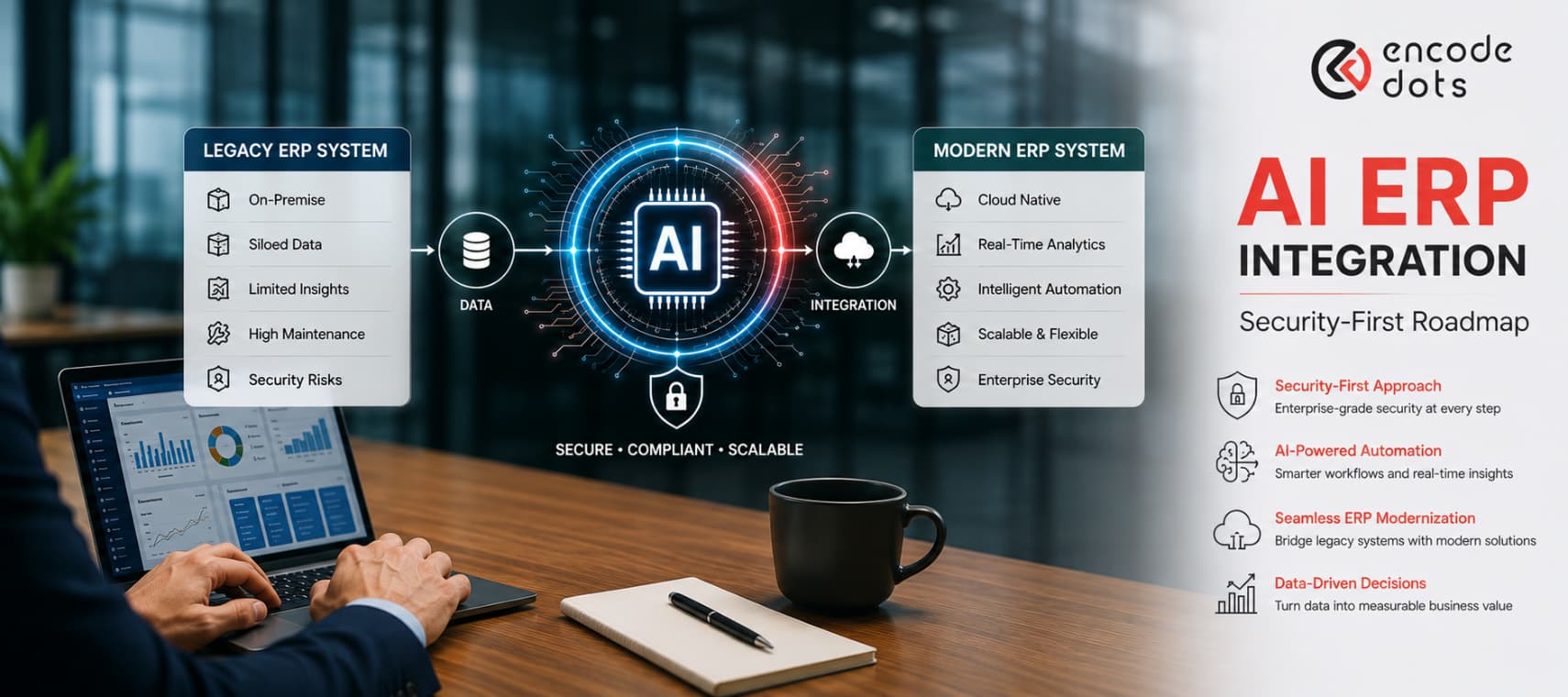
Integrating AI into an existing ERP isn’t about plugging in an API and hoping for the best. It’s a balance between operational efficiency, security, compliance, and data sovereignty. The biggest risk isn’t connecting AI to your ERP; it’s exposing sensitive enterprise data through a poorly designed pipeline that nobody stress-tested before go-live.
This guide walks through the security-first framework we use when advising enterprises on AI-ERP integration, including where most projects quietly go wrong before anyone notices.
What is the safest way to integrate AI into a legacy ERP system? Scope the use case first, then build around: data classification, prompt filtering, an appropriately private deployment model, representative testing before production, human approval on any write action, Zero Trust access controls, and continuous logging and monitoring.
What Is AI ERP Integration?
AI ERP integration means connecting large language models or AI agents to your ERP system so employees can query, analyze, and act on ERP data using natural language instead of manual reports or rigid dashboards.
In practice: a finance manager asks “What were our top five vendors by spend last quarter?” and gets an answer immediately, instead of filing a request and waiting for someone to build a report. The value is speed: faster answers, less report-building overhead, and AI copilots layered on top of systems like SAP, Oracle, or Microsoft Dynamics.
Why 2026 is different: private AI deployment options VPC-hosted models and self-hosted open-weight models have matured enough that enterprises no longer have to choose between “no AI” and “risky AI.” A secure middle path is genuinely available now, not just in vendor slide decks.
Key Takeaway: AI ERP integration means natural-language access to ERP data, layered behind security controls, not a direct wire from chatbot to database.
Why Businesses Are Integrating AI into Legacy ERP Systems
Legacy ERPs are powerful but slow to interact with manual workflows, delayed reporting, and knowledge locked in silos. AI closes that gap by:
- Cutting time spent on manual data pulls and recurring report generation
- Breaking down knowledge silos between finance, procurement, and operations
- Giving executives faster, conversational access to decision-relevant data
- Freeing employee time from repetitive lookups and status-chasing
Enterprise research and advisory firms have broadly pointed toward AI-augmented business systems as a growing productivity lever heading into the back half of the decade. We’re intentionally not attaching specific percentages or named-report figures to that statement here if you need a number for a board deck, pull the current figure directly from the source report rather than trusting a recycled statistic, since these numbers shift release to release.
Key Takeaway: the driver isn’t novelty; it’s the compounding cost of slow, manual ERP workflows that AI can measurably shorten.
Benefits Beyond Automation
- Faster reporting: natural-language queries instead of custom report requests
- Better forecasting: AI-assisted demand and financial forecasting
- Natural language search across ERP records
- Predictive maintenance for asset-heavy industries
- AI copilots for finance, HR, and procurement teams
- Proactive financial insights, surfaced rather than requested
- Inventory optimization using historical and real-time signals
- Procurement automation for routine, low-judgment purchase workflows
Key Takeaway: the ROI case isn’t just automation; it’s decisions made with better information, made faster.
The Reality Check: Why AI ERP Projects Fail
The biggest mistake ERP teams make is assuming on-premise data is automatically secure because it sits behind a firewall. Modern AI risk comes from insecure prompts, model retention policies, and poorly designed integrations, not just internet exposure.
If a team connects an AI assistant directly to production ERP data without a security layer in between, that “quick pilot” is usually the incident report six months later. Most failures trace back to one decision: skipping the audit phase to get to a demo faster.
Key Takeaway: AI ERP failures are usually sequencing failures: security bolted on last instead of designed in first.
Security Risks Nobody Talks About
- Prompt Injection: malicious instructions hidden inside data or user input that hijack the AI’s behavior
- Model Hallucinations: confident, wrong answers presented as fact
- Data Leakage: sensitive data surfacing in responses to unauthorized users
- Shadow AI: employees using unapproved AI tools with company data outside IT’s visibility
- Insider Threats: legitimate access misused to extract data through AI queries
- AI Cache Exposure: cached conversations retaining sensitive context longer than intended
- Training Data Retention: vendor policies that may retain submitted prompts
- Unauthorized Plugins: third-party AI plugins carrying excessive permissions
- API Abuse: scraping or over-querying through an exposed AI endpoint
Key Takeaway: most of these aren’t new risks; they’re familiar integration risks wearing a new interface. Treat the AI layer with the same scrutiny you’d give any new API surface.
Introducing the SAFE-ERP Framework
Most AI-ERP guides give you a checklist. We use a structured methodology internally at SAFE-ERP because a checklist tells you what to do, but a framework tells you why the order matters.
- S Scope the business use case
- A Audit data and permissions
- F Filter everything entering and leaving the model
- E Enforce Zero Trust access
- E Evaluate continuously
- R Record every AI interaction
- P Protect production through human approval
The rest of this guide follows SAFE-ERP in order; each section below maps to one letter.
Scope the Business Use Case Before You Scope the Architecture (S)
Before you even think about an API key, sit down and answer one question honestly: what specific decision or task gets faster or better because of this? Not “AI for procurement” in the abstract, the actual query, the actual user, the actual time saved.
Projects that skip this step tend to build impressive architecture for a use case nobody asked for. Projects that nail this step usually start absurdly small: one report, one department, one clearly measurable win.
Key Takeaway: if you can’t name the specific decision this AI integration improves, you’re not ready to pick a deployment model yet.
Choose Your AI Deployment Model: The First Security Wall (part of A/F)
This decision shapes almost everything downstream, so get it right before building anything else.
| Model | Security Considerations | Cost | Best For |
| On-Premise | Highest degree of control; you own the full stack | Highest | Healthcare, banking, government, and other tightly regulated environments |
| Private Cloud (VPC), e.g., Azure OpenAI, AWS Bedrock, Google Vertex AI | Strong control with vendor-managed infrastructure; security depends on your VPC configuration and access policies | Moderate | Most mid-to-large enterprises |
| Public / External API | Security posture depends on vendor contractual terms, data retention policy, network architecture, and identity controls, not on “public” as a label alone | Low–Usage-based | Non-sensitive, low-risk workloads, or vendors with strong enterprise-grade guarantees |
A well-configured public API with solid contractual and technical controls can outperform a badly configured private deployment. The deployment location is one input to your security posture, not the whole decision.
Key Takeaway: don’t pick a deployment model by security label alone; evaluate the actual contractual, technical, and network controls behind it.
Build the Security Boundary Before the LLM Touches ERP Data
A defensible architecture inserts multiple checkpoints between the ERP and the model, so no single point of failure exposes raw data:
ERP → API Gateway → Authentication → Prompt Sanitization →
Data Masking → Semantic Cache → LLM → Response Validation →
Audit Logs → ERP User
Each checkpoint catches a specific failure mode: authentication stops unauthorized calls, masking stops PII leakage before the model sees it, and response validation catches hallucinated or malformed outputs before a user acts on them.
Key Takeaway: security here comes from the chain of checkpoints, not from any single control; remove one link and the whole boundary weakens.
Audit: Find the Data You Cannot Afford to Expose (A)
This is where most teams either build a durable foundation or set themselves up for a breach six months later.
Pre-integration checklist:
- Inventory every ERP module in scope
- Identify existing integrations and dependencies
- Map databases and data flows end to end
- List all connected APIs
- Review current user permissions (not what’s documented, but what’s actually configured)
- Identify legacy components that can’t be easily secured or updated
- Define applicable compliance requirements (GDPR, HIPAA, SOC 2, or sector-specific rules)
Classification checklist:
- ☐ Public ☐ Internal ☐ Confidential ☐ Restricted
Then run targeted scans of PII, financial, HR, and customer records and build masking rules for every field marked Confidential or Restricted.
Key Takeaway: don’t connect an LLM until your ERP data is classified. If your security team can’t identify which tables hold PII, financial records, credentials, or restricted data, the AI project isn’t ready for integration full stop.
Filter Everything Entering and Leaving the Model (F)
Middleware sits between the ERP and the AI, and it does the job a firewall alone can’t:
- SQL injection detection on any query the AI generates
- Prompt injection prevention on inbound data and user input
- Schema filtering: the AI never sees table structures it doesn’t need
- PII masking and secret removal before prompts reach the model
- Placeholder replacement (Salary → [REDACTED], Card Number → [MASKED])
- Rate limiting and prompt validation to catch abuse patterns early
Key Takeaway: think of this middleware as the ERP’s bouncer; the AI never gets into the VIP room; it only receives what the bouncer decides to hand over.
Test With a Representative Sandbox, Not a Guess
You cannot responsibly test AI workflows on production ERP data; a single “harmless” pilot can leak a live customer record into a model’s context window, and there’s no clean way to undo that.
Instead of chasing an arbitrary sample size or timeline, build a representative synthetic dataset that covers the workflows, roles, edge cases, and sensitive-field patterns you expect in production. Run testing until your predefined security and accuracy thresholds are met, rather than stopping at a fixed percentage or a fixed number of weeks just because it feels thorough.
A narrowly scoped two-week pilot on one workflow can be a reasonable starting point in practice, but let the results, not the calendar, decide when you’re ready to move forward.
Key Takeaway: If the AI hallucinates or leaks synthetic data in testing, it will do the same with real data in production. Treat every sandbox failure as a preview of a real incident, not a bug to shrug off.
Enforce Zero Trust and Protect Production With Human Approval (E + P)
- The AI should default to read and suggest write or commit actions should require a documented, deliberate design decision, not a default. For most ERP workloads, that means a human approval step before anything is committed.
- Where an organization does grant an AI agent limited write capability (for narrow, low-risk, well-tested workflows), it should sit behind the same approval, logging, and rollback controls you’d require of a junior employee doing the same task for the first time.
- Role-Based Access Control (RBAC) scoped per department: a warehouse manager’s AI assistant shouldn’t be able to query payroll tables.
- Multi-Factor Authentication (MFA) on all administrative access to the AI layer.
- Least-privilege permissions by default, with periodic access reviews.
- Session expiration on AI-assisted sessions, so stale access doesn’t linger.
Critical Warning: Never expose your ERP’s raw SQL database directly to an AI model. Place a secure middleware, semantic filtering layer, and response validation engine between the ERP and the LLM. On caching: minimize persistent conversational state for sensitive ERP workloads unless there’s a documented business need. Where state is required, enforce encryption, tenant isolation, strict TTLs, access controls, and auditable retention policies. Statelessness alone isn’t a security strategy, and a securely governed stateful system can be safer than a carelessly configured stateless one.
Key Takeaway: Zero Trust isn’t a product you buy; it’s the discipline of never assuming access is safe just because it worked yesterday.
Record: Audit Trails Are Non-Negotiable (R)
Log everything: the prompt, the user, the timestamp, the AI’s response, any SQL it generated, related API calls, and every approval action. If a breach happens, this log, not anyone’s memory of what happened, is what tells you exactly who prompted the AI and what it produced in response.
Key Takeaway: an AI integration without tamper-resistant logging isn’t “streamlined”; it’s unauditable, and unauditable systems fail compliance reviews regardless of how well they perform.
Total Cost of Ownership
Cost conversations that stop at “API usage” undersell what CTOs and CIOs actually need to budget for. A realistic AI-ERP integration TCO includes:
- Implementation architecture design, middleware build, integration work
- Model / API usage token or subscription costs, which scale with adoption
- Cloud / GPU infrastructure relevant mainly for private or self-hosted deployments
- Security tooling masking, monitoring, and validation platforms
- Data engineering classification, pipeline work, ongoing data quality
- Monitoring & governance: the ongoing review cycle, not a one-time cost
- Maintenance: patching, model version updates, middleware upkeep
- Employee training: the most commonly underbudgeted line item
| Architecture | Initial Cost | Ongoing Cost | Internal Expertise Needed | Best Fit |
| External enterprise API | Low–Medium | Usage-based | Low–Medium | Fast, scoped pilots |
| Private Cloud (VPC) | Medium–High | Medium–High | Medium | Enterprise-scale, sustained use |
| Self-hosted / On-Prem | High | High | High | Strict data residency or regulatory requirements |
ROI expectation: model your first-year business case around reduced reporting hours and faster decision cycles, not headcount reduction. That’s the case that survives scrutiny in a budget review.
Key Takeaway: the sticker price of the model is the smallest line item in the real TCO; governance, training, and monitoring are where budgets actually get missed.
Common Mistakes
- Direct SQL access given to the AI agent
- No PII masking before prompts reach the model
- Using public consumer chatbots with sensitive ERP data
- Skipping sandbox testing to “move faster”
- No audit logs in place before go-live
- Excessive AI permissions granted “just in case”
- No human approval step for write actions
- Ignoring industry-specific compliance requirements
- No ongoing monitoring after launch
- No rollback plan if the AI misbehaves
Key Takeaway: almost every item on this list is a shortcut taken under deadline pressure; build the timeline assuming these steps stay in, not something to trim if the pilot runs late.
When AI Integration Is the Wrong Move for Your ERP
This is the section most vendors won’t write, because it doesn’t sell anything. AI will amplify whatever architecture you already have; it won’t repair a broken one.
Don’t proceed if:
- ERP data quality is already poor or inconsistent
- Existing user permissions are broken or undocumented
- No data classification exists yet
- There’s no clear, specific business use case, only a general mandate to “add AI”
- Existing APIs are unstable or poorly maintained
- Nobody owns security accountability for this project
- You have no way to measure whether the integration succeeded
- The initiative exists because leadership wants “AI,” not because a team has a defined problem
Key Takeaway: AI will amplify a weak ERP architecture; it will not repair one. Fix the foundation first, or the AI project inherits every existing problem at machine speed.
2026 Best Practices
- Zero Trust architecture
- Retrieval-Augmented Generation (RAG)
- AI agents with narrowly scoped permissions
- Model Context Protocol (MCP) for controlled tool access
- vector databases for semantic search
- formal AI governance policies
- AI observability tooling
- deliberate (not default) semantic caching
- human-in-the-loop approval
- confidential computing for sensitive workloads
Key Takeaway: none of these are optional “nice to haves” for a regulated enterprise; they’re the baseline a serious AI-ERP program is now expected to meet.
Example Architecture: Manufacturing Company Using SAP
The following is an illustrative example architecture, not a documented client case study; it reflects a common pattern we see across manufacturing ERP deployments, not a specific named engagement.
Setup: A manufacturing enterprise running SAP, where employees were losing hours manually searching procurement records.
Approach: Private Azure OpenAI deployment, prompt-sanitization middleware, a scoped AI assistant limited to read access, and mandatory human approval for any write action.
Typical outcome pattern: faster procurement reporting, lower manual research effort, a stronger compliance posture, and no direct database exposure to the model.
Key Takeaway: the pattern that works isn’t “add AI to SAP”; it’s “add a scoped, filtered, approved AI layer on top of SAP,” which is a materially different (and safer) project.
Decision Matrix
Does the ERP contain PII or regulated data?
→ Yes → Do you have HIPAA/GDPR or similar compliance obligations?
→ Yes → Private Cloud or On-Prem deployment, with full SAFE-ERP controls
→ No → Evaluate VPC deployment with strong governance
→ No → A well-vetted public/external API may be viable for lower-sensitivity workloads
Key Takeaway: this decision tree is a starting point for a conversation with security and compliance stakeholders, not a substitute for that conversation.
90-Day Enterprise Roadmap
| Weeks | Focus |
| 1–2 | Scope the use case and complete the pre-integration audit |
| 3–4 | Architecture and deployment model decision |
| 5–6 | Build the representative synthetic sandbox |
| 7–8 | Security testing against defined thresholds |
| 9–10 | Pilot deployment with human-in-the-loop approval |
| 11–12 | Production rollout and monitoring handoff |
Key Takeaway: 90 days is a realistic window for a scoped pilot; treat any timeline that skips weeks 1–2 as a warning sign, not a shortcut.
Future of AI ERP (2026–2028)
Expect continued movement toward autonomous AI agents handling routine ERP tasks end-to-end under supervision, self-healing workflows that flag and correct data inconsistencies, predictive operations replacing reactive reporting, voice-based ERP copilots, AI-native ERP modules designed with AI as a first-class citizen rather than a bolt-on, and multi-agent orchestration across finance, procurement, and operations.
Key Takeaway: the direction of travel is toward more autonomy, which makes the governance and approval controls in this guide more important over time, not less.
Conclusion
Key takeaways, gathered:
- Security and scope come first, not the deployment model, and not the demo
- The deployment model you choose (on-prem, VPC, or public) shapes every downstream control
- Middleware, masking, and human-in-the-loop approval aren’t optional extras; they are the architecture
- Audit logs and continuous monitoring are what make the system defensible after go-live, not just at launch
- AI amplifies whatever ERP foundation already exists; fix data quality and permissions before adding AI on top
Executive recommendation: start with a scoped 90-day pilot on one ERP module; procurement or internal reporting are usually low-risk starting points rather than an enterprise-wide rollout. Prove the security architecture holds before you scale it.
Planning an AI Integration for Your ERP?
Before you choose a deployment model or start building a chatbot, it’s worth validating your ERP’s data exposure risk, integration boundaries, and compliance requirements with someone who’s done this before. Talk to an AI Integration Architect to walk through your specific ERP environment and get a scoped assessment before you commit budget.