Web App Development
  Cloud App Development
  Front-End Development
  Cross Platform Development
  MVP Development
  Application Modernization
  PWA Development
  SaaS Application Development
  Software Development Outsourcing
  Offshore Custom Software Development
  Full Stack Software Development
  Custom Software Development
  Enterprise Software Development
  Cloud Computing Solutions
  Cloud Development
  Managed Cloud Services
  Cloud Native Development
  AI Consulting
  Machine Learning Development
  LLM Development
  AI Chatbot Development
  Data Analytics
  CI CD Development
  Digital Transformation
  Dev Ops
  Content Development
  Blockchain Development
  Web Development
  Web Design



 Generative AI
  Large Language Model
  AI Chatbot
  AngularJs
  ReactJS
  Dotnet Core
  Android
  iPhone
  Swift
Swift  E-Commerce
  NopCommerce
  BigCommerce
  Laravel
  Yii
Yii  AWS
AWS  Google Cloud
  Azure DevOps
  Automation Testing
  Security Testing
  API Testing
  Functional Testing
  MEAN Stack
  MERN Stack
  Full Stack Developers
  biz.encodedots
  biz@encodedots.com
  +91 99747 42737


- How PayTo Works, in Plain English
- What Your Checkout Is Quietly Costing You
- Five Things That Change the Day You Switch on PayTo
- What the Data Actually Shows
- And If You Bill the Same Customers Again and Again
- What It Looks Like on the Bottom Line
- Where PayTo Fits, and Where It Doesn't
- Why This Matters Now, Not in Five Years
- The One Thing Nobody Tells You
- How EncodeDots Helps
- Conclusion
- Frequently Asked Questions
Every payment your business collects leaks a little money. A card fee here. A failed direct debit you only hear about days later. A bank transfer with no reference that someone in finance has to chase on Thursday. Most Australian businesses have simply learned to live with it.
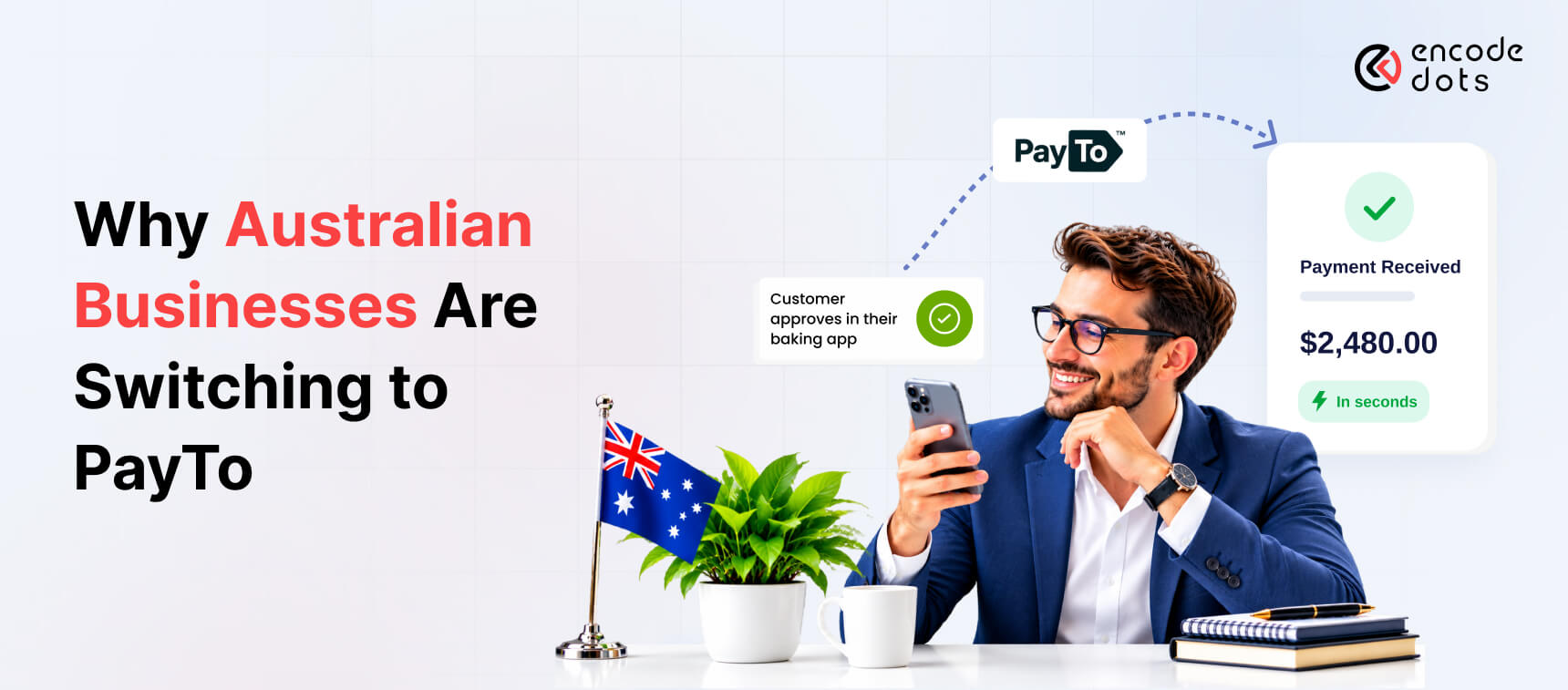
PayTo is changing that. Customers approve a payment agreement inside their own banking app, allowing businesses to collect payments directly from their bank accounts. In e-commerce and online retail, Zepto’s November 2025 PayTo Index recorded a 98.9% settlement rate (excluding insufficient-funds rejections), a median settlement time of 4.94 seconds, and 301% growth in online-retail PayTo payment volume over the preceding six months. The report also draws on Zepto’s PayTo data, covering more than 480,000 agreements across multiple industries (Zepto PayTo Index, November 2025).
For leadership, the useful question isn’t whether PayTo is new. It’s where it would reduce your payment costs, and whether the ROI justifies the integration. This guide shows you how to answer both.
Here’s what it’s already delivering for businesses that have switched it on.
| PayTo at a Glance | |
| Median time from approval to money in your account | 4.85 seconds |
| Payments that settle, excluding customers with no funds | 99.1% |
| Growth in online retail PayTo volume, six months to Nov 2025 | 301% |
| Agreements already running on one provider’s platform alone | 483,000+ |
Zepto PayTo Index, July and November 2025. Zepto is one of several PayTo providers; figures are from its own platform.
How PayTo Works, in Plain English
Think of it as a bank transfer that finally behaves like a card payment, without the card. It was built by the people behind PayID and the New Payments Platform, and it runs through the banks and payment providers you already use.
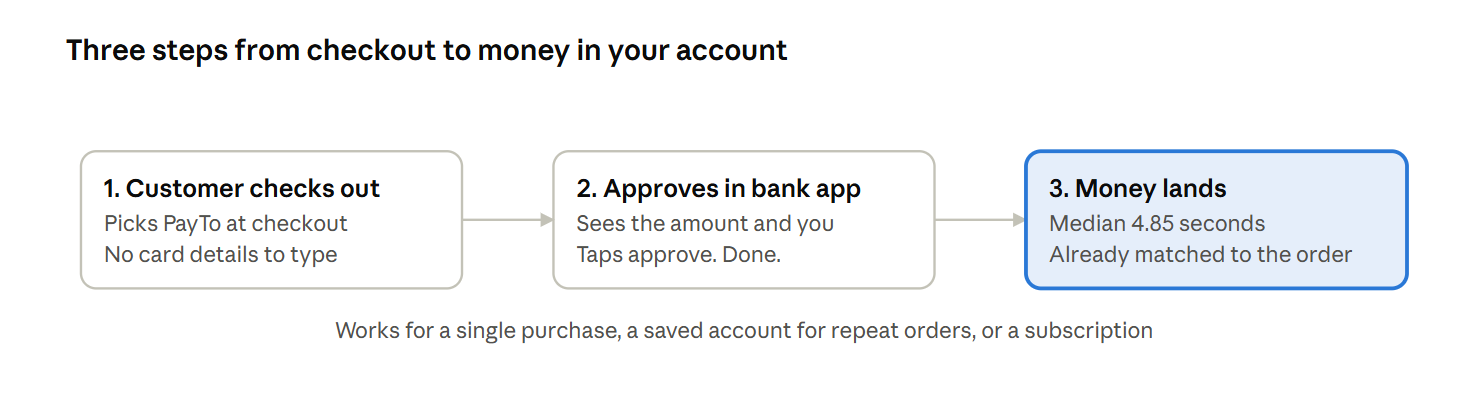
No card number. No typing a BSB and hoping the reference is right. The customer taps approve in their own banking app, and the money moves.
What Your Checkout Is Quietly Costing You
Most payment costs never appear as a line on a statement. They show up as lost hours, delayed cash, and customers who drift away without meaning to.
| The problem | What it really costs you | What PayTo changes |
| Card fees on every sale | A percentage of revenue, every time, forever | Bank-to-bank payments skip the card networks entirely |
| Bank transfers with no reference | Hours spent matching deposits to orders | Every payment is tied to the order that created it |
| Expired or declined cards | Sales and renewals that fail, customers who quietly churn | Bank accounts don’t expire |
| Finding out days later | A direct debit failure can take up to four business days to surface (GoCardless) | You’re told the moment a payment succeeds or fails |
| Customer disputes | “I didn’t approve that” calls and chargebacks | Customers approve each agreement in their own bank app |
If two or more of these sound familiar, keep reading.
Five Things That Change the Day You Switch to PayTo
PayTo doesn’t just add another button at checkout. It changes how money moves through your business from the first transaction.
1. You’re Paid in Seconds, Not Days
Card payments usually take one to three business days to settle. PayTo payments settle in a median of under five seconds. If you ship the same day, you can confirm the money has landed before the parcel leaves.
2. Fewer Payments Fail
There’s no card to expire. A customer’s bank won’t block the payment because it doesn’t recognise your store, and no 3D Secure pop-up will time out halfway through checkout. In Zepto’s data, 99.1% of PayTo payments settled, not counting customers who didn’t have enough funds.
3. Reconciliation Takes Care of Itself
You won’t see bank lines like “deposit from J SMITH, $84.50, no reference” anymore. Each PayTo payment carries structured data, so your accounting software matches the payment to the order automatically. That means less manual matching and fewer surprises at month-end.
4. It Can Cost Less Than Cards
Account-to-account payments carry no interchange, the part of every card fee that goes to the customer’s bank. Your rate depends on your provider, so ask for a direct comparison with what you pay for cards now. On thin margins, saving a percentage point or two on every transaction adds up quickly.
5. Customers Trust It
Customers never type in a card number. They approve the exact payment terms inside their own banking app, protected by their bank’s own security. For a first-time buyer on a site they don’t know yet, that can be what gets them to finish the purchase.
What the Data Actually Shows
There’s no official national PayTo success rate yet. The most detailed public data comes from Zepto’s PayTo Index, covering more than 480,000 agreements and over a million payments across ten-plus industries.
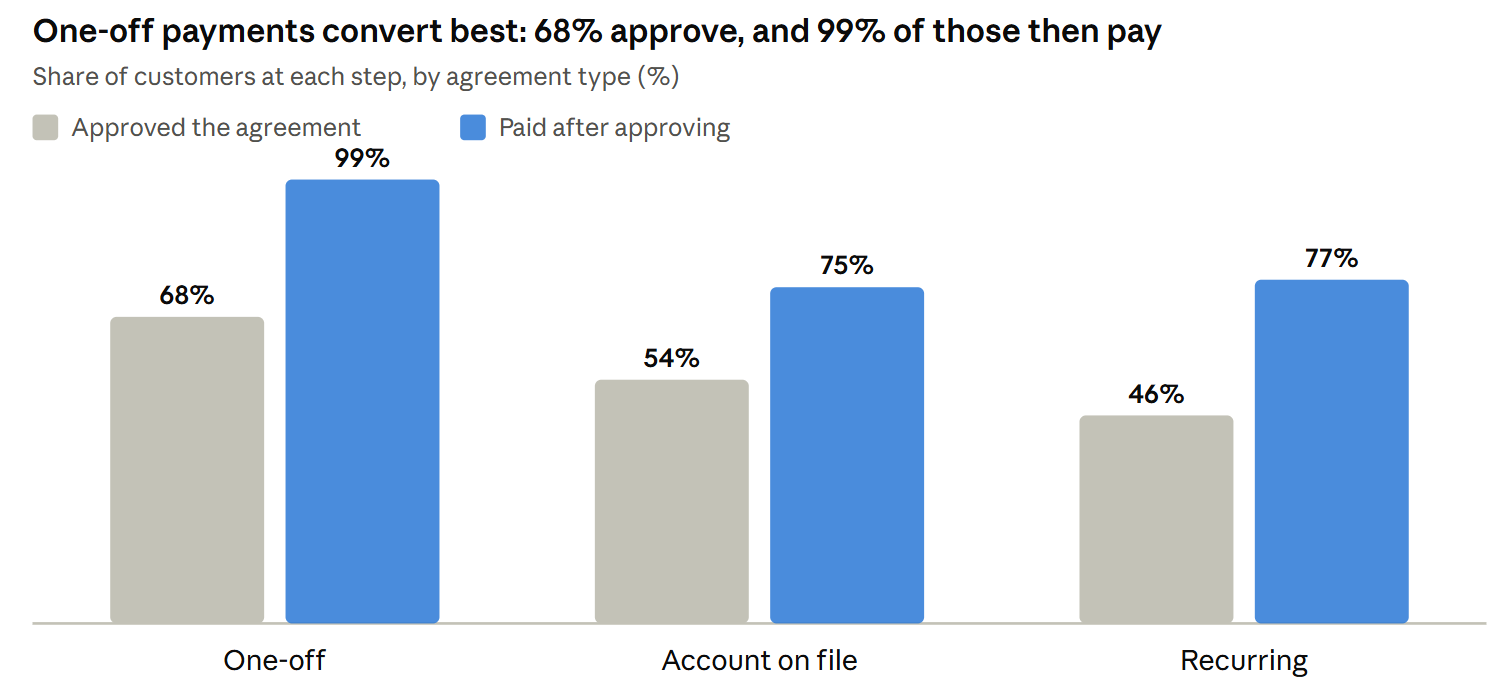
Two things stand out. First, single purchases are PayTo’s strongest use case: nearly seven in ten customers approve, and almost all of them then pay. Second, the step that decides your result is approval, not payment. Once a customer has said yes, the money almost always follows. The businesses getting the best numbers are the ones who made the approval step obvious and easy, which is where good integration earns its keep.
These are figures from one provider’s platform, not a universal benchmark. Your own numbers will depend on your customers and your checkout.
And If You Bill the Same Customers Again and Again
This is where PayTo stops being a nicer checkout and starts protecting revenue.
The biggest reason a subscription dies isn’t the customer leaving. It’s a card that expired, got replaced after a fraud scare, or hit its limit on the 28th. The customer still wants the service. The payment just failed, and by the time anyone chased it, they’d moved on.
With PayTo, the agreement sits with the customer’s bank, and every payment draws directly from the account. You know the outcome instantly. Customers can see, pause or cancel from their own banking app, which sounds like a risk and turns out to be the reason they say yes in the first place. In Zepto’s data, three in four recurring-agreement customers made repeat payments.
Dymocks Tutoring put it. Under its old bank-transfer process, it could take up to a week to learn a payment had a problem. With PayTo, CEO Mark Buckland says, the business can “set up a payment arrangement on the spot and know that it is accepted” (CommBank).
What It Looks Like on the Bottom Line
Take a business collecting 10,000 payments a year. The figures below are illustrative, not a provider quote, but the shape is what most businesses find: the savings come from fees and time, and the time is often the bigger number.
| Annual cost | Today | With PayTo | Saving |
| Processing and provider fees | $15,000 | $12,000 | $3,000 |
| Failed-payment and dishonour fees | $3,000 | $1,000 | $2,000 |
| Staff time chasing failures and reconciling | $12,000 | $5,000 | $7,000 |
| Revenue lost to failed renewals | $10,000 | $6,000 | $4,000 |
| Ongoing maintenance and support | — | $4,000 | ($4,000) |
| Total | $40,000 | $28,000 | $12,000 a year |
In that example, the business saves $12,000 a year, so integration typically pays for itself within the first year or two. Your own numbers depend on your provider’s pricing, how many customers choose PayTo, and how much of your checkout runs on cards today. All three are easy to measure before you commit.
Where PayTo Fits, and Where It Doesn’t
The deciding factor isn’t your industry. It’s how you get paid.
| Strong fit | Weaker fit |
| Online stores, especially with higher average orders | Most customers are outside Australia |
| Subscriptions, memberships, gyms, clubs | Very low payment volume |
| Education and tutoring collecting term fees or instalments | Customers who strongly prefer card rewards |
| Service businesses that invoice and wait: trades, agencies, clinics | Card payments already clean, cheap and rarely failing |
| Utilities, insurers and anyone with bills that vary month to month | Systems that can’t react to real-time events without a rebuild |
Utilities are leading adoption so far. Red Energy, part of Snowy Hydro, became the first major Australian utility to offer PayTo for real-time bill payment and reported shorter call-centre handling times, less manual reconciliation and lower transaction costs than its existing methods (Zepto).
Why This Matters Now, Not in Five Years
Card surcharges are gone. From 1 October 2026, the RBA has removed surcharging on EFTPOS, Mastercard and Visa payments. Businesses now absorb the full cost of card acceptance themselves, so it’s worth comparing every payment option against what your provider actually charges.
Bank payments are being modernised. BECS, the system behind direct debit, still carries most account-to-account payments in Australia. The industry plans to move away from it over time, but in December 2025 AusPayNet removed the June 2030 end date until a clearer roadmap is agreed. PayTo is one of the main options businesses can adopt now, without waiting for that timeline.
The One Thing Nobody Tells You
PayTo doesn’t replace cards. It sits beside them. Australians still make roughly three in four payments by card, and plenty will keep tapping a credit card for the points. Offer both, and let customers choose.
What decides whether PayTo works for you is the approval step. The customer has to open their banking app and say yes, and if that moment is clumsy or buried, many won’t. Across the four banks in Zepto’s data, the same approval step converted anywhere from 26% to 73% of customers. The businesses at the top of that range designed the checkout and the bank hand-off properly. The ones at the bottom just switched on a new button.
That’s the work we do at EncodeDots: wiring PayTo into your checkout, billing, and accounting so the whole thing runs without anyone babysitting it, and so your customers actually get through the approval step.
Curious what it would save you? Book a free 20-minute payment review. Bring last month’s numbers. We’ll show you where the leak is and what plugging it is worth.
How EncodeDots Helps You Make PayTo Work for Your Business
Turning on PayTo is the easy part. Getting real value from it means connecting it to your checkout, billing system, CRM, and accounting software, so every payment flows through your business without manual work.
That’s where EncodeDots comes in. We build custom payment integrations, APIs, and automated workflows for eCommerce, subscription, SaaS, and FinTech businesses. With PayTo, we focus on making it deliver what matters to your business:
- Faster cash flow: We connect real-time PayTo confirmations to your order and fulfilment systems, so your team acts the moment money lands.
- Fewer failed payments: We design a simple mandate approval journey from your website or app to the customer’s banking app and back, with clear handling for declined, paused, or cancelled mandates.
- Reconciliation without spreadsheets: We sync PayTo payment data with your accounting software, ERP, or CRM, so payments match orders and invoices automatically.
- Lower payment costs: We help you compare PayTo providers against your current card fees and decide where PayTo should replace cards and where cards should stay.
- Room to grow: We build integrations that aren’t locked to a single provider, so you can add recurring billing or change providers later without starting over.
Conclusion
PayTo won’t replace cards, but if you sell online, bill the same customers every month, or spend time chasing failed payments, it’s worth a serious look. You get paid in seconds, face fewer card-related payment failures, and see payments match your orders automatically. With card surcharges now removed, every dollar of payment cost comes out of your margin.
What decides whether PayTo pays off is how well it’s set up with your checkout, billing, and accounting.
Want to know what PayTo could save you? Book a free 20-minute payment review with EncodeDots
Sources: Australian Payments Plus, PayTo FAQs, Zepto PayTo Index, July 2025, Australian FinTech on the November 2025 PayTo Index, Reserve Bank of Australia, Consumer Payment Behaviour, May 2026, RBA Review of Retail Payments Regulation, 2026, AusPayNet BECS Transition, CommBank, PayTo for Business, GoCardless, PayTo