Web App Development
  Cloud App Development
  Front-End Development
  Cross Platform Development
  MVP Development
  Application Modernization
  PWA Development
  SaaS Application Development
  Software Development Outsourcing
  Offshore Custom Software Development
  Full Stack Software Development
  Custom Software Development
  Enterprise Software Development
  Cloud Computing Solutions
  Cloud Development
  Managed Cloud Services
  Cloud Native Development
  AI Consulting
  Machine Learning Development
  LLM Development
  AI Chatbot Development
  Data Analytics
  CI CD Development
  Digital Transformation
  Dev Ops
  Content Development
  Blockchain Development
  Web Development
  Web Design



 Generative AI
  Large Language Model
  AI Chatbot
  AngularJs
  ReactJS
  Dotnet Core
  Android
  iPhone
  Swift
Swift  E-Commerce
  NopCommerce
  BigCommerce
  Laravel
  Yii
Yii  AWS
AWS  Google Cloud
  Azure DevOps
  Automation Testing
  Security Testing
  API Testing
  Functional Testing
  MEAN Stack
  MERN Stack
  Full Stack Developers
  biz.encodedots
  biz@encodedots.com
  +91 99747 42737


- The Digital Shift in Real Estate
- What Is a Real Estate Mobile App?
- Mobile Apps Are Becoming Essential for Real Estate Businesses
- Key Features That Make Real Estate Apps
- Why Mobile Apps Drive Real Business Growth
- Before vs After Mobile Apps
- Common Mistakes Real Estate Businesses
- Cost of Real Estate Mobile App Development
- Why to Choose the Right Real Estate App Development Partner
- Why Choose EncodeDots
- The Future of Real Estate Apps
- Conclusion
- Ready to Build Your Real Estate App?
- Frequently Asked Questions
Think about the last time you looked for a new home or office space.
Did you pick up the phone to call an agent? Or did you open an app and start scrolling while having your morning coffee?
Most people choose the second option. That single, habitual shift has fundamentally rewired the real estate industry. What used to be a slow, manual process dictated by gatekeepers has evolved into a fast, user-driven Digital ecosystem.
Buyers want instant access. Sellers want frictionless deals. Agents need tools that work as hard as they do. In 2026, the bridge between these demands is no longer just a website; it’s a dedicated mobile experience.
If your business is still anchored to traditional methods, you aren’t just lagging; you’re becoming invisible to the modern market. Here is why a mobile app is no longer a luxury, but the smartest investment for your growth this year.
The Digital Shift in Real Estate
The real estate industry didn’t change overnight; it evolved alongside consumer expectations.
Not long ago, the journey to finding a property was notoriously slow: you contacted an agent, waited days for a curated list, spent weekends visiting mismatched properties, and manually compared notes. Today, that entire cycle is condensed into minutes. Powerhouses like Zillow, Redfin, and Realtor have fundamentally reshaped user behavior, turning property hunting into an experience as fluid and addictive as scrolling through a social feed.
This shift has created a new standard. Today’s buyers and investors no longer just appreciate speed; they demand it. Specifically, they expect:
- On-Demand Property Access: High-definition virtual tours and instant data at their fingertips.
- Hyper-Targeted Filtering: Sorting effortlessly by micro-neighborhoods, price per square foot, and specific lifestyle amenities.
- Zero-Lag Updates: Real-time push notifications the second a matching property hits the market.
- Frictionless Communication: Instant, in-app messaging with agents without digging for contact info.
This isn’t just a change in toolsets; it’s a complete Digital transformation. Technology is no longer a backend support system for real estate businesses; it is the front-facing engine driving growth. And right now, mobile apps are leading that charge.
Explore the Insight: Build an AI-Powered Real Estate App
What Is a Real Estate Mobile App?
A real estate mobile app isn’t just a mobile-friendly version of a property website; it is a self-contained Digital ecosystem. It brings buyers, sellers, and agents into a single, seamless environment where deals move faster. Instead of juggling tabs, users can tour homes virtually, filter hyper-specific preferences, track price drops, and chat with an agent instantly, all within a unified interface.
To drive real ROI, the technology must match your business model. Choosing the right avenue in property app Development ensures you build a tool that solves specific market friction rather than just adding noise.
Here is Why the market shapes up:
- Property Listing Apps: The modern marketplace. High-traffic platforms Designed for buying, selling, and broad discovery.
- Rental & Property Management Apps: Streamlined portals for tenants and landlords, automating short-term stays, leases, and rent collection.
- Agent-Centric Productivity Tools: Internal mobile engines packed with CRM capabilities, instant lead synchronization, and listing management tools.
- AI-Driven Marketplaces: Next-generation platforms utilizing predictive algorithms to deliver personalized property recommendations and automated valuation models.
- Commercial real estate (CRE) Platforms: Specialized applications tailored for high-stakes office, retail, and industrial leasing.
This is where property app Development becomes a strategic investment rather than just a technical decision. The right app type aligns with your audience and your revenue model.
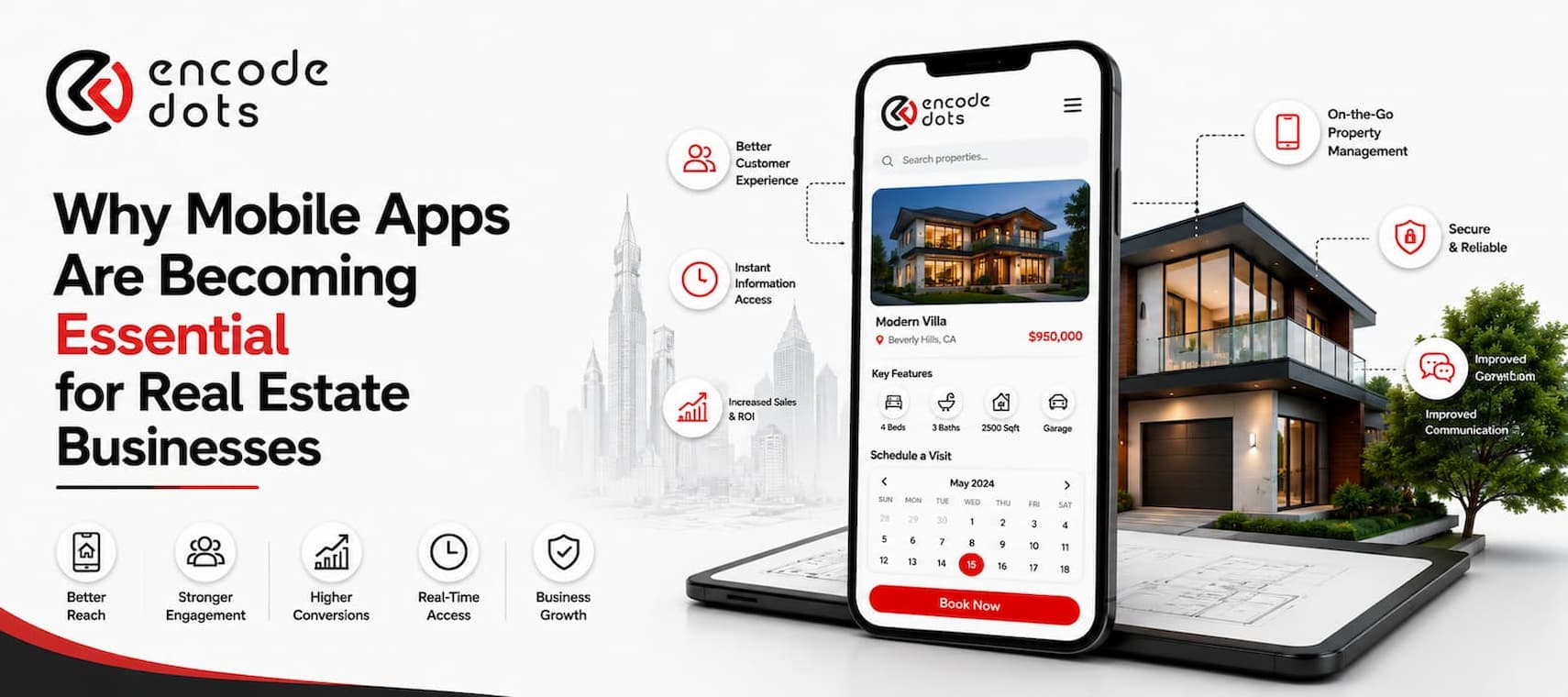
Why Mobile Apps Are Becoming Essential for Real Estate Businesses
Why are forward-thinking real estate businesses shifting from desktop websites to dedicated mobile apps? Because apps don’t just display listings, they solve friction points and accelerate transactions.
Here is Why a mobile app transforms your operations and baseline growth:
1. 24/7 Property Access
Unlike traditional methods, mobile apps don’t have working hours. Users can search properties anytime, compare options instantly, and make decisions faster. This always-available experience is one of the biggest real estate app benefits, especially for international buyers or working professionals who can’t make calls during business hours.
2. Better User Experience
Speed and simplicity matter more than ever. Mobile apps provide faster loading times, smoother navigation, and personalized experiences that adapt to each user. When users enjoy the experience, they stay longer, and longer sessions directly increase the chances of conversion.
3. More Leads, More Conversions
Every interaction inside an app is an opportunity. A search becomes interesting. A click becomes engagement. An inquiry becomes a qualified lead. Apps make it easy for users to take action with one-tap calls, instant chat, and saved searches, which directly increases lead volume and quality.
4. Faster Decision-Making
Modern apps include high-quality images, video walkthroughs, and 360° virtual tours. Users don’t need to physically visit ten properties before shortlisting. They make smarter decisions in less time, which means faster closings for your agents.
5. Stronger Brand Presence
Having a mobile app instantly positions your business as professional, modern, and customer-focused. In a competitive market, perception matters as much as performance, and a well-Designed app signals that you’re serious about your craft.
6. Direct Communication Channel
Unlike websites that rely on form submissions and email follow-ups, apps offer push notifications, in-app chat, and instant alerts. You stay connected with your users in real time, which builds trust and dramatically improves response rates.
Key Features That Make Real Estate Apps Successful
Not every real estate app succeeds. The difference usually lies in the features.
Core Features
These are the non-negotiables for any successful property listing platform:
- User registration and login
- Property listings with detailed information
- Advanced search filters (price, location, type, amenities)
- Map integration with neighborhood data
- Contact options (call, chat, email)
- Wishlist and saved searches
- Reviews and ratings
These are essential property listing app features that users now expect by default.
Advanced Features
These elevate your app from functional to exceptional:
- AI-based property recommendations
- Virtual tours and AR walkthroughs
- In-app chat and video calls
- Push notifications for price drops and new listings
- Mortgage and EMI calculators
- Document signing and e-verification
- Agent CRM and lead management
The more value you provide, the longer users stick around and the more likely they are to convert.
Why Mobile Apps Drive Real Business Growth
Mobile apps aren’t just tools. They’re growth engines.
Increased visibility. Your listings reach more users, more often, across more devices. An app keeps your brand on every prospect’s home screen.
Better engagement. Users spend significantly more time exploring properties inside an app than on a mobile website. That extra time builds familiarity and trust.
Higher conversion rates. Faster access combined with a better experience leads to quicker decisions and higher closing rates.
Data-driven insights. Apps provide valuable behavioral data, such as which listings users view, How long they linger on them, which filters they apply, and where they drop off. This helps businesses make smarter decisions using real estate business growth technology and continuously improve the user journey.
Customer retention. Push notifications, saved searches, and personalized recommendations keep users coming back even when they’re not actively searching.
Real-World Scenario: Before vs After Mobile Apps
Let’s simplify the impact.
Without a mobile app, a buyer typically contacts an agent, waits for a callback, visits multiple sites, and takes weeks to shortlist. The process is slow, frustrating, and full of friction.
With a mobile app, the same buyer opens the app, applies filters, views matching properties instantly, takes a virtual tour, and contacts the agent directly. The shortlisting that used to take weeks now happens in an afternoon.
The difference isn’t just convenience. It’s a competitive advantage.
Ready to Transform Your Real Estate Business with a Powerful Mobile App?
Don’t let outdated processes slow you down. Build a smart, scalable mobile app that helps you generate more leads, close deals faster, and deliver a seamless property experience.
Get a Free Consultation Today!Common Mistakes Real Estate Businesses Make With Apps
Even with the best intentions, a real estate app can fail if the execution is flawed. To protect your investment and ensure a high ROI, steer clear of these five common pitfalls:
- Ignoring Mobile-Native UX: If a user faces a cluttered interface, slow listing load times, or a confusing search process, they won’t stick around. In the mobile world, Design friction equals immediate abandonment.
- Feature Bloat in Version One: Trying to build a platform that Real everything at launch usually means doing nothing well. Start with a lean, high-performing MVP (Minimum Viable Product) focused on core user needs, then scale based on real user feedback.
- Treating the App Like a Shrunken Website: Simply squeezing a desktop interface into an app framework doesn’t work. True mobile experiences must be engineered from scratch for touch responsiveness, speed, and effortless one-handed use.
- Prioritizing Low Costs Over Quality Engineering: Choosing the cheapest Development option is a hidden tax. A buggy, unreliable app Real far more damage to your brand’s reputation than having no app at all. Premium engineering pays for itself in user retention.
- Treating Launch Day Like the Finish Line: An app is a living product, not a static project. It requires ongoing maintenance, OS compatibility updates, security patches, and iterative feature enhancements to remain competitive in the app stores.
Cost of Real Estate Mobile App Development
Let’s talk investment.
The real estate mobile app Development cost typically falls into three tiers:
- Basic app $15,000 to $30,000 (listings, search, basic filters, simple admin)
- Mid-level app $30,000 to $80,000 (chat, payments, agent dashboards, push notifications)
- Advanced app $80,000 to $150,000+ (AI recommendations, virtual tours, predictive analytics)
The final number depends on several variables: feature scope, Design complexity, choice of platform (iOS, Android, or cross-platform), and the location of your development team. Agencies in India and Eastern Europe typically offer 50–70% lower rates than US or UK firms without compromising on quality, which is why so many global brands offshore their real estate app Development today.
Don’t forget recurring costs, either maintenance, hosting, marketing, and feature upgrades typically add 15–20% of the original Development cost per year.
Why to Choose the Right Real Estate App Development Partner
Choosing the right team is the single most important decision you’ll make in this process.
Look for:
- Real estate domain experience:- Have they built property apps before? Because real estate platforms require handling complex listings, maps, and user journeys that generic apps don’t.
- A strong portfolio:- Don’t just look at screenshots. Ask for case studies with real user data, engagement metrics, and actual business results.
- Transparent pricing:- Avoid vague estimates. A reliable team will provide module-wise costing so you know exactly where your investment is going.
- Clear communication:- Regular updates, defined milestones, and a dedicated project manager ensure your project stays on track without confusion.
- Long-term support:- Your app will need updates, improvements, and scaling. Make sure the team supports you even after launch.
- Modern tech stack:- Technologies like Flutter, React Native, Node.js, and cloud infrastructure help build scalable, high-performance apps that grow with your business.
A reliable real estate app Development company doesn’t just build apps. They build scalable solutions that grow with your business.
Why Choose EncodeDots
Building a successful real estate app isn’t just about Development; it’s about creating a platform that attracts users, generates leads, and scales with your business.
At EncodeDots, we go beyond coding. We understand Why real estate users search, compare, and make decisions, and we build apps around that behavior.
We deliver custom real estate app solutions tailored to your business model, ensuring your platform works exactly the way your operations demand. Our focus on scalable architecture means your app performs seamlessly, whether you have hundreds or thousands of listings.
What truly sets us apart is our approach to design and technology. We create user-focused experiences that drive engagement and conversions, while leveraging modern technologies like AI and cloud infrastructure to future-proof your platform.
From strategy and design to development and post-launch support, we work as your long-term partner, not just a service provider.
Because at the end of the day, it’s not about building an app.
It’s about building a solution that grows your real estate business.
The Future of Real Estate Apps
The next phase of real estate is even more exciting than the current one.
- AI-powered recommendations that learn user behavior and surface the perfect property
- Virtual reality property tours that let buyers walk through homes from anywhere in the world
- Blockchain-based contracts for transparent, fraud-resistant transactions
- Smart home integrations that let buyers preview connected-home features before buying
- Predictive analytics that forecast price trends and ROI for investors
- Voice-assisted search for hands-free property discovery
This is where the industry is heading, and businesses that adopt early will lead the next decade. Those who wait will find themselves trying to catch up in a market that’s already moved on.
Conclusion: Mobile Apps Are No Longer Optional
Let’s keep it simple.
If your real estate business wants to stay competitive, generate consistent leads, and deliver the kind of experience today’s users expect, a mobile app is no longer a choice; it’s a necessity.
Not tomorrow. Not later. Now.
Because the way people search for property has already changed.
Buyers explore listings during their commute.
Investors compare options from different cities.
Agents manage leads on the go.
And all of it happens on mobile.
If your business isn’t present where your audience already spends their time, you’re not just missing opportunities, you’re losing them to competitors who are.
The real question isn’t whether you need a mobile app.
It’s Why soon you’re ready to build one.
Ready to Build Your Real Estate App?
If you’re serious about growing your real estate business, the next step doesn’t have to be complicated.
Start with a simple conversation.
At EncodeDots, we help you:
- Understand what your app actually needs (not unnecessary features)
- Define a clear roadmap with a timeline and a budget
- Build a scalable real estate mobile app that’s ready for real users
Whether you’re starting with an MVP or planning a full-scale platform, we guide you through every stage from idea to launch and beyond.
Because in today’s market, mobile isn’t the future, it’s the standard.
Let’s turn your idea into a real product.
Book a free consultation with EncodeDots and take the first step toward building something that truly works.