Web App Development
  Cloud App Development
  Front-End Development
  Cross Platform Development
  MVP Development
  Application Modernization
  PWA Development
  SaaS Application Development
  Software Development Outsourcing
  Offshore Custom Software Development
  Full Stack Software Development
  Custom Software Development
  Enterprise Software Development
  Cloud Computing Solutions
  Cloud Development
  Managed Cloud Services
  Cloud Native Development
  AI Consulting
  Machine Learning Development
  LLM Development
  AI Chatbot Development
  Data Analytics
  CI CD Development
  Digital Transformation
  Dev Ops
  Content Development
  Blockchain Development
  Web Development
  Web Design



 Generative AI
  Large Language Model
  AI Chatbot
  AngularJs
  ReactJS
  Dotnet Core
  Android
  iPhone
  Swift
Swift  E-Commerce
  NopCommerce
  BigCommerce
  Laravel
  Yii
Yii  AWS
AWS  Google Cloud
  Azure DevOps
  Automation Testing
  Security Testing
  API Testing
  Functional Testing
  MEAN Stack
  MERN Stack
  Full Stack Developers
  biz.encodedots
  biz@encodedots.com
  +91 99747 42737


- Why MERN for Enterprise Scale
- The Data Migration & Security Protocol
- Common Architecture Roadblocks
- Cost & Timeline
- In-House Team vs. Freelancer vs. Migration Agency
- Migration Checklist Framework
- Working With a MERN Stack Migration Agency
- Conclusion
- Frequently Asked Questions
Every month you keep that legacy monolith running, you’re paying for it twice.
Once in hosting and maintenance costs, and again, in engineering hours, the ones spent patching security vulnerabilities instead of shipping features. A 2025 Gartner estimate put the average annual tech debt interest at 20–40% of a development team’s total capacity. For an enterprise team of 20 engineers, that’s 8 engineers doing nothing but keeping the lights on.
We get why companies delay migration. Downtime is terrifying. You’re not just moving code, you’re moving live user data, active sessions, and business-critical workflows. One wrong step in a production cutover can cost you users, revenue, and trust.
But the architecture that worked in 2014 wasn’t designed for what you’re building today. If your backend is a PHP monolith or a Java EE application running on-premise, you already know it’s blocking your ability to scale microservices, adopt cloud-native infrastructure, or integrate modern AI/ML pipelines.
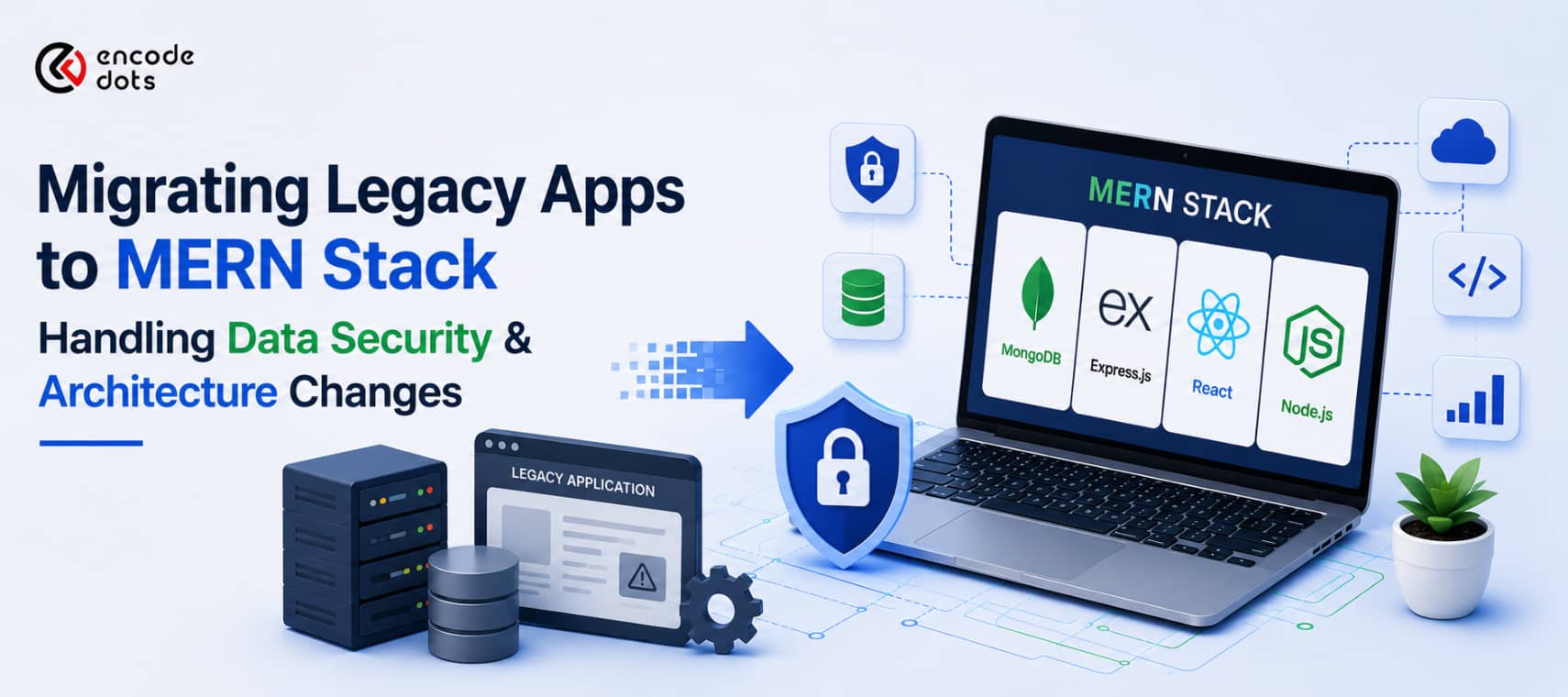
This guide walks your engineering team through exactly how to migrate to the MERN stack, specifically how to handle the two hardest parts: data security during the transition and architecture changes that don’t break your existing system.
Why MERN for Enterprise Scale?
Before your team commits to this, it’s worth being direct about what MERN solves and what it doesn’t.
MERN (MongoDB, Express.js, React, Node.js) is not a silver bullet. It’s a pragmatic choice for teams that need:
- JavaScript across the full stack, one language for frontend and backend, reduces context switching and hiring friction
- Microservices-ready architecture Node.js + Express handles independent service deployment natively
- Non-relational flexibility: MongoDB’s document model maps cleanly to modern API payloads, especially for complex nested data structures
- Horizontal scalability Node’s event-driven, non-blocking I/O handles concurrent connections efficiently, which matters at enterprise load
For Node.js enterprise development specifically, the decoupled architecture is the biggest win. Your monolith likely handles authentication, business logic, data access, and file processing all in the same codebase. MERN lets you break each of these into independently deployable services so your payment processor can scale independently from your reporting module.
When MERN might not be the right call:
- Heavy relational data with complex multi-table joins that MongoDB will complicate
- Strict ACID transaction requirements across multiple collections
- Teams with zero JavaScript experience (the migration cost spikes)
If you’re in one of these categories, the architecture conversation should happen before the migration plan is developed.
The Data Migration & Security Protocol
This is where most migrations fail or get stalled. The technical decisions here have direct security and compliance implications.
SQL to MongoDB Schema Mapping
Relational databases enforce a strict schema. MongoDB doesn’t. That flexibility is powerful and dangerous if you’re not intentional about it.
The core mapping principles:
| Relational Pattern | MongoDB Equivalent | Notes |
| One table, one entity | One collection, one document type | Straightforward |
| One-to-many (FK relationship) | Embedded documents | Use when the child’s data is always accessed with the parent’s |
| Many-to-many (join table) | Array of references ($lookup) | Use for large independent collections |
| Stored procedures | Aggregation pipelines | Requires a rewrite plan 2–3x time |
| NULL handling | Absent field vs. explicit null | Decide on a convention early and enforce it in schema validation |
Start with a schema audit of your existing relational database. Document every table, its relationships, and the average query patterns that hit it. This tells you which entities should be embedded documents and which should remain as separate collections with references.
Use MongoDB Schema Validation (JSON Schema) to enforce data integrity at the database level; don’t rely on application-layer validation alone.
Data Encryption: In Transit and At Rest
During migration, your data moves. That movement is the highest-risk window.
In-transit encryption:
- All data transfer pipelines must use TLS 1.2+ (enforce 1.3 wherever possible)
- Use encrypted tunnels (SSH or VPN) for any direct database-to-database sync operations
- Never run migration scripts over unencrypted public connections, even in staging
At-rest encryption:
- Enable MongoDB’s native encrypted storage engine (uses AES-256) before migrating data into it
- For cloud deployments (Atlas), enable encryption at rest at the cluster level before the first document lands
- Rotate encryption keys post-migration as a standard hygiene step
Key management: Use a dedicated KMS (AWS KMS, Azure Key Vault, or HashiCorp Vault) rather than storing keys in environment variables or config files. This is non-negotiable for HIPAA or SOC 2 environments.
Zero-Downtime Migration Strategy
You have two realistic options depending on your system complexity:
Option A: Blue-Green Deployment
Run two identical environments, Blue (current legacy system) and Green (new MERN stack). Migrate data to Green, test exhaustively, then switch your load balancer or DNS to route traffic to Green. Blue stays live as an instant rollback option.
Best for: Smaller applications or those with manageable data volumes where a point-in-time data snapshot is acceptable.
Option B: Phased API Routing (Strangler Fig Pattern)
This is the preferred approach for large enterprise systems.
- Build a new MERN-based API layer in parallel with your legacy system
- Route specific endpoints (starting with low-risk, read-heavy ones) to the new stack
- Keep a façade layer that proxies unknown requests to the legacy system
- Gradually migrate more endpoints over weeks or months
- Decommission legacy modules as each corresponding MERN module is validated in production
This pattern means you’re never doing a big-bang cutover. Traffic shifts incrementally, and rollback is as simple as re-routing an endpoint.
Not Sure If Your Legacy System Is Ready for MERN?
Our architects can evaluate your current application, identify migration risks, and recommend the safest modernization strategy.
Talk to a MERN ExpertCommon Architecture Roadblocks
State Management
Legacy monoliths often manage session state server-side. MERN encourages stateless APIs (JWT-based auth) with state management pushed to the client (React) or a cache layer (Redis).
The migration requires a conscious decision: do you maintain server-side sessions temporarily for legacy features while new features run stateless? Yes, you can run both patterns simultaneously with proper middleware, but document this clearly in your architecture spec.
Session Handling
If your legacy system uses cookie-based sessions, you need a migration path. The standard approach is to issue JWTs for new MERN endpoints while maintaining session cookies for legacy endpoints during the transition period. Use a shared Redis cache to validate both mechanisms against the same user store.
Legacy API Wrapper Creation
Your external clients (mobile apps, third-party integrations) are calling your old API contracts. Breaking those during migration is not an option.
Build a compatibility wrapper layer in Express that:
- Accepts legacy request formats and headers
- Transforms them to the new internal API contract
- Returns responses in the legacy format expected by existing clients
This wrapper lives in your codebase during transition and gets deprecated endpoint by endpoint as clients are updated.
Cost & Timeline: What to Expect
Direct answer: MERN migration costs and timelines depend primarily on data volume, integration count, and compliance scope, not app size alone.
| Application Complexity | Typical Timeline | Primary Cost Driver |
| Small (single module, <5 integrations) | 6–10 weeks | Frontend rebuild |
| Mid-size (multi-module, 5–15 integrations) | 3–6 months | Data migration + security layer |
| Enterprise (compliance-heavy, 15+ integrations) | 6–12+ months | Parallel-run validation + phased cutover |
Compliance-heavy migrations (healthcare, fintech) almost always take longer than the “app size” alone would suggest, because the security and audit work (Section 5) runs on its own timeline, independent of feature parity.
In-House Team vs. Freelancer vs. Migration Agency
| Factor | In-House Team | Freelancer | Migration Agency (EncodeDots) |
| Node.js/MongoDB expertise | Often requires new hiring | Variable, hard to vet | Pre-vetted, migration-specific experience |
| Data security ownership | Full internal responsibility | Limited accountability | Structured security process (Section 5) |
| Speed | Slower (hiring + ramp-up) | Fast start, risk on continuity | Fast start, team continuity |
| Cost predictability | High fixed cost | Lower, but scope creep risk | Fixed-scope engagement models |
| Best for | Long-term product ownership | Small, low-risk modules | Compliance-heavy, architecture-critical migrations |
“Isn’t it cheaper to just hire a freelancer for this?” It can look cheaper upfront. But data migration mistakes, a broken RBAC mapping, an unencrypted field, and a failed compliance audit cost far more to fix after go-live than to prevent during planning. Proof: Across our Node.js enterprise development engagements, migrations with a dedicated security workstream from day one have had zero post-launch data-integrity incidents.
Migration Checklist Framework
Use this as the technical backbone of your project plan. Each phase should have a clearly assigned owner and a go/no-go gate before the next phase begins.
| Phase | Task | Owner | Gate Criteria |
| Phase 1: Audit | Document all DB tables, relationships, and query patterns | DB Lead | Schema map complete |
| Phase 1: Audit | Inventory all existing API endpoints and consumers | Backend Lead | API contract doc signed off |
| Phase 1: Audit | Security audit of current data flows | Security/DevOps | Risk register created |
| Phase 2: Infrastructure | Set up a MongoDB Atlas cluster with encryption at rest | DevOps | Cluster passing security scan |
| Phase 2: Infrastructure | Configure KMS for key management | DevOps/Security | Keys stored, rotation policy set |
| Phase 2: Infrastructure | Set up CI/CD pipeline for new MERN codebase | DevOps | Pipeline deploying to staging |
| Phase 3: Data Migration | Build schema migration scripts (SQL → MongoDB) | DB Lead | 100% data parity on staging |
| Phase 3: Data Migration | Validate data integrity with an automated test suite | QA/Backend | Zero data loss confirmed |
| Phase 3: Data Migration | Set up real-time sync for the migration window | Backend Lead | Sync lag < 5 seconds |
| Phase 4: API Layer | Build Node.js/Express API for the first module | Backend Team | All endpoints passing integration tests |
| Phase 4: API Layer | Build legacy compatibility wrapper | Backend Lead | Existing clients unaffected |
| Phase 5: Traffic Routing | Route first 10% of traffic to MERN stack | DevOps | Error rate < 0.1% |
| Phase 5: Traffic Routing | Gradual rollout to 100% with monitoring | DevOps/Backend | SLA metrics maintained |
| Phase 6: Decommission | Remove legacy endpoints as MERN modules stabilize | Backend Lead | 30 days stable post-cutover |
Working With a MERN Stack Migration Agency
The teams that execute this well share one trait: they’ve done it before, on systems that had the same messy, undocumented legacy constraints yours does.
EncodeDots has run MERN stack migrations for enterprise clients across healthcare, fintech, and logistics, specifically the kind with decade-old codebases, undocumented schema decisions, and zero tolerance for production downtime.
The work isn’t just technical. It’s coordinating across your existing engineering team, your security requirements, your compliance obligations, and your business timelines. That coordination is where migrations succeed or stall.
If you’re at the planning stage, evaluating whether migration makes sense for your system, or scoping what it would actually take, talk to our team. We’ll give you a direct technical assessment, not a sales pitch.
Conclusion
Migrating a legacy application to the MERN stack is less about swapping technologies and more about protecting data while rebuilding the architecture underneath a live system. The teams that get this right treat security and architecture decisions as the priorities, not afterthoughts bolted on once the new frontend looks good.
If you’re evaluating a migration, start with an audit of your data flows and compliance obligations before choosing a target architecture. Talk to EncodeDots’ migration architects to get a security-first migration plan built around your specific legacy system.