Web App Development
  Cloud App Development
  Front-End Development
  Cross Platform Development
  MVP Development
  Application Modernization
  PWA Development
  SaaS Application Development
  Software Development Outsourcing
  Offshore Custom Software Development
  Full Stack Software Development
  Custom Software Development
  Enterprise Software Development
  Cloud Computing Solutions
  Cloud Development
  Managed Cloud Services
  Cloud Native Development
  AI Consulting
  Machine Learning Development
  LLM Development
  AI Chatbot Development
  Data Analytics
  CI CD Development
  Digital Transformation
  Dev Ops
  Content Development
  Blockchain Development
  Web Development
  Web Design



 Generative AI
  Large Language Model
  AI Chatbot
  AngularJs
  ReactJS
  Dotnet Core
  Android
  iPhone
  Swift
Swift  E-Commerce
  NopCommerce
  BigCommerce
  Laravel
  Yii
Yii  AWS
AWS  Google Cloud
  Azure DevOps
  Automation Testing
  Security Testing
  API Testing
  Functional Testing
  MEAN Stack
  MERN Stack
  Full Stack Developers
  biz.encodedots
  biz@encodedots.com
  +91 99747 42737


- Why Buffstreams Keeps Breaking
- Quick Picks: Which One Fits You?
- 18 Licensed Alternatives to Buffstreams
- What Actually Matters When You Choose
- What It Actually Takes to Build a Platform Like This
- The Bottom Line
- Frequently Asked Questions
Buffstreams always seems to buffer at the exact wrong moment. Not during the warm-up. During the penalty.
That isn’t bad luck. It’s the deal you make with unlicensed streams: links pulled from third-party sources nobody controls, with no guaranteed uptime, no support, and nobody accountable when it dies in the 88th minute.
This guide covers 18 licensed alternatives for watching live sports in 2026, what each one is genuinely good at, where it falls short, and which one fits the specific sport you actually follow. At the end, we get into what it takes to build a streaming platform that survives a live final, because that’s the work we do.
Before you scroll: broadcast rights change every season. Availability, pricing, and coverage vary by country and by event. Everything below reflects what these services were offering as of. Always confirm current coverage for your region on the platform’s own site before subscribing.
Why Buffstreams Keeps Breaking (And Why People Leave)
Buffstreams doesn’t broadcast anything. It aggregates links to streams hosted by third parties. No account, no fee: pick a game, click, watch. That’s the whole appeal, and it’s a real one.
The catch is that Buffstreams doesn’t control any of those sources. So quality, uptime, and safety change from link to link, and from week to week.
In practice, that means:
- Streams that drop mid-match with no warning
- An escalating wall of pop-ups and forced redirects
- Browser security warnings and unexpected downloads
- Domains that vanish and reappear under a new name after a takedown
For a dead-rubber league game on a Tuesday, none of this matters much. For a final, a playoff, or a fight card you rearranged your evening around, it matters enormously.
That’s the actual reason people search for alternatives. Not because free is unappealing; free is great. But unreliable free stops being a bargain the moment it costs you the thing you sat down to watch.
Quick Picks: Which One Fits You?
If you don’t want to read all 18, start here.
| If you mainly watch… | Start with |
| A bit of everything (U.S.) | YouTube TV, Fubo |
| Soccer / international football | Fubo, Peacock, Paramount+, Sky Sports |
| Combat sports (boxing, MMA) | DAZN, Paramount+ |
| Cricket | Hotstar / JioHotstar, Sony LIV |
| NFL | NFL+, Fox Sports, CBS Sports, Amazon Prime Video |
| NBA | NBA League Pass |
| MLB | MLB.TV |
| UK sports (football, F1, cricket) | Sky Sports |
| You already pay for Prime | Amazon Prime Video (check what’s included) |
18 Licensed Alternatives to Buffstreams
How to read this list: none of these is a 1:1 swap for “every sport, free, no account.” They’re licensed services, so coverage is tied to broadcast rights, and most require a subscription. What you get for that is a stream that’s still running when the match reaches the moment that matters.
1. ESPN+

Best for: U.S. fans who want breadth across several leagues in one subscription.
ESPN+ is the most general-purpose option on this list for a U.S. audience. It spans college football and basketball, soccer, tennis, hockey, and a deep on-demand library of documentaries and studio programming, all licensed, so nothing disappears mid-game. Combat sports coverage on ESPN+ has shifted in recent years, so check what’s currently included before subscribing on that basis alone.
Key features: licensed live sports across multiple leagues · college football and basketball · soccer, tennis, hockey · original documentaries and studio shows · multi-device support · replay and highlight library
| Pros | Cons |
| Stable, licensed streams | Some marquee league games sit with other rights holders |
| Deep college sports coverage | Certain events cost extra on top of the subscription |
| No ads, redirects, or malware risk | Regionally restricted outside the U.S. |
2. FuboTV
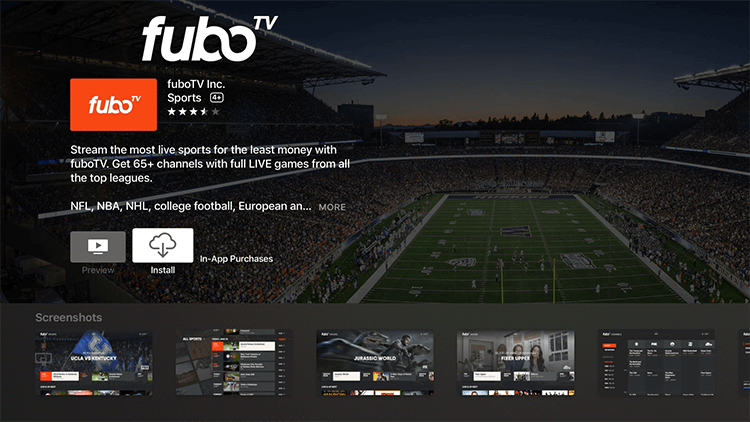
Best for: people who want a cable-style sports bundle without the cable contract.
Fubo is built around live sports channels rather than treating them as an add-on. It leans harder into soccer and international competitions than most U.S. services, and cloud DVR is included so matches you can’t watch live are still there afterwards.
Key features: sports-heavy live channel lineup · strong international soccer coverage · cloud DVR · smart TV and mobile apps
| Pros | Cons |
| Wide live sports channel coverage | Pricier than single-sport services |
| No pop-ups or unsafe redirects | Regional channel availability varies |
| Cloud DVR included | More than casual viewers typically need |
Want to Launch Your Own Sports Streaming Platform Like These?
At EncodeDots, we help you build fast, scalable, and high-performance streaming apps tailored for real users.
Get Your Free Consultation Today!3. Hulu + Live TV

Best for: households where not everyone is watching the game.
Hulu + Live TV pairs a live sports channel bundle with Hulu’s full on-demand catalogue. One subscription covers the match and everything the rest of the house wants to watch instead of the match.
Key features: live sports and entertainment channels in one plan · Hulu on-demand catalogue included · cloud DVR · multiple simultaneous profiles
| Pros | Cons |
| Sports and entertainment in one subscription | More expensive than sports-only options |
| Reliable, licensed streaming | Not every league is fully covered |
| Good for shared and family accounts | Interface feels cluttered for sports-only use |
4. Sling TV
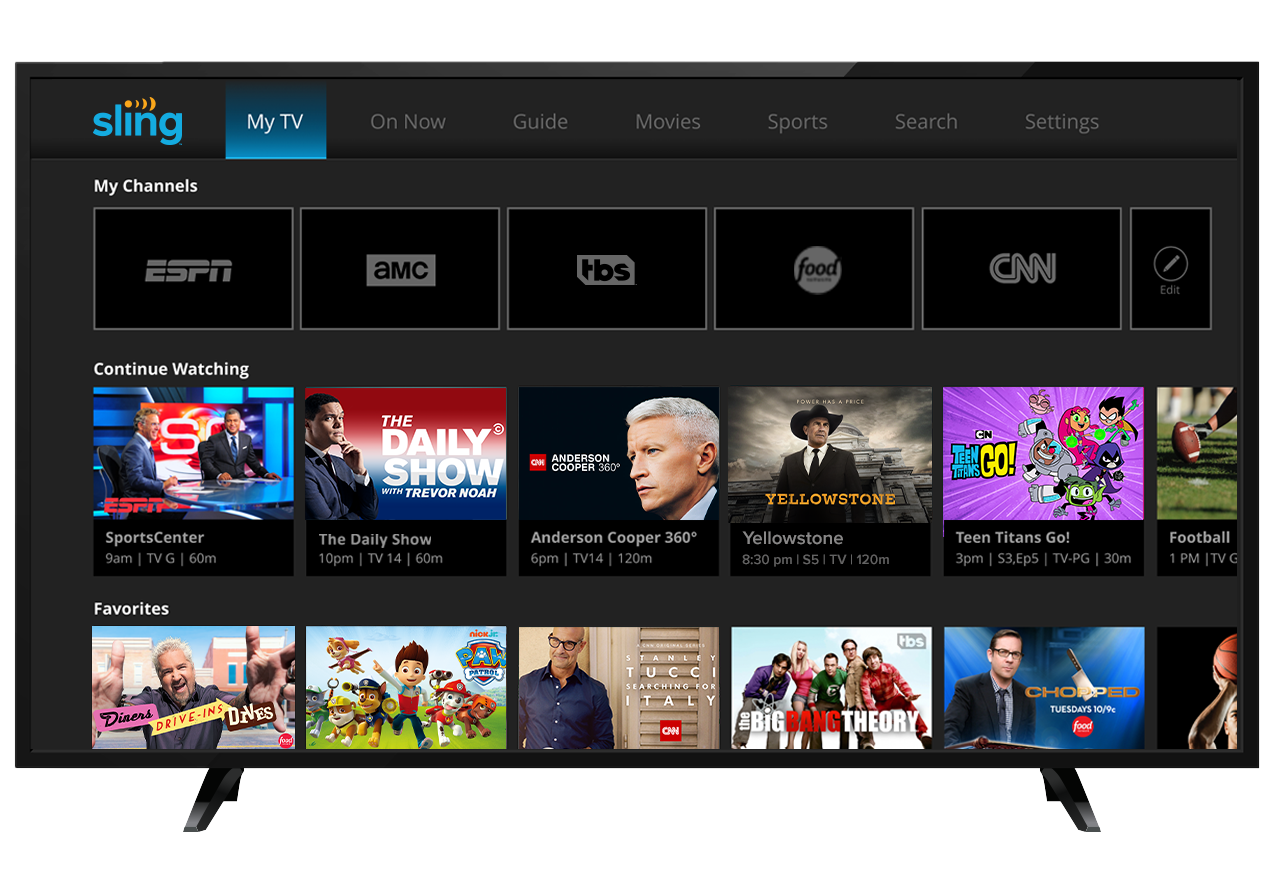
Best for: fans who follow one or two leagues seasonally, not everything year-round.
Sling’s pitch is control. You build a package around the sports you actually watch instead of paying for 200 channels to get four. It rewards people who know exactly what they want.
Key features: customisable channel packages · major sports network add-ons · cloud DVR · cross-device support
| Pros | Cons |
| Pay only for the channels you want | Coverage depends entirely on package choice |
| More affordable than full bundles | Add-ons push the price up quickly |
| Licensed, stable streaming | Local channel availability is limited |
5. YouTube TV

Best for: anyone who just wants it to work without thinking about it.
YouTube TV is the “make it work” option: a full live TV package with strong sports coverage, local channels, unlimited cloud DVR, and one of the cleaner interfaces here. It holds up during high-traffic events, which is precisely when free streams collapse.
Key features: major sports and local network access · unlimited cloud DVR · consistent performance under load · multi-device support
| Pros | Cons |
| Reliable during high-demand live events | Higher monthly cost |
| Unlimited DVR storage | More than casual viewers need |
| Clean, uncluttered interface | Needs a stable connection for best results |
6. DAZN

Best for: boxing and MMA fans who don’t need anything else.
DAZN doesn’t try to cover everything, and that’s the point. It concentrates on combat sports and select global events, which means the stream is loaded and ready when the walkouts start, not being hunted for four minutes before the main event.
Key features: dedicated boxing and MMA coverage · select global sports events · on-demand replays and fight archives · clean, ad-light interface
| Pros | Cons |
| Strong choice for combat sports fans | Limited U.S. major-league coverage |
| Full replay and archive access | Availability varies significantly by region |
| No buffering chaos from unstable sources | Narrow focus compared to all-in-one services |
7. Peacock

Best for: soccer fans who want official access without cable pricing.
Peacock’s strongest case is soccer, with top-league coverage sitting alongside a broad on-demand library of shows and films. Its live sports lineup has been expanding, so it’s worth checking the current schedule for your leagues; there may be more there than you expect.
Key features: live soccer and league coverage · expanding live sports lineup · on-demand shows and films · affordable entry tier · cross-device access
| Pros | Cons |
| Solid, affordable soccer coverage | Coverage shifts with broadcasting rights |
| Licensed, stable streaming | Not every major sport included |
| Easy switching between live and on-demand | Ads on lower-tier plans |
Want to Launch Your Own Sports Streaming Platform Like These?
At EncodeDots, we help you build fast, scalable, and high-performance streaming apps tailored for real users.
Get Your Free Consultation Today!8. Amazon Prime Video
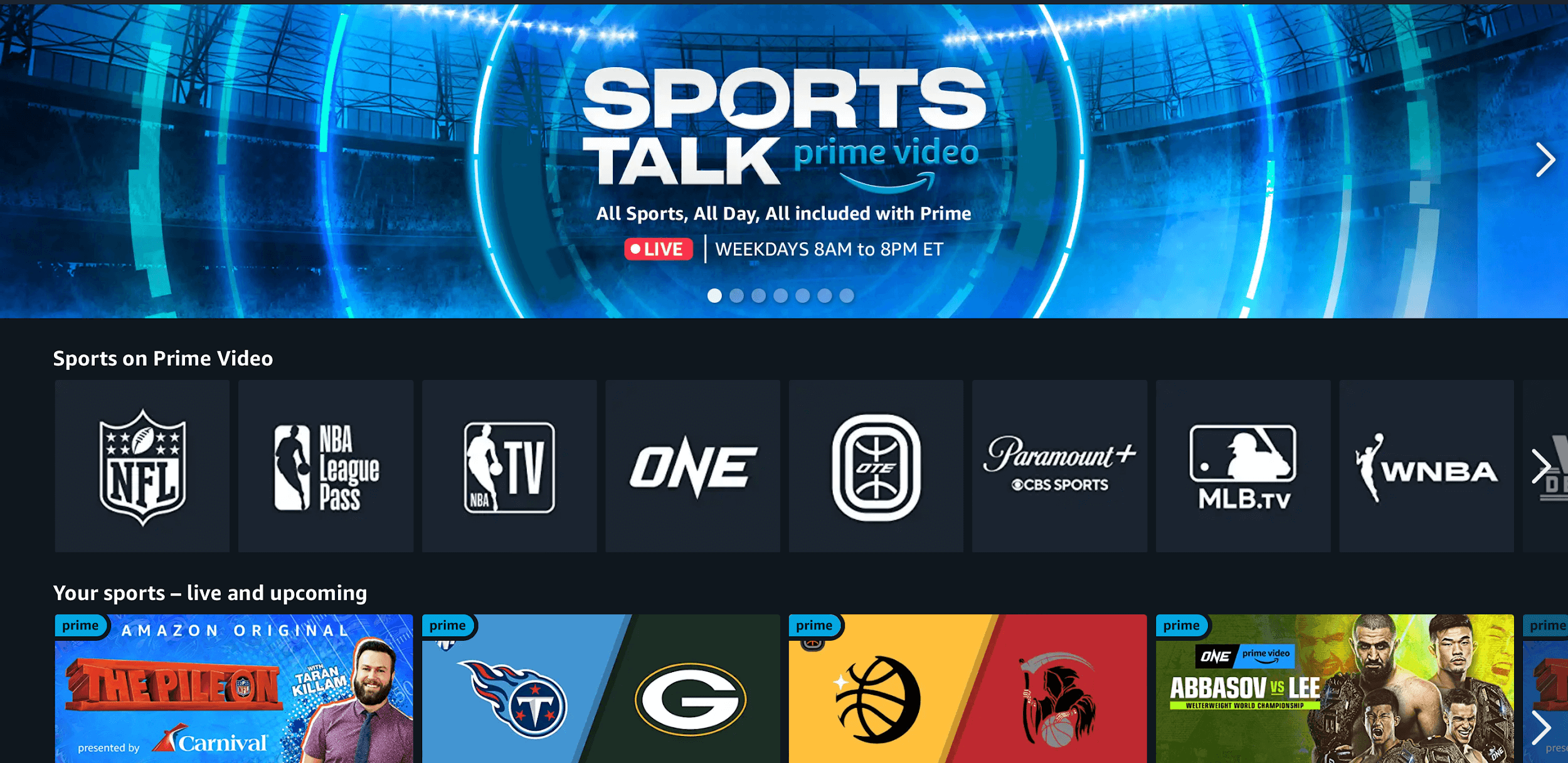
Best for: the millions of people already paying for Prime who don’t realise sport is included.
If you have Prime, you may already have live sports access you’re not using, including select NFL coverage and, in some markets, other leagues. It isn’t a sports-first platform and the coverage is event-focused rather than comprehensive, but the production quality on what it does carry is high.
Key features: select exclusive live sports events · included with existing Prime subscription · ad-free streaming on most content · cross-device support
| Pros | Cons |
| Often already included if you have Prime | Coverage is narrow, not comprehensive |
| High-quality, stable streams | Not designed as a sports-first platform |
| No pop-ups or security risk | Sports lineup varies by region |
9. Paramount+

Best for: households that want CBS sports plus a full entertainment library.
Paramount+ rests on CBS-broadcast sports and international soccer tournaments, bundled with CBS’s on-demand catalogue. Its live sports rights have been expanding notably, so check the current lineup it may now include events it didn’t a year ago.
Key features: CBS Sports live access · international soccer tournament coverage · expanding live event lineup · combined with on-demand entertainment · affordable pricing tier
| Pros | Cons |
| Strong soccer tournament coverage | Some leagues sit elsewhere |
| Affordable relative to full bundles | Smaller lineup than all-in-one services |
| No intrusive ads on live streams | Some events are region-locked |
10. NBA League Pass
Best for: following a team that isn’t your local team.
If you follow basketball past the highlight reel, League Pass gives you season-long access to games and replays, especially valuable for tracking an out-of-market team, which is exactly the use case free sites handle worst.
Key features: full-season NBA access · live and on-demand replays · condensed-game option · cross-device support
| Pros | Cons |
| Purpose-built for serious NBA fans | Local blackout restrictions apply |
| High-quality, stable streaming | Basketball only |
| Excellent for out-of-market teams | Requires a paid subscription |
11. NFL+
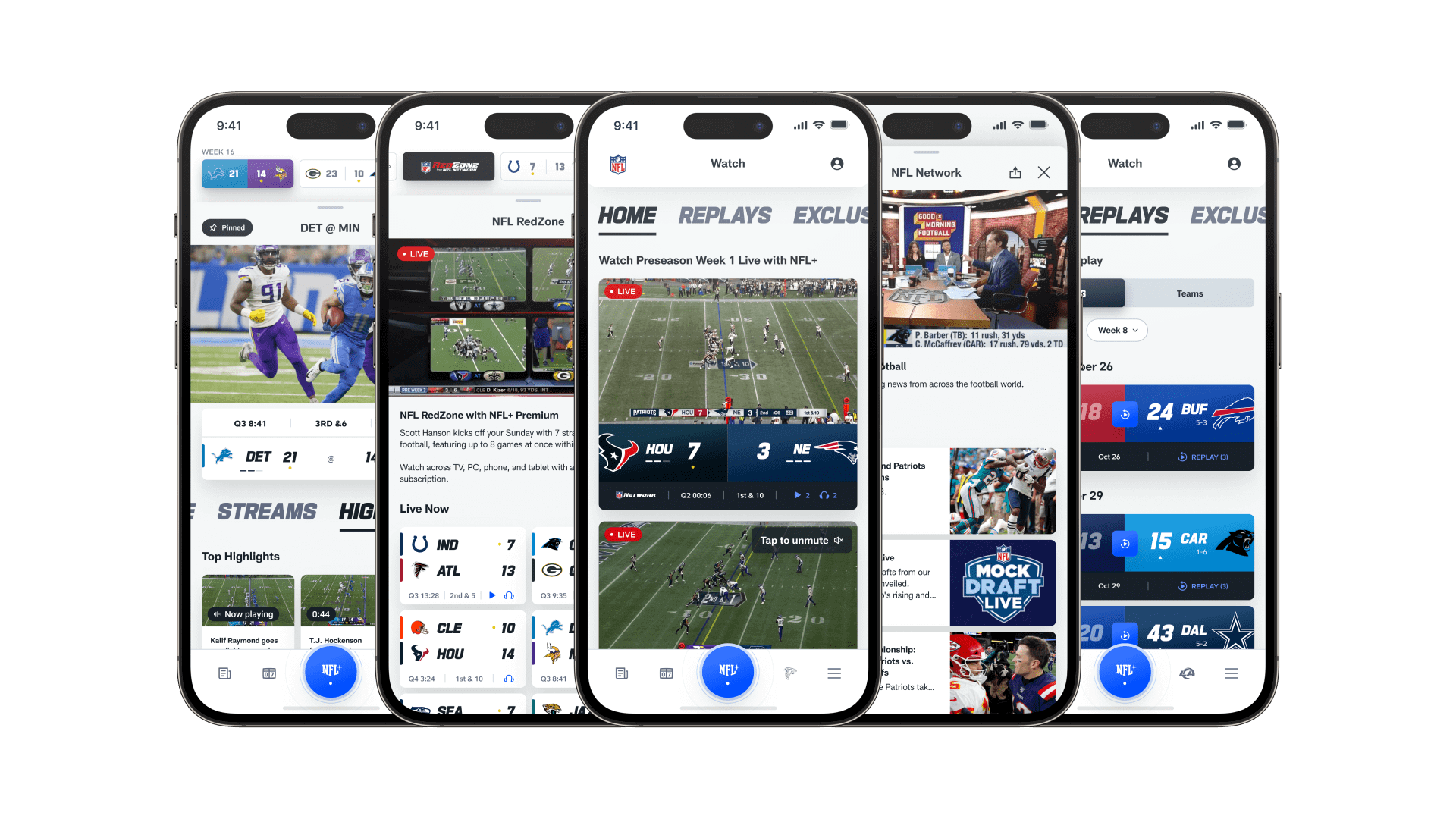
Best for: watching football on your phone.
NFL+ is the official mobile-first option, built around live local games and condensed replays for phone and tablet viewing. Understand the device limitations before subscribing it’s designed for the commute, not the living room.
Key features: official NFL streaming · live local games on mobile · full-game and condensed replays · ad-free
| Pros | Cons |
| Fully licensed, official NFL access | Live games are largely mobile-only |
| Strong replay library | Not ideal for big-screen live viewing |
| No pop-ups or unsafe ads | Regional limits apply |
12. MLB.TV
Best for: out-of-market baseball fans, all 162 games of it.
A long season rewards consistency over spectacle, and that’s exactly what MLB.TV delivers dependable access to full games, especially for fans following a team outside their home broadcast region.
Key features: full regular-season coverage · out-of-market team access · live and on-demand viewing · cross-device support
| Pros | Cons |
| Reliable for long-season, out-of-market fans | Local blackout restrictions |
| Easy archive and replay access | Baseball only |
| Consistent through full-length games | Subscription required |
13. Apple TV+

Best for: people already inside the Apple ecosystem.
Apple has moved into live sport through selective exclusive deals rather than broad coverage, wrapped in a clean, ad-free interface with consistently high production quality across Apple devices and smart TVs. Check which rights it currently holds; this lineup changes more than most.
Key features: select exclusive live sports deals · ad-free experience · high production quality · seamless Apple device integration
| Pros | Cons |
| High-quality, licensed content | Narrow sports selection |
| No ads or security risk | Not a replacement for full coverage |
| Smooth cross-device performance | Focused on select leagues and events |
14. Fox Sports App

Best for: big U.S. events already airing on FOX.
The Fox Sports App gives direct access to major sporting events under FOX’s broadcast rights. In most cases, it requires a TV provider login rather than working as a standalone subscription check that before you rely on it.
Key features: official FOX Sports broadcasts · major U.S. event coverage · HD streaming · mobile, web and smart TV access
| Pros | Cons |
| Fully licensed, stable streaming | Full access usually needs a TV provider login |
| Strong for major FOX-broadcast events | Limited to FOX’s rights |
| No malicious redirects | Less useful for international sports |
Want to Launch Your Own Sports Streaming Platform Like These?
At EncodeDots, we help you build fast, scalable, and high-performance streaming apps tailored for real users.
Get Your Free Consultation Today!15. CBS Sports
Best for: NFL and college sports with proper analysis around it.
CBS Sports covers network-aired NFL games, college sports, and major tournaments, with expert commentary and post-game analysis layered on top of the live streaming, useful if you want context, not just the feed.
Key features: official NFL and college sports coverage · expert analysis and commentary · on-demand replays · cross-device access
| Pros | Cons |
| Licensed, dependable streaming | Full access may need a TV provider subscription |
| Strong NFL and college coverage | Limited international league coverage |
| Genuine expert commentary | Not every game streams live |
16. Sky Sports

Best for: UK viewers who want the best production quality available.
Sky Sports is the premium UK option for football, cricket, Formula 1, and boxing, with broadcast-level production and genuinely deep studio analysis. It’s priced accordingly, and it’s mainly relevant if you’re within its UK availability.
Key features: premium live broadcasting · deep football, cricket, F1 and boxing coverage · expert studio analysis · multi-device apps
| Pros | Cons |
| Top-tier production and coverage depth | Higher cost than most alternatives |
| Excellent football and motorsport content | Mainly available in the UK |
| Broadcast-level reliability | May require a bundle or contract |
17. Sony LIV

Best for: cricket and international tournaments.
Sony LIV is one of the two strongest cricket options here, combining live sport with a general entertainment library. Coverage of U.S. leagues is thin, so this is a fit for cricket-focused viewers specifically rather than a general bundle.
Key features: official cricket and tournament coverage · live matches plus replays and highlights · sport paired with entertainment content · cross-device support
| Pros | Cons |
| Strong, reliable cricket coverage | Limited U.S. league coverage |
| Licensed streaming, no malware risk | Some events sit behind higher tiers |
| Good value across long tournaments | Not a fit for NFL or NBA fans |
18. Hotstar / JioHotstar
Best for: major cricket tournaments, where concurrency records get broken.
Hotstar, now JioHotstar in India, with Disney+ Hotstar branding in some other markets, is engineered to handle extreme concurrent viewership during major cricket tournaments and global events. That’s the exact scenario where free aggregator sites fail hardest, and it’s the clearest real-world proof that infrastructure is the whole game.
Key features: licensed live sports streaming · major cricket tournament coverage · stable performance at extreme traffic · sports plus entertainment catalogue
| Pros | Cons |
| Handles peak-traffic events reliably | Access, branding and pricing vary by region |
| Outstanding cricket tournament coverage | Some plans include ads |
| No unsafe redirects | Limited U.S. league coverage |
Read More: OTT Platforms Explained: What’s Next in Streaming?
What Actually Matters When You Choose
Price is the first filter almost everyone applies, and on its own it’s the least useful one. A free stream that dies at half-time didn’t save you money it cost you the thing you sat down for.
Here’s what’s worth weighing instead.
Legal standing and safety. Licensed platforms don’t carry the malware, forced redirects, or overnight shutdowns that come with unofficial sources. You aren’t gambling on an anonymous third party’s server staying up.
Coverage match. Pick for what you actually watch. A service with broad coverage but shallow depth in your sport will frustrate you faster than a narrow, focused one that nails it.
Device support. Most licensed services work across phones, browsers, smart TVs, and consoles. Free aggregators are typically built for desktop browsers and behave badly on TVs and streaming boxes.
Regional restrictions. Rights are licensed by territory. The same service can look completely different depending on where you are. Check before you subscribe, not after.
Reliability under load. The real test isn’t a Tuesday league game; it’s the final. Licensed services invest specifically in infrastructure for peak-traffic live events. That’s the exact moment unlicensed sites fail most.
What It Actually Takes to Build a Platform Like This
Everything above comes down to one thing: infrastructure. Which is worth understanding whether you’re choosing a service or building one.
Live sports is one of the hardest categories of app to get right, because the traffic pattern is hostile by design. A platform can idle at a fraction of capacity for days, then absorb thousands of concurrent viewers the instant kickoff happens with zero tolerance for buffering, because a live moment has no replay.
A few things decide whether a platform holds or folds:
Adaptive bitrate streaming: playback quality adjusts to each viewer’s connection instead of forcing one fixed quality on everyone.
CDN and edge delivery: video served from nodes close to each viewer, rather than one origin server absorbing every concurrent request at once.
Autoscaling infrastructure capacity added automatically when the match starts, instead of someone provisioning servers in advance and guessing the number right.
DRM and content protection necessary if you’re licensing rights-protected content rather than hosting user-generated streams.
Cross-device playback continuity: start on mobile, finish on the smart TV, without losing your place or reconnecting.
None of this is exotic. It’s disciplined architecture and honest load planning done before launch, not patched in after the first outage. That’s the entire gap between a platform that works on a quiet Tuesday and one that still works during a final.
This is the work we do at EncodeDots. If you’re weighing what a platform like this would take, we’re happy to walk through the architecture and the real cost tradeoffs for your case.
[Get a Free Consultation →]
The Bottom Line
Buffstreams’ appeal is simple: no account, no cost, instant access. The tradeoff is equally simple: no guarantee it’s still running when the match reaches the moment you actually cared about.
The 18 platforms above trade some of that upfront convenience for a stream that doesn’t vanish mid-game. For anyone watching something they genuinely care about, that’s a trade worth making.
And if you’re on the other side of this, building the platform that has to stay up during a live final, not just a quiet Tuesday, that’s the specific problem we spend our time on.