Web App Development
  Cloud App Development
  Front-End Development
  Cross Platform Development
  MVP Development
  Application Modernization
  PWA Development
  SaaS Application Development
  Software Development Outsourcing
  Offshore Custom Software Development
  Full Stack Software Development
  Custom Software Development
  Enterprise Software Development
  Cloud Computing Solutions
  Cloud Development
  Managed Cloud Services
  Cloud Native Development
  AI Consulting
  Machine Learning Development
  LLM Development
  AI Chatbot Development
  Data Analytics
  CI CD Development
  Digital Transformation
  Dev Ops
  Content Development
  Blockchain Development
  Web Development
  Web Design



 Generative AI
  Large Language Model
  AI Chatbot
  AngularJs
  ReactJS
  Dotnet Core
  Android
  iPhone
  Swift
Swift  E-Commerce
  NopCommerce
  BigCommerce
  Laravel
  Yii
Yii  AWS
AWS  Google Cloud
  Azure DevOps
  Automation Testing
  Security Testing
  API Testing
  Functional Testing
  MEAN Stack
  MERN Stack
  Full Stack Developers
  biz.encodedots
  biz@encodedots.com
  +91 738 328 3858


- Supply Chain Is the Part of Construction
- What Construction ERP Software Actually Does
- Fixing Procurement
- Inventory Management Without the Guesswork
- Vendor Management
- Real-Time Visibility
- What ERP Actually Returns on Your Investment
- What to Look for When You Choose a System
- Getting Implementation Right
- Where This Is All Heading
- EncodeDots Solve These Construction Supply Chain Problems
- The Bottom Line
Walk onto any stalled construction site and ask the site engineer why work stopped. Nine times out of ten, the answer has nothing to do with the architect’s drawings or the bank’s funding. It’s something far more ordinary. The steel didn’t show up. The cement that was supposed to arrive on Tuesday is now “coming Friday, sir.” The plumbing fixtures were ordered twice by two different people, and now half of them are sitting unused in a corner, getting damaged.
These aren’t dramatic failures. They’re the quiet, daily friction of a supply chain that nobody is fully watching. And over a 24-month project, that friction adds up to weeks of lost time and a budget that quietly bleeds.
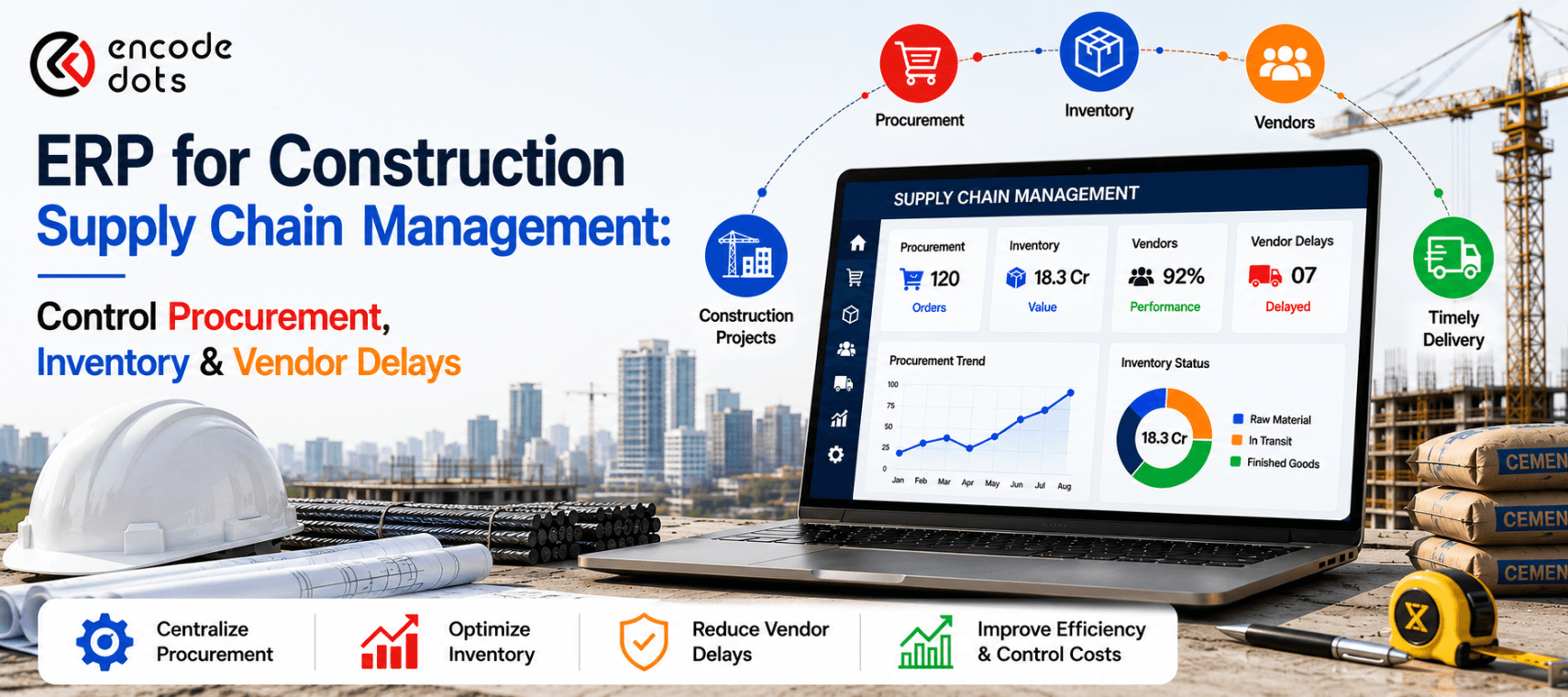
If you build for a living, you already know this in your gut. The question is what you do about it. For a growing number of developers and contractors, the answer is ERP for construction supply chain management, a single system that pulls procurement, inventory, and vendor coordination into one place, so the people running the project finally stop flying blind.
This isn’t a pitch for software you don’t need. It’s a practical look at where the money actually leaks, and how the right construction ERP software plugs those leaks.
Why the Supply Chain Is the Part of Construction That Breaks First
Construction is unlike almost any other industry when it comes to logistics. A manufacturing plant orders the same components, from the same suppliers, to the same location, week after week. You don’t have that luxury.
Every project is its own little economy. Different site, different mix of materials, different set of subcontractors, and a timeline where a delay in week three can push the finishing trades back by a month. You might be juggling fifty or sixty distinct materials at once, sourced from a dozen vendors, delivered to multiple floors or zones, all while the labour bill keeps running whether the material arrived or not.
That complexity is exactly why supply chain management in construction is so fragile, and why the cracks usually appear here before anywhere else. A few specific failure points show up again and again.
The first is simply not knowing what you have. Ask three people on a typical project what’s in stock, what’s already been ordered, and what’s running late, and you’ll often get three different answers. Decisions get made on memory and assumption instead of fact.
The second is procurement that lives in people’s phones. Material requests come in over WhatsApp, get approved verbally, and turn into orders with no paper trail. When something goes wrong, nobody can reconstruct who ordered what or why.
The third is inventory that swings between two bad extremes. Overstock ties up cash and clutters the site; understock halts a crew. Without proper inventory management for construction, you tend to lurch between both.
The fourth is vendor dependence with no accountability. You rely heavily on a handful of suppliers, but you have no real record of who delivers on time, whose quality is consistent, and who quietly costs you days every project.
Each of these, on its own, is survivable. Stacked together, on a tight schedule, they’re how a project loses its margin without anyone making a single obviously bad decision.
What Construction ERP Software Actually Does
Strip away the jargon, and an ERP is simply a shared source of truth. Instead of procurement, the storekeeper, accounts, and the project manager each keeping their own version of reality, everyone works from the same live data.
A purpose-built construction ERP software ties together the pieces that matter most on a project: the procurement pipeline from request to delivery, the materials sitting in your stores, the performance of the vendors you depend on, and how all of that maps against the project schedule and budget. The point isn’t to add a layer of administration. It’s to remove the guesswork that currently sits between your teams.
In practice, that means a single dashboard where the project manager can see, in real time, what’s been ordered and what’s still pending. It means approvals that follow a defined route instead of a verbal nod. It means inventory numbers that update as materials move, not at the end of the month when someone finally does a stock count. And it means reports built from data that’s already in the system, rather than someone staying late to assemble a spreadsheet from scattered notes.
For developers running more than one site, this stops being a nice-to-have. The moment you have two or three projects competing for the same materials, the same cash, and the same vendors, a construction project management ERP becomes the only sane way to keep them from cannibalising each other.
Fixing Procurement: From WhatsApp Chaos to a Controlled Pipeline
Procurement is where most construction supply chains either work or fall apart, so it’s the natural place to start.
The traditional process is held together with goodwill and follow-up calls. A site engineer needs material, messages the office, someone approves it informally, and a purchase order may or may not get raised before the vendor is called. Costs aren’t tracked against the budget until the bills come in, by which point overspending has already happened. Wrong quantities, duplicate orders, and “I thought you ordered it” are routine.
Good construction procurement software built into an ERP replaces that with a pipeline you can actually see end-to-end. A site team member raises a purchase request inside the system, against the right project and cost head. That request moves through a defined approval workflow, so the right person signs off before any commitment is made, and there’s a record of who approved what. Once it’s cleared, a purchase order is generated cleanly, with the correct quantities and rates, rather than reconstructed from a phone call.
The quieter benefit is comparison. Because the system holds your vendor data, you can weigh a supplier not just on price but on how reliably they’ve delivered before and how their material quality has held up. Over a few projects, that history turns into leverage. You stop awarding orders out of habit and start awarding them on evidence.
The result isn’t glamorous, but it’s real: shorter cycles between “we need this” and “it’s on site,” fewer ordering errors, and spending that stays visible against the budget while you can still do something about it.
Losing Track of Inventory Across Multiple Construction Sites?
Inventory mismatches can slow down your entire project timeline. An intelligent ERP system gives you real-time visibility into stock levels, movement, and usage across all locations.
Track Inventory in Real-Time!Inventory Management Without the Guesswork
If procurement is where money leaks, inventory is where it sits and slowly disappears.
On sites without proper tracking, material goes missing, gets damaged in storage, or gets reordered because nobody was sure it had already arrived. Cement and steel are the obvious culprits, but the same thing happens with tiles, fittings, electricals, and anything easy to lose track of across a big site over many months.
A construction material tracking system inside your ERP changes the basic question from “I think we have enough” to “we have exactly this much.” Stock levels update as material comes in and gets consumed, so you’re looking at live numbers rather than a count from three weeks ago. Set a threshold on the items that matter, and the system warns you before you run out instead of after the crew has already downed tools.
Allocation is the other half of it. When you assign materials to specific projects, you stop the silent theft that happens when one site quietly draws down stock meant for another. And because usage is tracked, you start to see your real consumption patterns, which trade waste material, which estimates were off, and where you’re consistently buying more than you use.
Here’s the everyday scenario that makes the case better than any feature list. Your finishing work is a week out, and the system flags that adhesive stock will run dry in four days at the current rate. You place the order now, it arrives with room to spare, and the crew never stops. The old way, you’d have found out when the storekeeper radioed up that the shelf was empty, and you’d have lost two days waiting for a rushed delivery. Same materials, same vendor, completely different outcome, all because someone saw it coming.
Vendor Management and the Art of Killing Delays Before They Start
Vendors will make or break your schedule, and yet most builders manage them with nothing more than a contact list and a good memory. That works until it doesn’t.
The problems are familiar. Deliveries slip with no consequence. There’s no record of which vendor caused last quarter’s delay, so the same one gets the next order. Quality varies, communication is patchy, and accountability is essentially a matter of who shouts loudest on the phone.
Proper vendor management in construction through an ERP turns that relationship into something you can actually manage. You keep a real vendor database, contacts, agreed rates, and crucially, a delivery history. Every order is tracked, so you know what’s en route and what’s overdue without making a single call. Automated reminders nudge vendors ahead of scheduled deliveries, which sounds small but quietly removes a whole category of “oh, we forgot” delays.
Over time, the performance record is the real prize. When you can see that one supplier has been late on six of their last ten deliveries while another has never missed, your sourcing decisions get sharper and your leverage in negotiations gets stronger. That’s how developers genuinely reduce delays in construction projects, not by chasing vendors harder, but by knowing which ones deserve the work in the first place.
Real-Time Visibility: Deciding on Facts Instead of Hunches
Tie procurement, inventory, and vendors together in one system, and you get something that’s hard to put a price on: visibility.
Without it, every important decision rests partly on an assumption. You think there’s enough cement. You believe the steel is on its way. You assume the vendor will deliver on Friday. With a connected ERP, those become things you know: procurement status, stock levels, vendor performance, and project progress, all current, all in one view.
That changes how you run the job. You stop waiting for someone to compile a report before you can act, because the picture is always live. You spot the problem developing, the slipping delivery, the stock about to run dry, while there’s still time to do something about it, rather than after it’s already cost you. And because every team is reading from the same data, the gap between the office and the site narrows. Fewer surprises, fewer arguments about whose numbers are right.
What ERP Actually Returns on Your Investment
It’s a fair question to ask whether the cost is worth it, especially when you’re being careful with cash. The honest answer is that the real comparison isn’t ERP versus its price tag, it’s ERP versus the cost of the delays and waste you’re already absorbing.
Tighter material tracking means less wastage and less double-ordering. Vendor comparison and history tend to bring procurement costs down as you stop overpaying out of habit. Fewer stoppages mean faster completion, and on a project where labour and finance costs run daily, finishing sooner is money straight back in your pocket. Leaner inventory frees up the capital you’d otherwise have sitting on shelves.
Be sensible about the numbers, though. The often-quoted figures show meaningful reductions in material cost, and noticeably faster completion is achievable, but only if the system is actually adopted and the data is kept honest. An ERP that people work around delivers nothing. One that’s genuinely used, on the kind of multi-project operation where the friction is worst, is where the returns show up clearly. For larger developers and infrastructure firms in particular, that’s usually a question of when, not whether.
What to Look for When You Choose a System
Not every construction ERP is built the same, and the wrong choice will frustrate your team into abandoning it. A few things genuinely matter.
It needs to be accessible from anywhere, which in practice means cloud-based, because your people are on sites, not at desks. Tied to that, it needs to work properly on a phone if a site engineer can’t update stock or raise a request from where they’re standing, the data will always be stale. It should connect to the tools you already run, particularly your accounting and any CRM, so you’re not re-entering the same numbers in three places. Dashboards should be tailorable to what your business actually needs to watch, not a generic template. And it should scale with you, so the system that fits two projects still fits when you’re running ten.
None of these is an exotic requirement. They’re just the difference between the software your team relies on and the software they quietly route around.
Getting Implementation Right
Bringing in an ERP is less a software purchase than a change in how the business operates, and that’s where most failed rollouts go wrong. A handful of habits make the difference.
Start by understanding your own processes before you try to digitise them. Mapping how procurement and material flow actually work today, not how they’re supposed to, saves enormous pain later. Invest properly in training, because a powerful system nobody knows how to use is worse than the spreadsheet it replaced. Resist the urge to switch everything on at once; getting one module like procurement working well, then expanding, beats a big-bang rollout that overwhelms everyone. Choose an implementation partner who understands construction specifically, not just software in the abstract, since the workflows are unusual and generic ERP thinking doesn’t translate cleanly. And treat go-live as the start rather than the finish, keep watching how the system performs, and refine it as you learn.
Where This Is All Heading
Construction is, slowly but genuinely, becoming a more data-driven industry. AI is starting to surface in demand forecasting and scheduling, IoT sensors are tracking material and equipment, and automation is creeping into the routine administrative work that used to eat up people’s days.
Most of that depends on having clean, connected, real-time data to build on, which is exactly what an ERP provides. The developers who put that foundation in place now will be ready to adopt these tools as they mature. The ones still running the supply chain out of spreadsheets and group chats will spend the next few years watching competitors deliver faster and bid sharper, without quite being able to match them.
How Exactly Does EncodeDots Solve These Construction Supply Chain Problems?
You already know the issues: procurement delays, inventory confusion, and unreliable vendors.
The real challenge isn’t identifying the problem.
It’s fixing it in a way that actually works on-site.
This is where EncodeDots comes in, not just as a software provider, but as a solution partner for construction businesses.
Instead of offering generic ERP systems, EncodeDots builds solutions based on how your projects actually run. We analyze your workflows, how procurement requests are raised, how inventory moves, and where vendor delays happen, and then design a system around it.
Here’s how we help:
Structured Procurement:- Digital requests, approval workflows, and real-time cost tracking eliminate confusion and delays.
Real-Time Inventory Control:- Know exactly what’s in stock, get alerts before shortages, and avoid unnecessary purchases.
Vendor Performance Tracking:- Monitor delivery timelines, identify unreliable vendors, and make decisions based on data.
Centralized Visibility:- Track procurement, inventory, and project progress from one dashboard in real time.
Easy Adoption:- Simple, mobile-friendly systems your team can actually use daily.
The Result?
- Fewer delays
- Better cost control
- Complete operational visibility
EncodeDots doesn’t just implement ERP.
We help you take control of your entire construction supply chain.
Ready to stop reacting and start controlling? Let’s build your ERP system.
The Bottom Line: Take Control Before Delays Take It From You
In construction, delays aren’t just an inconvenience. They’re one of the most expensive and most avoidable things that can happen to a project. And the uncomfortable truth is that most of them trace back to the same three places: procurement that’s running on memory, inventory nobody is fully watching, and vendors with no record of how they actually perform.
A well-chosen ERP for construction supply chain management doesn’t magically build faster. What it does is give you visibility you didn’t have, give you control where you had guesswork, and give you a record you can actually act on. For a serious construction business today, that’s stopped being a luxury and started being the baseline.