Web App Development
  Cloud App Development
  Front-End Development
  Cross Platform Development
  MVP Development
  Application Modernization
  PWA Development
  SaaS Application Development
  Software Development Outsourcing
  Offshore Custom Software Development
  Full Stack Software Development
  Custom Software Development
  Enterprise Software Development
  Cloud Computing Solutions
  Cloud Development
  Managed Cloud Services
  Cloud Native Development
  AI Consulting
  Machine Learning Development
  LLM Development
  AI Chatbot Development
  Data Analytics
  CI CD Development
  Digital Transformation
  Dev Ops
  Content Development
  Blockchain Development
  Web Development
  Web Design



 Generative AI
  Large Language Model
  AI Chatbot
  AngularJs
  ReactJS
  Dotnet Core
  Android
  iPhone
  Swift
Swift  E-Commerce
  NopCommerce
  BigCommerce
  Laravel
  Yii
Yii  AWS
AWS  Google Cloud
  Azure DevOps
  Automation Testing
  Security Testing
  API Testing
  Functional Testing
  MEAN Stack
  MERN Stack
  Full Stack Developers
  biz.encodedots
  biz@encodedots.com
  +91 99747 42737


- How does Estate Businesses Are Losing Leads
- What is Real Estate CRM Automation?
- The Real Problem: Where Most Agents Actually Fail
- How does Estate CRM Automation Actually Works
- Key Features That Actually Matter in a Real Estate CRM
- Benefits of Using Real Estate CRM Automation
- A Real-World Scenario
- Signs You Need CRM Automation Right Now
- Why to Choose the Right Real Estate CRM
- Common Mistakes to Avoid
- Custom CRM vs Ready CRM
- The Future of Real Estate CRM Automation
- Final Thoughts
- Ready to Automate Your Real Estate Business?
In real estate, speed isn’t just important; it’s everything.
A lead that calls at 11:47 AM doesn’t wait until 3 PM for your follow-up. They’ve already toured two other listings, chatted with a competitor on WhatsApp, and probably saved a different broker’s number. By the time your team gets to them, the deal isn’t lost. It was lost hours ago; you just didn’t know it yet.
This is the silent leak inside almost every growing real estate business. Not bad marketing. Not weak listings. Not even unmotivated agents. It’s the gap between getting a lead and acting on one. That gap is where real estate CRM Automation lives and where the smartest brokers are now winning markets they previously couldn’t compete in.
This guide breaks down what real estate CRM automation actually is, How it works behind the scenes, what to look for when choosing one, and the real-world results brokers are seeing after they switch. No jargon. No generic “top 10 tools” list. Just what actually matters.
How does Estate Businesses Are Losing Leads (Even Good Ones)
Walk into ten real estate offices, and you’ll find roughly the same scene: sticky notes on monitors, half-updated spreadsheets, three WhatsApp groups for “hot leads,” and at least one agent searching their phone for “what was that client’s budget again?”
The real estate industry runs fast, but most of its internal systems run slowly. The result is a quiet bleed:
- Inquiries come in through portals, ads, websites, and walk-ins, but no one source is talking to the others.
- Agents chase whoever shouted loudest that morning, not whoever is most likely to close.
- High-intent buyers go silent because no one followed up on day two, day five, and day fourteen.
- When a deal closes, no one really knows why it closed, so the win can’t be repeated.
Add competition into the mix, and the problem compounds. Today’s buyers are comparing properties, brokers, and even response times. Whoever responds first, with the right unit and the right tone, usually wins. Manual systems can’t keep up with that pace, and they were never Designed to.
Explore the Insight: Real Estate Software Development Company
What is Real Estate CRM Automation?
A Real Estate CRM (Customer Relationship Management) system is software that stores and manages every lead, client, conversation, and deal in one place. Automation is what turns that storage into action.
In simple terms, a regular CRM remembers things. An automated CRM Real things.
It captures leads the moment they come in, assigns them to the right agent based on rules you set, sends out the first follow-up before your team even sees the notification, schedules reminders for site visits, and nudges silent leads back into the pipeline, all without a human pressing a button.
The difference shows up most clearly at 9 PM on a Sunday. A traditional CRM has a Sunday inquiry sitting in a spreadsheet waiting for Monday. An automated CRM has already sent a personalized WhatsApp, logged the lead’s source, and put the agent’s name on the case so they walk in Monday morning to a warm conversation, not a cold one.
When AI is layered on top, predicting which leads are likely to convert, suggesting next-best actions, and summarizing call transcripts, the CRM stops being a database and starts behaving like an extra team member. One that doesn’t sleep.
The Real Problem: Where Most Agents Actually Fail
Most articles will tell you agents lose deals because they “don’t have the right tools.” That’s only half true. Tools fix workflows. They don’t fix behaviour.
Here’s where the real failure happens:
The “I’ll do it later” trap. An agent finishes a site visit, gets in the car, and tells themselves they’ll log the visit notes once they’re home. They forget. Two weeks later, the lead asks about “the property with the open kitchen,” and nobody remembers which one.
The favourite-lead bias. Every agent quietly ranks their own leads. The polite ones get follow-ups. The hesitant ones get ignored. Often, the hesitant ones were the buyers; they just needed two more conversations.
The spreadsheet illusion. A team thinks it’s organized because there’s a master Excel sheet. But three people are editing it, two are using outdated versions, and nobody trusts the numbers in the “Status” column.
The silent middle. Most CRMs (and most agents) chase brand-new leads and chase ready-to-close leads. The leads in the middle, the ones who said “let me think about it” three weeks ago, get forgotten. That middle is usually where 40–60% of revenue is hiding.
A good automated CRM doesn’t just fix the workflow. It removes the human moments where deals quietly die.
Explore the Insight: Real Estate Lead Management Software
How does Estate CRM Automation Actually Works
Let’s walk through what happens when someone clicks an ad for a 3 BHK at 10:14 PM:
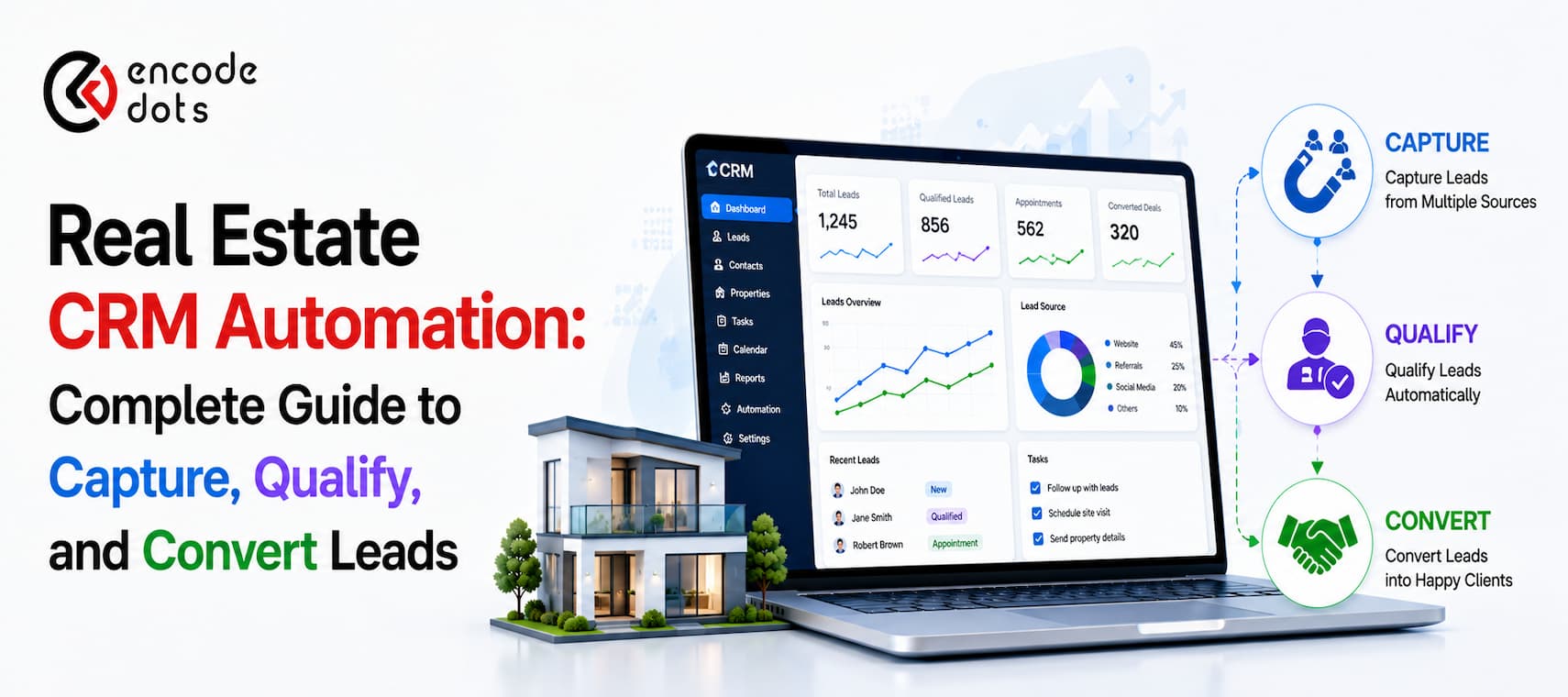
Step 1 Capture:- The CRM pulls the lead directly from the ad platform, website form, property portal, or WhatsApp Business inbox. No copy-paste. No “did anyone get that lead from Meta?”
Step 2 Qualify and tag:- The system automatically tags the lead with source, budget range (if shared), property type, and location interest. If lead scoring is enabled, it assigns a score based on browsing behaviour, source quality, and past patterns.
Step 3 Assign:- Round-robin, location-based, language-based, or expertise-based, the lead is routed to the right agent based on the rules you set. No more “who is taking this one?” messages in the group chat.
Step 4 First touch:- Within seconds, a personalized message goes out via email, SMS, or WhatsApp. Not a robotic blast, a templated message with the lead’s name, the property they showed interest in, and a clear next step.
Step 5 Nurture:- If the lead doesn’t respond, automated drip sequences kick in over the next few days, sharing relevant listings, walkthrough videos, or social proof.
Step 6 Track and report:- Every interaction call, message, site visit, and document shared is logged automatically. The pipeline dashboard shows exactly where every deal is, in real time.
The agent’s job changes from chasing leads to closing leads. That single shift is what changes the numbers.
Key Features That Actually Matter in a Real Estate CRM
Feature lists are long and mostly the same. These are the ones that change outcomes:
Smart Lead Management
Look for automatic lead capture across multiple sources, instant deduplication (so the same buyer doesn’t appear as three different leads), and behavioural lead scoring, not just demographic scoring. A lead that opened your email three times this week is hotter than one who filled out a form last month.
Automated Follow-Up Sequences
The best systems support multi-channel follow-up emails, SMS, and especially WhatsApp, which now drives the majority of property conversations in many markets. Drip campaigns should be customizable by property type, budget segment, and stage.
Visual Pipeline Tracking
A drag-and-drop Kanban view of every deal from “New Inquiry” to “Site Visit Booked” to “Negotiation” to “Closed” gives sales managers visibility they’ve never had on a spreadsheet.
Task and Reminder Automation
Every site visit should trigger a follow-up task two days later. Every document shared should trigger a check-in. Manual reminders break. Automated ones don’t.
Integration Capabilities
Your CRM should talk to your ad platforms, property portals, website, calling system, and accounting tools. A CRM that lives alone on an island is just an expensive contact list.
Mobile-First Design
Agents live on their phones. If your CRM only works well on desktop, agents won’t update it, and unupdated data is worse than no data; it creates false confidence.
Custom Reporting
Source-wise conversion rate, agent-wise performance, time-to-first-response, and deal velocity. Without these, you’re managing on instinct. With them, you’re managing on evidence.
Stop Losing High-Intent Property Leads Every Day
Every missed follow-up, delayed response, or manual error is costing you real revenue. With the right real estate CRM Automation, you can capture every lead instantly, qualify them automatically, and convert faster without increasing your workload.
Get Started!Benefits of Using Real Estate CRM Automation
Higher Conversion Rates
Industry data consistently show that responding to a lead within five minutes, rather than thirty minutes, can dramatically increase the likelihood of conversion. Automation makes a five-minute response the default, not the exception.
Real Time Savings
The average real estate agent spends a surprising amount of their week on administrative work, data entry, follow-up writing, status updates, and internal reporting. Automation cuts that significantly, which means more hours spent on conversations that actually move deals forward.
Smarter Decisions, Backed by Data
You stop guessing which marketing channel works. You stop guessing which agent needs coaching. You stop guessing why last quarter dipped. Every answer is in the dashboard.
Consistent Lead Nurturing
The buyer who said “not now, maybe in three months” usually means it. With automation, you’ll still be on their radar in month three through useful content, market updates, and check-ins without an agent having to remember.
A Better Customer Experience
Buyers feel the difference. They feel heard, remembered, and respected when their preferences carry across conversations. That experience is increasingly what separates brands that buyers refer to friends from brands they ghost.
Scalability Without Chaos
The hardest jump in any real estate business is going from 50 leads/month to 500. The systems that worked at 50 collapse at 500. Automation is what lets you handle volume without doubling headcount.
A Real-World Scenario
Consider a mid-sized real estate brokerage handling around 200 leads a month across three agents.
Before CRM automation, the team’s typical month looked like this: about 40% of inquiries received no second follow-up. Site visit no-shows hovered around 35% because no reminder was sent. Roughly 60 leads each month were marked “not interested,” but on closer review, many had simply gone quiet because no one followed up after the second message. The closing rate sat around 4%.
After moving to an automated CRM, the same team rebuilt their workflow in about three weeks:
- Every inquiry got a personalized first-touch message within sixty seconds, even outside office hours.
- Site visit reminders were automated 24 hours and 2 hours before the appointment, cutting no-shows in half.
- Silent leads were re-engaged with a 7-day, 14-day, and 30-day nurture sequence, bringing a meaningful percentage back into conversation.
- The sales manager stopped asking “what’s happening with that lead?” because the dashboard already showed her.
Three months in: response time roughly doubled in speed, conversion rate improved by around 30%, and perhaps most importantly, the team stopped feeling overwhelmed. They were handling more leads, more calmly, with fewer people.
This isn’t a magic story. It’s just what happens when the busywork is taken off humans and given to systems built for it.
Signs You Need CRM Automation Right Now
You don’t need a consultant to diagnose this. If two or more of these are true, you’re already losing money:
- Your team uses Excel, WhatsApp, and a notebook for the same leads.
- You can’t pull a “lead source vs conversion” report in under five minutes.
- Leads from last quarter are sitting in someone’s inbox, untouched.
- New agents take weeks to ramp up because there’s no clean lead history to learn from.
- You’re spending more on ads each month, but conversion isn’t moving.
- You’ve heard “I already spoke to your colleague” more than twice this month.
- Site visit no-shows feel normal.
These aren’t small problems. They’re the exact symptoms automation was built for.
Why to Choose the Right Real Estate CRM
Don’t choose features. Choose outcomes.
It’s easy to get dazzled by long feature lists during a demo. The better question is: what does my business look like 90 days after implementation? If the answer isn’t clear, the CRM probably isn’t right.
A practical evaluation framework:
Ease of use. If your least tech-savvy agent can’t use it confidently within a week, adoption will fail, and an unused CRM is worse than no CRM.
Automation depth. Many CRMs claim “automation,” but only mean basic email drip. Ask specifically about WhatsApp automation, conditional workflows, and AI-based lead scoring.
Integration ecosystem. Does it connect with your ad platforms, calling system, accounting tools, and property listing portals? Forced double-entry kills momentum.
Customization. Real estate isn’t generic. Resale, rental, commercial, and primary sales all behave differently. Your CRM should bend to your workflow, not the other way around.
Reporting clarity. Open the reports section during the demo. If you can’t immediately understand what you’re looking at, your managers won’t either.
Support and onboarding. Software is 30% of success. Implementation is 70%. Ask about training, data migration, and ongoing support before you sign anything.
Cost vs. ROI. Cheaper isn’t always better. A CRM that costs more but saves 10 hours per agent per week pays for itself almost immediately.
Common Mistakes to Avoid
Buying before defining the problem. Teams often buy a CRM, then try to figure out what to do with it. Reverse the order. Map your current workflow, identify the leaks, then shop for tools that plug them.
Skipping team training. A CRM rolled out without proper training quietly dies in three months. Invest in onboarding. Make it part of the agent KPIs that data is logged.
Over-automating. Not every interaction should feel automated. The first message can be templated, but anything that follows should feel personal. Buyers can smell a bot from a mile away.
Ignoring the data once it’s there. Many businesses set up beautiful CRMs and then never open the reports. The CRM only pays off if leadership is making decisions from it weekly.
Choosing based on price alone. The hidden cost of cheap CRMs is usually poor automation, no integrations, and weak support, all of which cost far more in lost deals than the software saved.
Custom CRM vs Ready CRM: Which One is Right for Real Estate?
In real estate, your CRM is not just a tool; it’s the backbone of your sales process. From capturing leads to managing follow-ups and closing deals, everything depends on Why efficiently your system works.
One of the most important decisions you’ll make is choosing between a ready-made CRM and a custom-built CRM. The right choice directly impacts your response time, conversion rate, and overall business growth.
Ready CRM
Ready CRMs are pre-built platforms Designed for multiple industries. They offer standard features that work for general use cases.
Pros:
- Quick and easy to set up
- Lower upfront cost
- Basic features available instantly
Cons:
- Limited flexibility for real estate workflows
- May not match Why your sales team actually works
- Integration limitations
- Scalability issues as your business grows
Best for: Small teams or early-stage businesses
Custom CRM
Custom CRMs are built specifically for your business workflow and needs.
Pros:
- Fully tailored to your real estate sales process
- Advanced automation for lead assignment and follow-ups
- Easy integration with ads, WhatsApp, and property portals
- Scales as your business grows
Cons:
- Higher initial investment
- Development time required
Best for: Growing real estate businesses aiming for long-term scalability
Key Insight
In real estate, speed and consistency win deals. A system that doesn’t match your workflow slows you down, while a system built around your process helps you close faster and scale without chaos.
At EncodeDots, we help real estate businesses move beyond limitations by building custom CRM solutions tailored to Why your team actually works, from lead capture to closing.
If you’re serious about scaling your business, it’s time to upgrade from generic tools to a system built for your growth.
Let’s build your custom CRM with EncodeDots and turn your process into a powerful growth engine.
The Future of Real Estate CRM Automation
The next wave is already here, just unevenly distributed:
AI-driven lead prioritization:- Instead of treating all leads equally, AI will score them in real time based on hundreds of signals, browsing patterns, response speed, and sentiment in messages, so agents always know who to call first.
Predictive insights:- Systems will start predicting when a buyer is likely to close, which property they’re most likely to commit to, and which objection is most likely to come up before the agent even gets on the call.
Voice and chat assistants:- AI bots will handle the first two or three conversations on WhatsApp or chat, qualify the lead, and only hand off to a human when the conversation is genuinely worth a human’s time.
Hyper-personalization:- Every email, message, and recommendation will be tailored to the individual buyer’s history and behaviour. The era of mass blasts is ending.
The brokers who adopt these early will not just be a little ahead. They’ll be operating on a fundamentally different cost structure than everyone still doing it manually.
Final Thoughts
Real estate stopped being a manual business years ago. Most teams just haven’t updated their systems to match.
Every lead that goes unanswered, every site visit that quietly slips, every “let me think about it” that never gets a follow-up, that’s not a small loss. Stack them up across a quarter, and that’s the difference between a team that grows and a team that stalls.
Real Estate CRM Automation isn’t a luxury, and it isn’t just about Software. It’s about deciding that your business will stop running on memory, sticky notes, and good intentions and start running on systems that don’t forget.
If you’re still managing leads manually, you’re not just wasting time. You’re handing revenue to whichever competitor automated first.
Ready to Automate Your Real Estate Business?
At EncodeDots, we build smart CRM solutions Designed specifically for real estate growth. From capturing leads instantly to managing follow-ups and closing deals faster, everything is streamlined in one system.
In today’s fast-moving market, speed and consistency matter. Manual processes often lead to missed opportunities, delayed responses, and lost deals. Our AI-powered CRM eliminates these gaps by automating workflows and ensuring every lead is tracked, nurtured, and converted effectively.
We help you:
- Capture leads from multiple sources automatically
- Assign and manage leads efficiently
- Automate follow-ups and reminders
- Track your entire sales pipeline in real-time
- Improve team productivity and close more deals
Our solutions are built around Why your team actually works, simple, scalable, and easy to use. Whether you’re handling 50 leads or 500, your system stays organized and efficient.
With EncodeDots, you’re not just managing leads, you’re building a predictable and scalable sales process.
Ready to upgrade your real estate operations? Let’s build smarter systems together.